
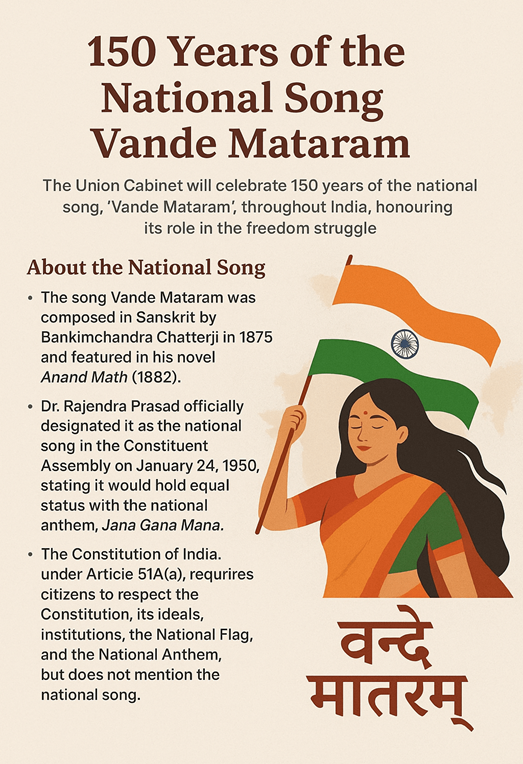
Context :- The Union Cabinet will hold nationwide celebrations to mark the 150th anniversary of the national song, ‘Vande Mataram’, honoring its role in the freedom struggle.
Vande Mataram: The National Song of India :-
“Vande Mataram” is a Sanskrit poem composed by Bankim Chandra Chatterjee in 1875, later included in his 1882 Bengali novel Anandamath. The title translates to “I praise thee, Mother.”
Historical Significance & Adoption:-
- 1896: First sung by Rabindranath Tagore at an Indian National Congress (INC) session (Calcutta), linking it to the freedom movement.
- 1937: The INC Working Committee adopted the first two verses as the National Song.
- 1950 (Jan 24): Dr. Rajendra Prasad, in the Constituent Assembly, officially designated it as the National Song, stating it should be “honoured equally” with the National Anthem.
Legal Status:-
The Constitution, under Article 51A(a) (Fundamental Duties), explicitly mandates respect for the National Flag and National Anthem, but it does not specifically mention the National Song.
Vande Mataram movement:-
The Vande Mataram movement, synonymous with the Swadeshi Movement, was a protest against the 1905 Partition of Bengal. The song “Vande Mataram” became its central rallying cry, symbolizing national resistance. It was a successful early campaign against British rule, characterized by the boycott of foreign goods and the promotion of indigenous products.
