
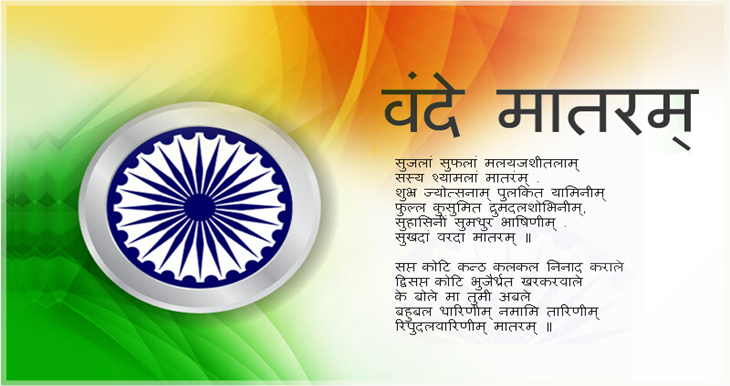
Vande Mataram (National song):
Context: The Union Cabinet has announced nationwide celebrations to commemorate 150 years of Vande Mataram, recognizing its enduring role in India’s freedom struggle.
Overview:
- “Vande Mataram” — composed in Sanskrit by Bankim Chandra Chatterjee in 1875, later featured in his 1882 novel Anandamath.
Historical Significance:
- 1896: First sung by Rabindranath Tagore at the INC Session, Calcutta & it became a rallying cry for freedom.
- 1937: INC Working Committee adopted the first two stanzas as the National Song.
- 1950 (Jan 24): Dr. Rajendra Prasad, in the Constituent Assembly, declared it the National Song, to be honoured equally with the National Anthem.
2. National Anthem of India – Jana Gana Mana
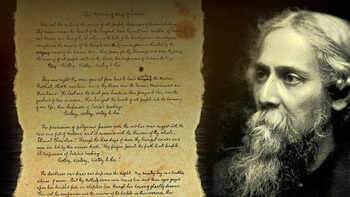
Historical Background: Symbolizes unity, pride, and patriotism of the nation.
Composition & Origin:
- Composed by Rabindranath Tagore in Bengali on 11 December 1911.
- First sung: 27 December 1911 at the INC Session, Calcutta by Sarala Devi Chowdhurani and students.
Official Adoption:
- Adopted: 24 January 1950 by the Constituent Assembly as the National Anthem.
- Authorized version: In Hindi, retaining Tagore’s original poetic spirit.
- Duration: Officially 52 seconds when sung in full.
Legal & Constitutional Recognition:
- Protected under the Prevention of Insults to National Honour Act, 1971.
- Disrespect or disruption during performance is a punishable offence.
3. National Flag of India – Tiranga
Overview:
- Designed by Pingali Venkayya in Vijayawada.
- Known as the Tiranga (Tricolour), symbolising India’s unity and diversity.
- Colour Significance:
- Saffron: Courage and sacrifice
- White: Peace and truth
- Green: Fertility and growth
- Ashoka Chakra: Navy blue wheel with 24 spokes, symbolising law, dharma, and motion.
- Proportion: Rectangular flag with a 3:2 length-to-width ratio.
Origin & Evolution:
- 1921: Pingali Venkayya presented a tricolour design (red, white, green) with a spinning wheel to Mahatma Gandhi at the Vijayawada Congress Session.
- 1931: The flag was modified — red replaced with saffron, and adopted by the Congress.
- 22 nd July 1947: The Constituent Assembly adopted the final design; the Charkha replaced by Ashoka Chakra.
Legal Framework:
- Governed by the Flag Code of India (2002).
- Article 51A(a): Citizens must respect the National Flag and Anthem.
- Prevention of Insults to National Honour Act, 1971: Offences involving disrespect can lead to legal action and six-year disqualification from elections.
4. State Emblem of India
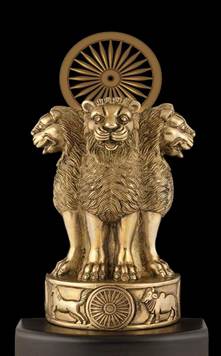
- Origin: Adapted from the Lion Capital of Ashoka at Sarnath.
- Structure: Four lions standing back-to-back on a circular abacus, resting on a lotus (omitted in emblem).
- Abacus Relief: Features elephant, horse, bull, and lion, separated by Dharma Chakras.
- Adoption: Officially adopted on 26 January 1950.
- Design:
- Only three lions visible, fourth hidden.
- Wheel (Dharma Chakra) at centre; bull (right) and horse (left) depicted.
- Motto: “Satyameva Jayate” (Truth Alone Triumphs) — from the Mundaka Upanishad, inscribed in Devanagari script.
- Legal Regulation:
- Governed by the State Emblem of India (Prohibition of Improper Use) Act, 2005 and Regulation of Use Rules, 2007.
Restricted use by authorized government entities only.