
Why in the News?
Scientists from the Indian Institute of Astrophysics (IIA), utilizing the Visible Emission Line Coronagraph (VELC) payload on India’s Aditya-L1 mission, have successfully estimated the critical parameters of a Coronal Mass Ejection (CME) immediately after its lift-off from the Sun
About Aditya-L1 Mission :-
India’s first space-based observatory, launched by ISRO on September 2, 2023, to study the Sun.
Strategic Location :
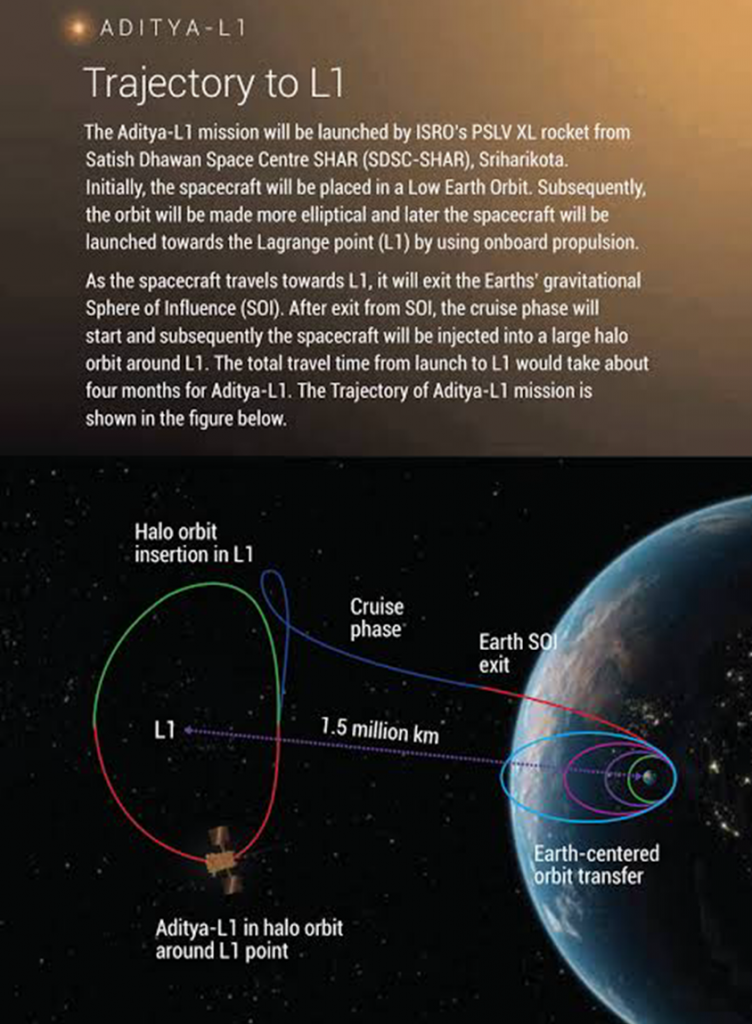
The spacecraft operates from a halo orbit at the Sun-Earth Lagrange point 1 (L1). This position, 1.5 million km from Earth, affords a continuous, unobstructed view of the Sun.
Primary Objectives
The mission’s core goal is to understand solar dynamics and space weather. Key objectives include:
- Investigating Coronal Heating and Solar Wind Acceleration.
- Studying the initiation of Coronal Mass Ejections (CMEs) and solar flares.
- Analyzing the solar wind and its distribution.
Key Instruments
Aditya-L1 carries seven payloads (including a coronagraph and various spectrometers) to observe the Sun’s photosphere, chromosphere, and corona in multiple wavelengths.
Aditya-L1 Trajectory to L1
The Aditya-L1 spacecraft will reach its destination via a phased trajectory:
1. Launch: Insertion into a Low-Earth Orbit (LEO).
2. Earth-Bound Manoeuvres: A 16-day phase of orbital adjustments to build velocity and depart Earth’s Sphere of Influence (SOI).
3. Trans-Lagrangian1 Insertion (TL1I): A key manoeuvre initiating the 110-day transfer trajectory toward the L1 point. This phase includes periodic Trajectory Correction Manoeuvres (TCM).
4. Halo Orbit Insertion: Upon arrival at L1, a final manoeuvre will capture the spacecraft, placing it into its designated halo orbit.
The Solar Atmosphere
The atmosphere of the Sun is structured in three primary layers:
- Photosphere: The lowest layer and visible surface of the Sun, emitting the majority of its radiation.
- Chromosphere: A thin layer of plasma located immediately above the photosphere.
- Corona: The outermost, highly diffuse plasma atmosphere of the Sun.
Solar Emissions:
The Sun emits energetic phenomena that impact the solar system:
- Solar Flares: Intense, localized eruptions of electromagnetic radiation, caused by the release of magnetic energy from sunspots. They can damage satellites and electronics.
- Solar Winds: Continuous streams of plasma from the corona, driven by the Sun’s magnetic field. They are the cause of auroras and can induce geomagnetic storms.
- Coronal Mass Ejections (CMEs): Large-scale expulsions of plasma and magnetic fields from the corona. CMEs can cause significant geomagnetic storms and damage Earth’s magnetic field.
About Lagrange Points:-
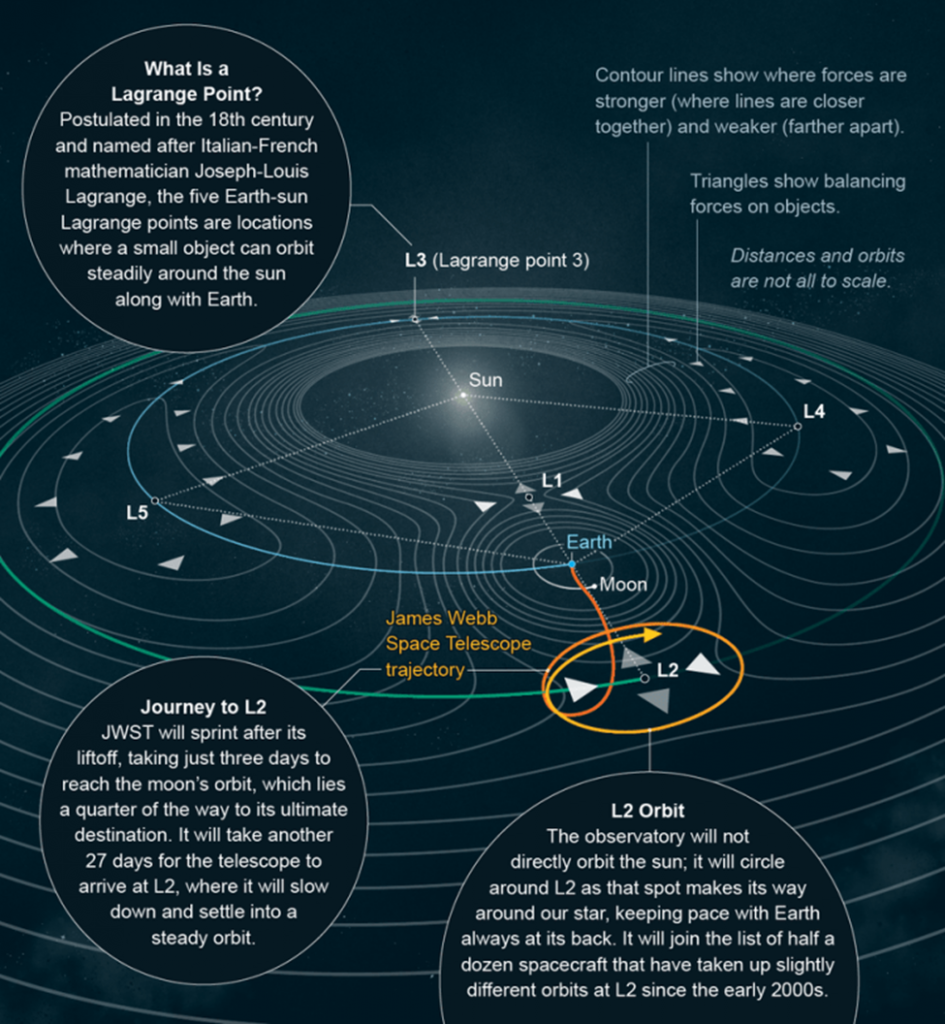
Lagrange points are positions in space where the gravity of two large bodies (like the Sun and Earth) and centrifugal force balance. An object placed there remains in a fixed position relative to them, requiring minimal fuel.
About Aditya-L1 Mission :-
India’s first space-based observatory, launched by ISRO on September 2, 2023, to study the Sun.
Strategic Location :
The spacecraft operates from a halo orbit at the Sun-Earth Lagrange point 1 (L1). This position, 1.5 million km from Earth, affords a continuous, unobstructed view of the Sun.
Primary Objectives
The mission’s core goal is to understand solar dynamics and space weather. Key objectives include:
- Investigating Coronal Heating and Solar Wind Acceleration.
- Studying the initiation of Coronal Mass Ejections (CMEs) and solar flares.
- Analyzing the solar wind and its distribution.
Key Instruments
Aditya-L1 carries seven payloads (including a coronagraph and various spectrometers) to observe the Sun’s photosphere, chromosphere, and corona in multiple wavelengths.
Aditya-L1 Trajectory to L1
The Aditya-L1 spacecraft will reach its destination via a phased trajectory:
1. Launch: Insertion into a Low-Earth Orbit (LEO).
2. Earth-Bound Manoeuvres: A 16-day phase of orbital adjustments to build velocity and depart Earth’s Sphere of Influence (SOI).
3. Trans-Lagrangian1 Insertion (TL1I): A key manoeuvre initiating the 110-day transfer trajectory toward the L1 point. This phase includes periodic Trajectory Correction Manoeuvres (TCM).
4. Halo Orbit Insertion: Upon arrival at L1, a final manoeuvre will capture the spacecraft, placing it into its designated halo orbit.
The Solar Atmosphere
The atmosphere of the Sun is structured in three primary layers:
- Photosphere: The lowest layer and visible surface of the Sun, emitting the majority of its radiation.
- Chromosphere: A thin layer of plasma located immediately above the photosphere.
- Corona: The outermost, highly diffuse plasma atmosphere of the Sun.
Solar Emissions:
The Sun emits energetic phenomena that impact the solar system:
- Solar Flares: Intense, localized eruptions of electromagnetic radiation, caused by the release of magnetic energy from sunspots. They can damage satellites and electronics.
- Solar Winds: Continuous streams of plasma from the corona, driven by the Sun’s magnetic field. They are the cause of auroras and can induce geomagnetic storms.
- Coronal Mass Ejections (CMEs): Large-scale expulsions of plasma and magnetic fields from the corona. CMEs can cause significant geomagnetic storms and damage Earth’s magnetic field.
About Lagrange Points:-
Lagrange points are positions in space where the gravity of two large bodies (like the Sun and Earth) and centrifugal force balance. An object placed there remains in a fixed position relative to them, requiring minimal fuel.
The Five Points (L1-L5)
- L1, L2, and L3: These points are collinear (lie on the line connecting the two large masses). They are inherently unstable.
- L1: (Between Sun and Earth) Ideal for solar observatories (like SOHO and Aditya-L1) as it offers a constant, uninterrupted view of the Sun.
- L2: (Behind Earth) Ideal for deep-space astronomy (like the James Webb Space Telescope) as it provides a clear view away from the Sun.
- L4, L5: Form equilateral triangles with the two large bodies. These points are stable and host asteroids known as “Trojans.”
The L1 point (1.5 million km from Earth) is crucial for heliophysics. It provides an early warning vantage point to observe solar events like CMEs, which is vital for space weather prediction.
Halo Orbits :- A halo orbit is a quasi-periodic trajectory around an unstable Lagrange point (like L1). A spacecraft in this orbit does not orbit the L-point itself (which exerts no net force), but rather maintains a stable position in a balanced gravitational location with minimal propellant use for station-keeping.
International solar missions:
Parker Solar Probe (NASA, 2018): The closest-ever mission to the Sun, studying its outer corona and the solar wind.
- Solar Orbiter (ESA/NASA, 2020): Observes the Sun’s poles and solar wind to understand the 11-year solar cycle.
- SOHO (ESA/NASA, 1995): A long-running observatory studying the Sun’s interior, corona, and solar wind; vital for space weather data.
- Hinode (JAXA, 2006): Focuses on solar magnetic fields and the mechanisms behind solar flares and sunspots.
- Aditya-L1 (ISRO, 2023): India’s first solar mission, studying the Sun’s outer layers and their impact on space weather.
- ASO-S / Kuafu-1 (China, 2022): Studies solar flares, CMEs, and magnetic fields to understand their effects on Earth.