
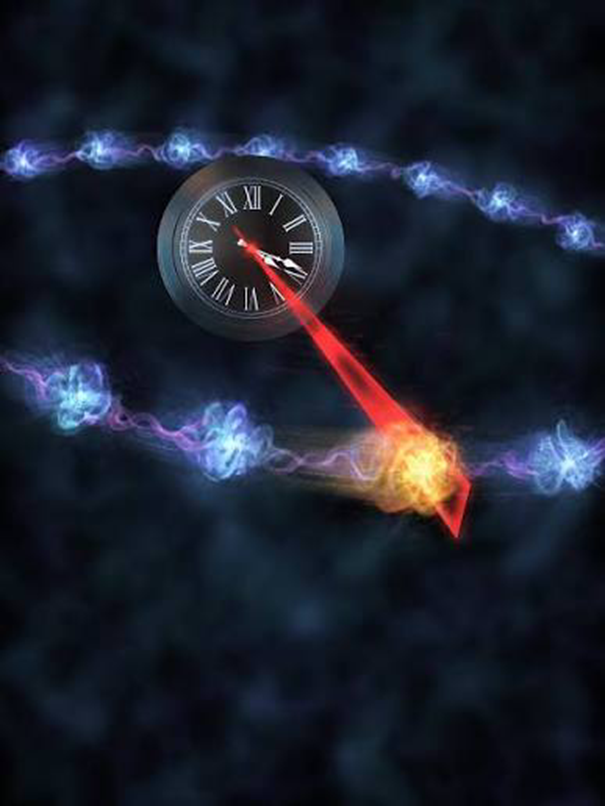
Context: A 2025 Physical Review Letters study shows that in quantum clocks, the energy required to measure time can be greater than the energy needed to make the clock tick. This challenges classical notions of timekeeping and has implications for atomic clocks, metrology, and quantum computing.
Key Concepts
A. Quantum Dots (The “Artificial Atoms”):
- Definition: Nanoscale semiconductor particles (sized 2-10 nanometers) that have optical and electronic properties different from larger particles due to quantum mechanics.
- Properties: When illuminated, they re-emit light of a specific color that depends entirely on their size (Smaller dots = Blue light; Larger dots = Red light).
- Applications: QLED TV screens, LED lamps, medical imaging (tagging tumor tissue), and quantum computing.
- Nobel Fact: The Nobel Prize in Chemistry 2023 was awarded to Moungi Bawendi, Louis Brus, and Alexei Ekimov for the discovery and synthesis of Quantum Dots.
B. Quantum Tunnelling :
- Definition: A quantum phenomenon where a particle (like an electron) passes through a potential energy barrier that it classically should not be able to cross (like a ball passing through a solid wall).
- Role in Study: The “tick” of the quantum clock was defined by an electron tunnelling between two quantum dots.
- Nobel Fact: The Nobel Prize in Physics 2025 was awarded to John Clarke, Michel Devoret, and John Martinis for demonstrating this phenomenon on a macroscopic scale (in a large electric circuit), proving quantum mechanics applies to objects we can hold.
C. Entropy & The Arrow of Time
- Entropy: A measure of the disorder or randomness in a system.
- Second Law of Thermodynamics: In an isolated system, entropy always increases over time. This increase creates the “irreversible” flow of time (we can break a glass, but it won’t un-break itself).
- New Insight: In the quantum world, processes can be reversible (go backward). The study found that the measurement process creates the necessary entropy to force time to move “forward.”
International Year of Quantum Science and Technology (2025)
- The year 2025 has been designated as the International Year of Quantum Science and Technology. This marks the centenary of German physicist Werner Heisenberg’s seminal 1925 paper, which laid the foundation for Quantum Mechanics.
Core Objectives :
- Global Capacity Building: To strengthen national capacities in basic sciences and science education.
- Sustainable Development: To highlight the role of quantum science in developing sustainable solutions (energy, climate modelling).
- Knowledge Dissemination: To emphasize the contribution of quantum science to understanding the physical universe.
Understanding Quantum Mechanics :
- Fundamental Principle: It explains the behavior of matter and energy at atomic and subatomic levels.
- Wave-Particle Duality: Objects in the quantum realm simultaneously exhibit characteristics of both particles (matter) and waves (energy transfer).
Key Applications of Quantum Technology :
Quantum Computing & Simulations:
- Utilizes Qubits (subatomic particles) as the basic unit of information rather than binary bits (0s and 1s).
- AI Integration: When combined with AI, it processes vast datasets rapidly.
- Logistics: Solves complex optimization problems (e.g., route planning, supply chain management).
- Healthcare & Pharmaceuticals:
- Quantum Photonics: Advances medical imaging and diagnostics.
- Quantum Chemistry: Accelerates vaccine development and drug discovery.
- Quantum Communications:
- Post-Quantum Cryptography: Developing encryption proof against quantum attacks.
- Quantum Key Distribution (QKD): Uses photons to transmit secure, random encryption keys.
- Sensing & Metrology:
- Uses individual particles (photons/electrons) as ultra-sensitive sensors for measuring gravity, electric fields, and force.
India’s Strategic Initiatives
- National Quantum Mission (2023): A flagship mission to nurture and scale up scientific and industrial R&D in quantum technology.
- Research Programs:
- QuEST (Quantum Enabled Science & Technology): To build domestic quantum capabilities.
- QCAL (Quantum Computing Applications Lab): To accelerate R&D and enable scientific discoveries.
NMQTA: National Mission on Quantum Technologies & Applications.
- Tools & Defense:
- QSim: An indigenous Quantum Computer Simulator Toolkit.
- Defense Applications: Establishment of dedicated quantum labs at the Military Engineering Institute in Mhow, Madhya Pradesh.