
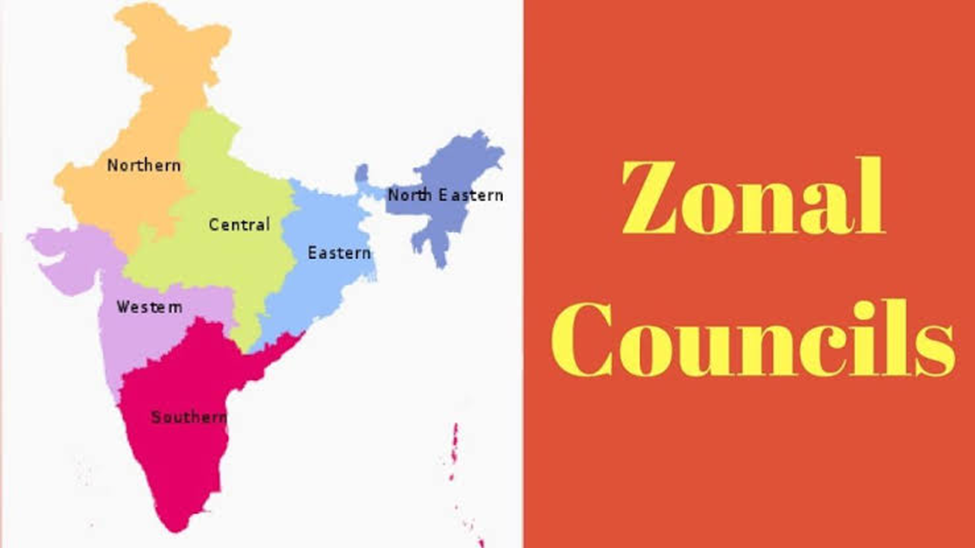
Context: At the 32nd Northern Zonal Council (NZC) meeting held in Faridabad, Union Home Minister Amit Shah reaffirmed the Centre’s commitment to eliminating terrorism and assured strict action against the perpetrators of the November 10 Delhi blast.
Zonal Councils: Administrative Framework & Composition
Legal Genesis and Nature:
- Origin: Conceptualized by Prime Minister Jawaharlal Nehru in 1956 to mitigate linguistic hostility.
- Statutory Basis: Established under the States Reorganisation Act, 1956. They are not constitutional bodies.
- Nature: Function purely as deliberative and advisory bodies; recommendations are non-binding.
- Primary Objective: To foster interpersonal and interstate cooperation, ensuring political, economic, and social stability.
Determinants of Zoning
The formation of zones is based on the following integration factors:
- Geographical & Environmental: Natural divisions and river systems to facilitate resource management.
- Socio-Cultural: Linguistic affinities and shared cultural heritage.
- Strategic: Requirements for economic development, security, and law and order.
Administrative Composition:
- Chairman: The Union Home Minister (Common Chairman for all five councils).
- Vice-Chairman: Chief Ministers of the member states within the zone (Rotational tenure of one year).
Members:
- Chief Minister and two other Ministers from each member state.
- Administrators of included Union Territories.
Advisors (Non-Voting):
- Representatives from NITI Aayog.
- Chief Secretaries and Development Commissioners of member states.
- Standing Committee: Comprises Chief Secretaries of member states to screen agendas prior to council meetings.
Operational Zones and Jurisdiction
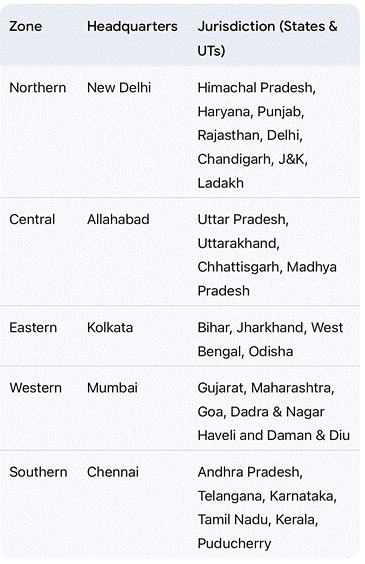
Special Regional Framework: North Eastern Council
- Legal Entity: Established distinctively under the North Eastern Council Act, 1971 (effective 1972).
- Jurisdiction: Assam, Manipur, Mizoram, Arunachal Pradesh, Nagaland, Meghalaya, Tripura, and Sikkim (added in 2002).
- Leadership:
- Chairman: Union Home Minister.
- Vice-Chairman: Minister for Development of North Eastern Region (DoNER).
- Distinction: Functions similarly to Zonal Councils but with an added mandate for security review and regional planning.
- Functional Mandate
- Cooperative Federalism: Acts as a platform to resolve Centre-State and inter-state disputes.
- Conflict Resolution: Addresses issues related to border disputes, linguistic minorities, and administrative reorganization.
- Economic Integration: Harmonizes development schemes, infrastructure projects, and resource sharing.
- Social Welfare: Monitors parameters such as healthcare, malnutrition, and education to ensure balanced regional growth.