
Context: Effective from November 21, 2025, the Government of India has operationalized a historic transformation in the labour sector by consolidating 29 fragmented labour laws into 4 comprehensive Codes. This reform aims to foster Aatmanirbhar Bharat by balancing worker welfare with the ease of doing business.However, Tamil Nadu has expressed reservations specifically regarding the Code on Social Security (CSS), 2020.
I. The Four Pillars of Labour Reform
The new framework streamlines regulations into the following statutory codes:
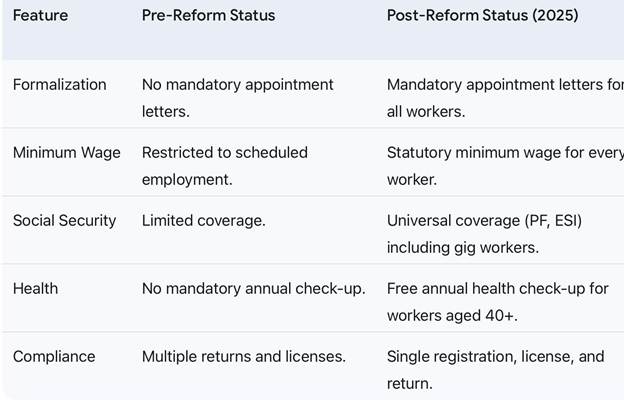
- Code on Wages, 2019: Guarantees statutory minimum wages for all workers and ensures timely payment.
- Industrial Relations Code, 2020: Enhances flexibility in hiring/firing (Fixed Term Employment), streamlines dispute resolution, and regulates trade unions.
- Code on Social Security, 2020: Extends universal social security coverage (PF, ESI) to unorganized, gig, and platform workers.
- Occupational Safety, Health (OSH) & Working Conditions Code, 2020: Mandates safety standards and health checks across all industries.
II. Rationale for Structural Transformation :
- The reform addresses the inefficiencies of the pre-2025 regime:
- Obsolescence: Replacement of laws from the 1930s-50s that were incompatible with modern digital and gig economies.
- fragmentation: Elimination of inconsistent definitions across 29 separate Acts.
- Inclusivity: Addressing the exclusion of gig/platform workers from the social security net.
- Gender Parity: Removal of archaic restrictions on women’s employment in specific sectors and shifts.
III. Key Regulatory Shifts & Provisions
The transition introduces standardized benefits across the workforce:
IV. Sector-Specific Impact & Benefits :
1. Gig, Platform & Unorganized Workers
- Legal Recognition: First-time legal definition and recognition.
- Social Security: Aggregator-funded welfare schemes and portable, Aadhaar-linked benefits.
2. Women in Workforce :
- Night Shifts: Permitted in all sectors (including factories) with mandatory safety provisions and consent.
- Representation: Mandatory representation in safety committees.
3. Fixed-Term & Contract Employees
- Parity: Entitlement to equal pay and benefits as permanent staff.
- Gratuity: Eligibility for gratuity after one year of service (previously five years).
4. High-Risk Sectors (Mines, Plantations, Hazardous Industries)
- Safety Nets: Enhanced accident coverage, protective gear requirements, and regulated working hours (8–12 hour shifts).
- Healthcare: Full ESI coverage extended to families of plantation workers.
V.Impact on the Labour Ecosystem:
The implementation of these codes marks a shift towards a future-ready workforce. By expanding social security coverage (projected rise from 19% in 2015 to 64% in 2025) and digitizing compliance, the framework ensures that India’s demographic dividend is protected while enhancing industrial competitiveness in the global market.