
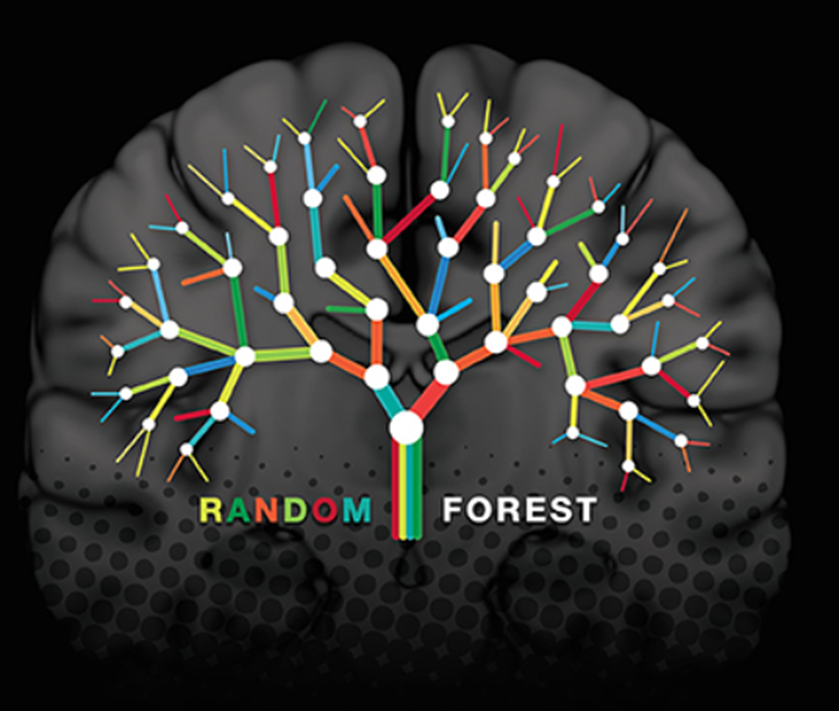
Context: In a study published in the journal PNAS scientists utilized the Random Forest machine-learning model to identify 2.5 billion-year-old photosynthetic microbes, distinguishing true biological fossils from abiotic rock formations.
I. What is the ‘Random Forest’ Model?
- Definition: It is a machine-learning method that acts as an “ensemble” learner. Instead of relying on one calculation, it combines the decisions of multiple simpler models known as Decision Trees.
- Core Mechanism: It operates on the principle of “wisdom of the crowd.” By aggregating the results of many trees, it cancels out individual errors, resulting in higher accuracy.
- Operational Mechanism: The Decision Tree Framework
- Context: Understanding the fundamental unit of the Random Forest algorithm is essential to grasping its predictive power.
Structural Functioning
- Hierarchical Logic: Acts as a bottom-up flowchart where each ‘node’ represents a specific attribute test (e.g., “Is carbon isotope value > X?”).
- Binary Splitting: At every node, the data bifurcates based on a Yes/No response.
- Terminal Outcome: The branching process continues iteratively until it reaches a ‘leaf’, representing the final decision or classification.
II. Technical Limitation: Overfitting
- Lack of Generalization: A solitary decision tree is highly sensitive to the specific “noise” or outliers in the training data.
- Consequence: While it may memorize the training set perfectly, it often fails to make accurate predictions on new, unseen data (high variance).
Application: The PNAS Fossil Study
- Objective: To differentiate between organic molecules created by lifeforms and those formed by natural geological processes.
- Methodology: The model was trained to recognize “chemical fingerprints” on rocks.
- Significance: It successfully identified evidence of photosynthetic microbes dating back 2.5 billion years, offering a non-invasive tool to study the origins of life.