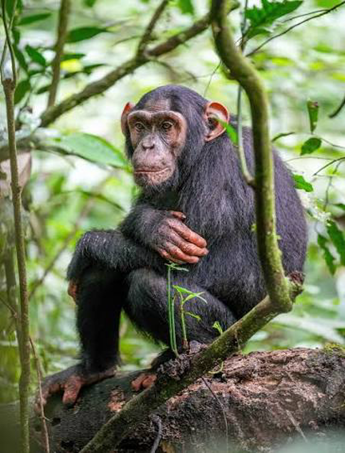
Context: A recent study published in Science challenges the long-held anthropocentric view that “rational belief revision” (the ability to weigh evidence and change one’s mind) is a uniquely human trait. This builds upon Jane Goodall’s 1960 discovery of tool use in chimpanzees, further blurring the line between humans and great apes.
What is the Core Discovery?
- Rationality in Apes: The study suggests that chimpanzees possess the cognitive ability to weigh conflicting evidence, filter information, and revise their beliefs based on reliability rather than just immediacy.
- The Framework: The researchers utilized a Bayesian Model to analyze the decision-making process.
- Bayesian Inference is a statistical method of using new evidence to update the probability that a hypothesis is true. In this context, it refers to updating beliefs based on new sensory data.
Where was the Study Conducted?
- Location: Ngamba Island Chimpanzee Sanctuary, Lake Victoria, Uganda.
- Subjects: 15-23 rescued chimpanzees were observed in semi-captive conditions.
- How do Chimpanzees Demonstrate Rationality? :
- The study employed five behavioural tests involving hidden food and clues (sound vs. sight) to observe decision-making patterns:
- Weighing Evidence: Chimpanzees consistently favoured “strong clues” (visual confirmation of food) over “weak clues” (vague acoustic sounds), regardless of which clue was presented last.
- Information Filtering: They distinguished between “old” and “new” information. They only changed their choice if the second signal provided genuinely new evidence, ignoring redundant data.
IV. What is the Evolutionary Significance?
- Shared Ancestry: The findings suggest that the cognitive roots of human rationality—specifically evidence-based reasoning—predate the emergence of Homo sapiens.
- Wild Implications: While difficult to observe in the wild, this trait allows chimpanzees to adapt to changing environments (e.g., realizing a tree with red leaves is not a fruit tree and conserving energy).
- About Chimpanzee (Pan troglodytes) : Chimpanzees are our closest living relatives, sharing a common ancestor with humans approximately 7-8 million years ago. Their conservation is critical due to threats from habitat destruction and hunting.
- Taxonomy & Conservation Status
- Subspecies: Four recognized subspecies exist—Central, Western, Nigeria-Cameroon, and Eastern.
IUCN Red List Status:
- Overall: Endangered.
- Western Chimpanzee: Critically Endangered.
- Behavioral Ecology & Cultural Traits
- Social Structure: They live in highly complex, fission-fusion societies ranging from 20 to 150 members.
- Cultural Learning: Exhibits “cultural” behaviors that vary by region, including specific vocal dialects and unique feeding techniques.
- Tool Usage: Demonstrates advanced cognition through:
- Termite fishing.
- Honey harvesting.
- Nut cracking (tools and methods vary across populations).
- Dietary Adaptations: Highly adaptable diet, ranging from fruits and nuts to specific adaptations like consuming mangrove leaves and cave usage in dry environments.