
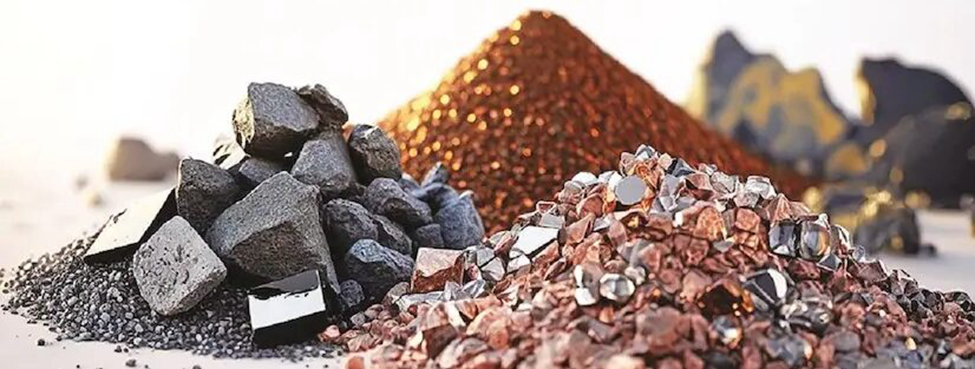
Context :- India and Canada issued a joint statement to enhance cooperation in critical minerals, clean energy, and trade.
About critical minerals :
What Defines a “Critical Mineral”?
A mineral is deemed ‘critical’ based on two parameters:
1. Economic Importance: It is essential for modern technologies (e.g., semiconductors, EVs, solar panels) and national security (e.g., defence, aerospace).
2. Supply Risk: Its supply chain is vulnerable due to limited availability or high geographic concentration of extraction and processing (e.g., China, Congo, Chile).
What is India’s Legislative and Policy Framework?
India has adopted a two-pronged approach to govern the sector:
1. Legislative Empowerment (MMDR Act, 1957): 24 of the 30 identified critical minerals (e.g., Lithium, Cobalt, Graphite, REEs) were added to Part D of Schedule I of the Mines and Minerals (Development and Regulation) Act.
- Significance: This grants the Central Government exclusive power to auction the mining and exploration licenses for these minerals, ensuring unified and strategic development.
2. Institutional Oversight:
- A Centre of Excellence for Critical Minerals (CECM) will be established to regularly review the list based on evolving technological and market dynamics.
What are the Key Pillars of the National Critical Mineral Mission Mission (NCMM)?
The NCMM aims to create a robust framework across the entire mineral value chain.
- Exploration (Domestic & Foreign):
- The Geological Survey of India (GSI) is tasked with 1,200 exploration projects by 2030-31 to ensure domestic production of at least 15 critical minerals.
- The mission aims to support Indian companies in acquiring 50 mining assets worldwide.
- Recycling (Circular Economy):
- An incentive scheme (approx. ₹1500 crore) will be established to promote mineral recycling, targeting 400 kilotonnes of recovered material.
Strategic Stockpiling:
- A National Critical Minerals Stockpile (comprising at least 5 critical minerals) will be created to mitigate global supply chain disruptions.
Research & Development:
- The mission seeks self-sufficiency in processing at least 5 critical minerals and aims to generate 1,000 patents across the value chain by 2031.
- This includes setting up 4 regional mineral processing parks and 3 Centres of Excellence.
Governance:
- An Empowered Committee on Critical Minerals will coordinate and implement the mission’s initiatives.
