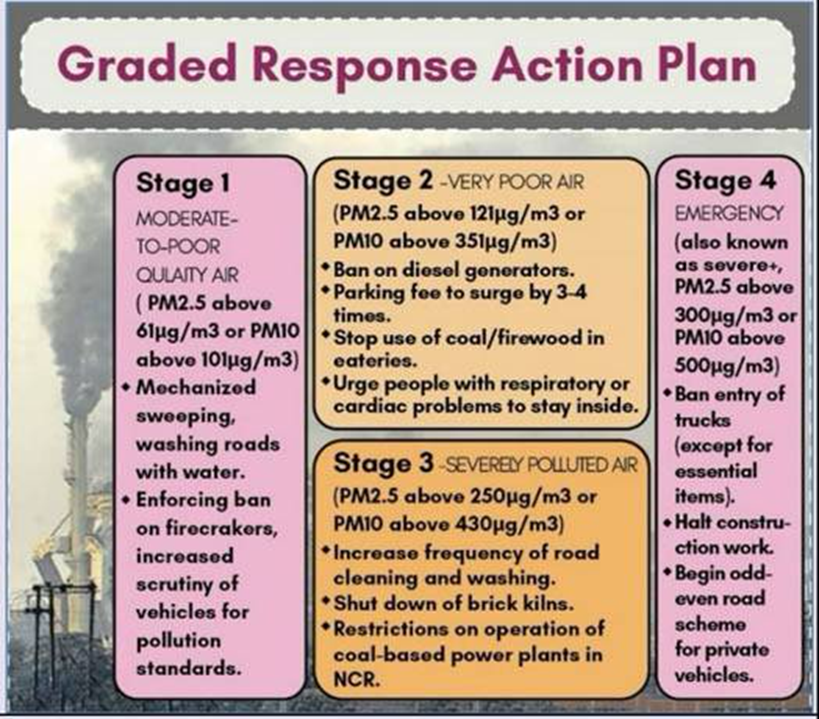
Context: The Supreme Court has cautioned the Centre against relying on year-round GRAP (Graded Response Action Plan) to curb Delhi–NCR’s persistent air pollution crisis, emphasising the need for sustainable, long-term interventions.
Overview of the Graded Response Action Plan (GRAP)
- Objective: GRAP is an emergency response framework designed to combat air pollution specifically within the Delhi-NCR region.
- Activation: The plan is triggered automatically when the Air Quality Index (AQI) deteriorates to the “Poor” category.
- Seasonality: It is a crucial mechanism during the winter months when atmospheric conditions cause a sharp decline in air quality.
Implementation and Governance
- Nodal Authority: The Commission for Air Quality Management (CAQM) in NCR and adjoining areas oversees execution, in collaboration with the Ministry of Environment, Forest and Climate Change (MoEFCC).
- Operational Sub-Committee: A specialized body operationalizes GRAP, comprising officials from the CAQM, member secretaries of Pollution Control Boards (UP, Delhi, Haryana, Rajasthan), the CPCB, and scientists from IMD and IITM.
- Jurisdiction: The sub-committee convenes frequently to issue invocation orders. In the event of a conflict, CAQM directives supersede instructions issued by State governments.
Operational Stages of GRAP:
GRAP involves four progressive stages, each mandating specific actions from authorities based on the severity of pollution:
- Stage I (Poor): Delhi AQI 201–300
- Stage II (Very Poor): Delhi AQI 301–400
- Stage III (Severe): Delhi AQI 401–450
- Stage IV (Severe+): Delhi AQI > 450