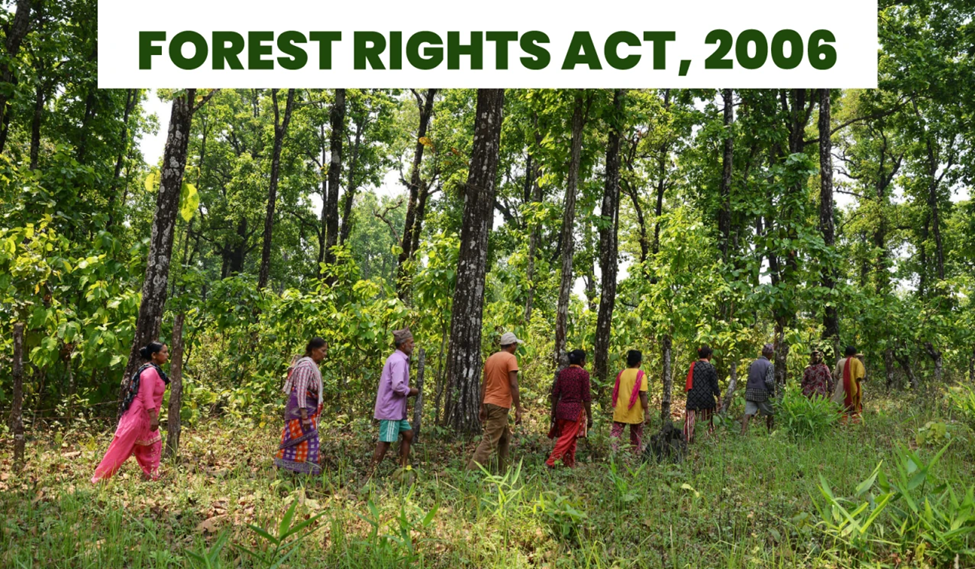
Context: The Union Ministry of Tribal Affairs is currently reviewing a Supreme Court order (dated September 23) that highlights a legislative conflict between the Forest Rights Act (FRA), 2006 and the Forest Conservation Act (FCA), 1980. This legal friction threatens to derail flagship tribal welfare schemes like PM-JANMAN and DAJGUA.
What is the Legal Tussle? (FRA vs. FCA)
The core issue arose from a case in Madhya Pradesh where PVTGs (Particularly Vulnerable Tribal Groups) holding land titles were attempting to build homes under PMAY-Gramin.
- The FRA Stand: The Forest Rights Act, 2006 allows the government to divert forest land for specific “non-forestry” purposes (like schools, hospitals, or water lines) to provide facilities to forest dwellers.
- The SC Observation: The Court noted that “construction of pucca housing” is not explicitly listed as a permitted activity under the FRA diversion rules.
- The Consequence: Even if a tribal person holds a land title (Patta) under FRA, the Forest Conservation Act (FCA), 1980 may still block the construction of concrete (pucca) houses on that land, classifying it as unauthorized non-forestry use.
Which Schemes are at Risk?
- The government fears this legal interpretation could hinder the “saturation approach” of two major schemes launched to celebrate the legacy of Birsa Munda:
- PM-JANMAN (Pradhan Mantri Janjati Adivasi Nyaya Maha Abhiyan): Focuses on 11 critical interventions (including housing) specifically for 75 PVTGs.
- DAJGUA (Dharti Aaba Janjatiya Gram Utkarsh Abhiyan): Aims to fill critical gaps in social infrastructure in tribal-majority villages.
- The Dependency: Both schemes rely on FRA Titles to identify beneficiaries. If title holders cannot build homes due to FCA restrictions, the schemes’ primary objective (housing) fails
About Forest Rights Act (FRA), 2006:
- Nodal Ministry: Ministry of Tribal Affairs (MoTA).
- Objective: To undo historical injustice by recognizing rights of forest dwellers.
- Beneficiaries:
1. Forest Dwelling STs (FDST): Occupying land before 13 Dec 2005.
2. Other Traditional Forest Dwellers (OTFD): Resident for 3 generations (75 years) prior to 13 Dec 2005.
Key Rights Granted
1. Title Rights: Ownership of land actually cultivated by the family (Max 4 Hectares).
2. Use Rights: Ownership and disposal of Minor Forest Produce (tendu, bamboo, honey).
3. Relief & Development: Right to rehabilitation in case of illegal eviction; right to basic amenities.
4. Management Rights: Right to protect and conserve Community Forest Resources (CFR).
Implementation Mechanism :
- Gram Sabha: The supreme authority to initiate, verify, and map claims.
- Hierarchy: Gram Sabha \rightarrow Sub-Divisional Level Committee \rightarrow District Level Committee.
- Nature of Title: Heritable but Non-Transferable (cannot be sold/leased).
- Critical Challenges
- Burden of Proof: High rejection rate for Other Traditional Forest Dwellers (OTFDs) due to lack of 75-year-old documentary evidence.
- Legal Conflict: Frequent friction between FRA rights and wildlife conservation laws (e.g., Tiger Reserves).