
Why in News?
A decade after the first gravitational wave (GW) detection, an international network of detectors—LIGO (U.S.), Virgo (Italy), and KAGRA (Japan)—has successfully observed GW250114.
What Exactly Are Gravitational Waves (GWs)?
- Einstein’s Prediction: First predicted by Albert Einstein in his 1915 General Theory of Relativity.
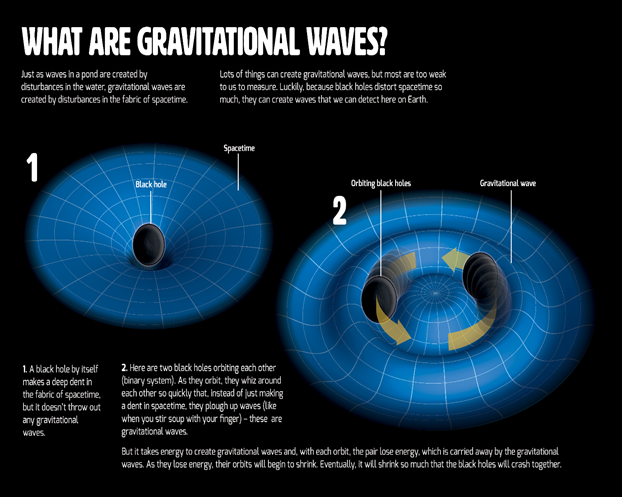
- Core Concept: They are ‘ripples’ in the fabric of spacetime (the unified four-dimensional continuum of space and time).
- Origin: Caused by the universe’s most violent and energetic processes, specifically involving massive accelerating objects.
- Travel: These ripples travel at the speed of light, carrying information about their powerful sources.
What Are the Sources of These Cosmic Ripples?
Gravitational waves are generated by cataclysmic cosmic events, such as:
• The merger of two black holes.
• The orbiting and collision of two neutron stars.
• Asymmetrical supernova explosions (the death of a massive star).
How Do Scientists Detect These Elusive Waves?
Two primary methods have been successful, targeting different frequencies:
1. High-Frequency Waves (LIGO):
- Who: The Laser Interferometer Gravitational-Wave Observatory (LIGO) in the USA.
- When: First-ever detection in 2015.
- Source: The merger of two black holes 1.3 billion light-years away.
- Method: LIGO uses laser interferometers with long “arms.” A passing GW minutely squeezes and stretches space, causing a measurable change in the arms’ lengths.
2. Low-Frequency Waves (Pulsar Timing Arrays):
- Who: A global network of radio telescopes, including the Indian Pulsar Timing Array (InPTA).
- Method: This method relies on pulsars—rapidly-rotating neutron stars that emit radiation pulses at extremely precise intervals, acting as ‘cosmic clocks’.
- Mechanism: Low-frequency GWs passing through spacetime cause tiny, inconsistent delays (arriving early or late) in the signals from these pulsars, which astronomers can detect.
Why Does This Discovery Matter for Science?
The detection of gravitational waves is not just a confirmation; it is a transformative tool for astronomy:
- A New Observational Spectrum: Like the electromagnetic spectrum (light, radio waves, etc.), GWs provide a completely new way to observe the universe.
- Studying the “Dark” Universe: It allows for the direct study of objects that do not emit light, such as black holes.
- Refining the Hubble Constant: GWs act as ‘sirens’. By measuring both the GW signal (for distance) and the light flash (for velocity) from an event like a neutron star merger, scientists can precisely calculate the universe’s expansion rate, known as the Hubble Constant.
- Testing General Relativity: These detections provide strong, direct evidence for Einstein’s General Theory of Relativity, alongside other phenomena like gravitational lensing (the bending of light by massive objects).
Key Terms at a Glance
- Neutron Star: The incredibly dense remnant core of a massive star after a supernova. They are the densest observable objects in the universe.
- Pulsar: A type of neutron star that rotates rapidly and emits beams of radiation, observed from Earth as regular pulses.
- InPTA (Indian Pulsar Timing Array): An array of radio telescopes in India used to detect low-frequency gravitational waves by monitoring pulsars.
