
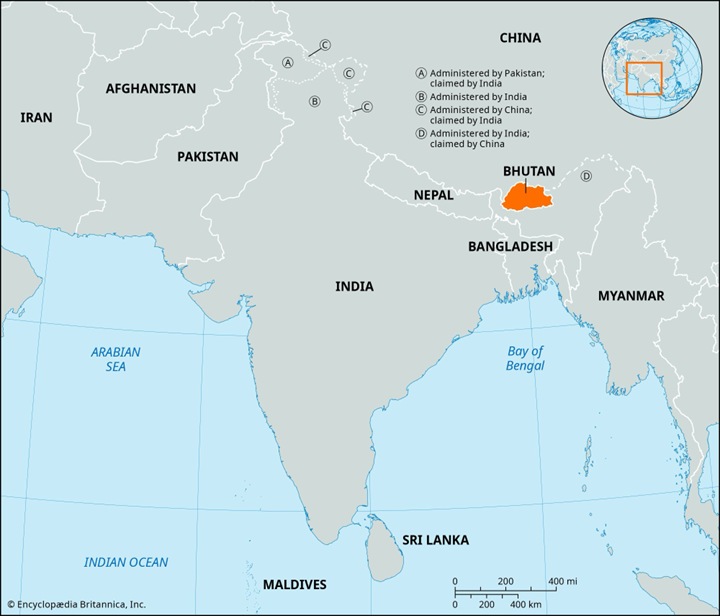
Context : India and Bhutan maintain a unique and exemplary bilateral relationship founded on mutual trust and understanding.
Significance for Both Nations
- Political: The relationship is anchored by the 1949 Treaty of Friendship (renegotiated in 2007), forming the basis for a robust and enduring political partnership.
- Hydropower Cooperation: A mutually beneficial 2006 agreement allows Bhutan to leverage Indian financing and market access for socio-economic development, while providing India with a sustainable source of clean energy.
- Environmental: Joint stewardship of the region’s ecology through initiatives like the Transboundary Manas Conservation Area (TraMCA).
Significance for Bhutan :
- Economic: India provides a free trade regime (Agreement of 1972, revised 2016) and duty-free transit for Bhutanese exports to third countries.
- Developmental: India is a premier development partner, providing substantial support for Bhutan’s Five Year Plans and its Economic Stimulus Programme.
- Security: India acts as a net security provider, offering military training via IMTRAT (est. 1961-62) and support for Bhutanese territorial sovereignty, as exemplified during the 2017 Doklam standoff.
- Infrastructure: India is critical to Bhutan’s infrastructure development, notably through the Border Roads Organisation (Project ‘DANTAK’) and support for digital infrastructure (‘Digital Drukyul’).
- Financial & Human Capital: India is a key source of FDI and provides numerous scholarships for Bhutanese students.
Significance for India
- Strategic: Bhutan’s geographic position is of high strategic importance, acting as a crucial buffer state between India and China, particularly near the sensitive Chumbi Valley.
- Economic: India is Bhutan’s largest trade and development partner, maintaining a strong, favorable balance of trade.
Important and strategic locations of Bhutan :-
1. Doklam plateau :-
- Doklam lies at the tri-junction of India (Sikkim), Bhutan (Haa district) and China (Tibet/Chumbi Valley).
- The area is disputed between Bhutan and China; control over this region gives strategic oversight of the Siliguri Corridor (“Chicken’s Neck”) via the Chumbi Valley.
2.Chumbi Valley (Tibet side) :- The Chumbi Valley in Tibet points southward toward India’s Siliguri Corridor through Bhutan–Doklam region. It is considered a major strategic “dagger” in the Himalayas.
3. Gelephu (Southern Bhutan ) :-
- Gelephu lies on the Bhutan-India border (near Assam) and acts as a gateway for trade and connectivity.
