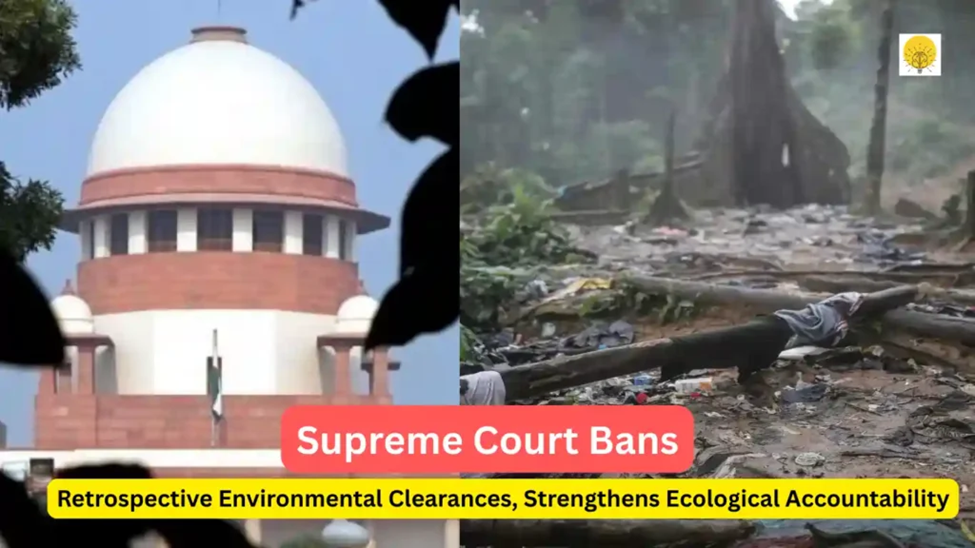
Context : The Supreme Court’s three-judge Bench has recalled its May 16, 2024 judgment that had declared retrospective (ex post facto) environmental clearances (ECs) for construction projects as “gross illegality”.
Concept and Regulatory Framework:
- Definition: Retrospective or Ex-post facto Environmental Clearance (EC) refers to the granting of environmental approval to projects after they have already commenced construction or operations, effectively bypassing mandatory prior permission.
- Statutory Mandate: The EIA Notification (2006), issued under the Environment (Protection) Act, 1986, strictly mandates prior environmental clearance before initiating any industrial or construction activity.
Administrative Deviations:
- Amnesty Scheme: The Environmental Amnesty Notification (2017) provided a one-time window (March–September 2017) for violators to seek retrospective clearance.
- Procedural Normalization: The Ministry of Environment, Forest and Climate Change issued an Office Memorandum in 2021, establishing a Standard Operating Procedure (SOP) to institutionalize the processing of such violation cases.
Judicial Review: Vanashakti vs. Union of India
- The Supreme Court of India delivered a landmark judgment striking down the validity of ex-post facto clearances.
- Verdict on Illegality: The Court ruled that retrospective ECs are “illegal,” “arbitrary,” and “anathema” to established environmental jurisprudence.
- Nullification of Policies: The bench struck down both the 2017 Amnesty Notification and the 2021 Office Memorandum, dismantling the framework used to regularize violations.
Operational Implications:
- Existing Clearances: Approvals already granted under the defunct regimes remain valid to ensure legal certainty.
- Future Prohibition: No new retrospective clearances can be granted, and the Union government is permanently restrained from issuing future circulars to regularize such violations.
Legal and Constitutional Rationale
- The judgment is anchored in the following legal principles:
- The Precautionary Principle: A fundamental tenet of Indian environmental law requiring risks to be assessed before potential harm occurs, rather than managing damage retrospectively.
- EIA Integrity: Ex-post facto approvals defeat the core objective of Environmental Impact Assessments, which is to evaluate feasibility and risk prior to project approval.
- Constitutional Obligations:
- State Duty: The judgment reinforces the State’s duty to protect the environment under Article 48A (Directive Principles) and Article 51A(g) (Fundamental Duties).
- Fundamental Rights: Retrospective clearances were held to violate Article 21, infringing upon the citizens’ fundamental right to health and a clean environment.