
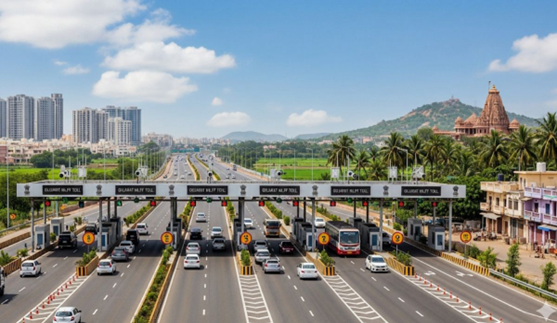
Context:- The Government of India is reassessing its bank-centric tendering model for the Multi-Lane Free Flow (MLFF) tolling system as part of efforts to modernise toll collection and reduce congestion on national highways.
System Overview and Implementation
- Definition: A barrier-less tolling system enabling toll collection without requiring vehicles to stop.
- Mechanism: Utilizes High-Performance RFID Readers (for FASTag) and ANPR Cameras (for Vehicle Registration Number) to process transactions seamlessly.
- Recent Development: The Indian Highways Management Company Limited (IHMCL) has partnered with ICICI Bank to implement India’s first comprehensive MLFF system at Choryasi Fee Plaza, Gujarat (NH-48).
Significance and Benefits:
- Efficiency: Reduces congestion and travel time by eliminating the need to stop at toll plazas.
- Economic & Environmental: Leads to enhanced fuel efficiency and lower vehicle emissions.
- Revenue: Aims to improve toll revenue collection and contribute to a more efficient National Highway network.
About the National Highways Authority of India (NHAI):
- Role: India’s primary agency for developing, maintaining, and managing National Highways.
- Legal Status: A statutory body under the Ministry of Road Transport and Highways, established by the NHAI Act, 1988, and operational since February 1995.
- Composition: Headed by a full-time Chairman, supported by full-time and part-time members appointed by the Central Government.
