
Introduction
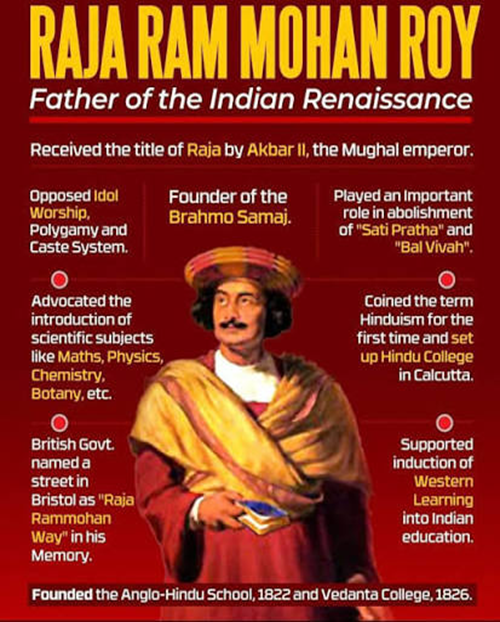
Raja Ram Mohan Roy, celebrated as the “Father of Modern India” and the “Father of Indian Renaissance,” was a polymath, social reformer, and the founder of the Brahmo Samaj. Born in Radhanagar, Bengal, he mastered multiple languages (Sanskrit, Persian, Arabic, English) and served the East India Company until 1814 before dedicating his life to reform.
Key Contributions
Social Reforms:
- Atmiya Sabha (1814): Founded the “Society of Friends” in Kolkata to campaign against caste rigidities and meaningless rituals.
- Abolition of Sati (1829): His persistent campaigning led to the passing of Regulation XVII by Governor-General Lord William Bentinck, declaring Sati illegal.
- Women’s Rights: Vigorously opposed child marriage and polygamy while advocating for widow remarriage and women’s education.
Religious Reforms:
- Monotheism: Advocated for the worship of a single formless God and criticized idol worship. Authored Tuhfat-ul-Muwahhidin (A Gift to Monotheists) in 1803.
- Brahmo Samaj (1828): Established to promote monotheism, rationalism, and universal worship, devoid of priestly intervention.
- Christian Critique: Published Precepts of Jesus (1820), separating the moral message of Christ from the miraculous/theological aspects.
Educational Reforms:
- Institutions: Established the Anglo-Hindu School (1822) and Vedanta College (1826).
- Curriculum: Promoted a synthesis of Western scientific inquiry and traditional Indian philosophy. He was a staunch supporter of English education as a tool for modernization.
- Journalism and Literature:
- Pioneered the Indian press to educate public opinion.
- Key Publications: Sambad Kaumudi (Bengali Weekly, 1821), Mirat-ul-Akbar (Persian Weekly), and Brahmanical Magazine (1821).
- Political and Economic Views:
- Advocated for the Indianization of administrative services and separation of executive from judiciary.
- Demanded freedom of the press and condemned oppressive taxation by Zamindars.
Ideology :-
His worldview was grounded in Rationalism, Humanism, and Universalism. He believed that reason should be the sole guide for religious and social life, seeking to purify Hinduism of superstitions while bridging the gap between Indian and Western thought.
Legacy He passed away in Bristol, England (1833), while visiting as an envoy of the Mughal Emperor (who bestowed upon him the title of ‘Raja’).
