
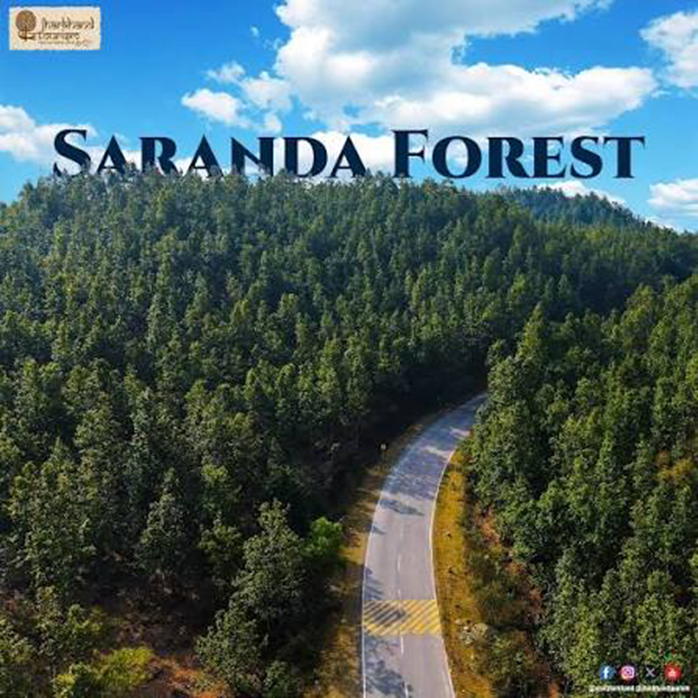
Context:- The Supreme Court has ordered the Jharkhand government to declare 31,468.25 hectares (approx. 314 sq. km.) of the Saranda forest as a wildlife sanctuary, emphasising the State’s statutory duty to protect ecologically significant areas.
About Saranda Forest:
Ecological Profile:
- Location and Topography: Situated in West Singhbhum, Jharkhand, the Saranda Forest Division covers 856 sq km. Its name signifies “seven hundred hills,” reflecting its dense Sal forests and undulating terrain.
- Biodiversity Status: Recognized by the Wildlife Institute of India (WII) as a significant biological and ecological hotspot.
- Wildlife and Connectivity: The forest supports diverse fauna, including elephants and sloth bears. It is critical for ecological connectivity, containing three elephant corridors that link to forests in Odisha.
- Habitat Challenges: Despite past sightings, tigers have not established a resident population, primarily due to habitat fragmentation and human pressure.
- Economic Significance and Ecological Impact of Mining
- Resource Value: The region is highly significant, holding 26% of India’s iron ore reserves. Active mines produce 10–15 million tonnes annually (approx. 5% of India’s total output).
- History of Violations: The Justice M. B. Shah Commission previously investigated the region, uncovering widespread illegal extraction of iron ore and manganese in violation of environmental and mining laws.
Legal Status and Indigenous Rights Considerations
- State Government Position: The Jharkhand government has informed the Supreme Court that it supports a wildlife sanctuary designation, provided the rights of tribals and forest dwellers are fully protected.
- Constitutional and Legal Context: Saranda is a Fifth Schedule area, home to Adivasi communities and Particularly Vulnerable Tribal Groups (PVTGs).
- Legislative Conflict Concerns: The state argued that a sanctuary designation must not criminalize traditional livelihood activities, which would violate the Forest Rights Act (FRA) and the PESA Act, 1996.
About Sal tree:
Overview and Distribution:
- A robust, long-lived (up to 100 years) tree native to India, known as the “Sentinel of the Forests” for its resilience.
- Distribution: Found in Uttarakhand, Uttar Pradesh (Terai), Jharkhand, Odisha, Madhya Pradesh, Chhattisgarh, and West Bengal.
Habitat Requirements
- Climate: Thrives in warm, humid conditions up to 1500m altitude.
- Temperature: Tolerates a wide range (5°C to 45°C).
- Soil & Rainfall: Prefers light, well-drained loamy soil with 1000–3000 mm of annual rainfall.
Pollution Control Functions:
- Particulate Trapping: Thick, waxy leaves capture dust, carbon, and fine particles.
- Gas Processing: High chlorophyll content helps withstand and process harmful gases like CO and SO2.
- Filtration: The dense canopy acts as an effective natural air filter.
