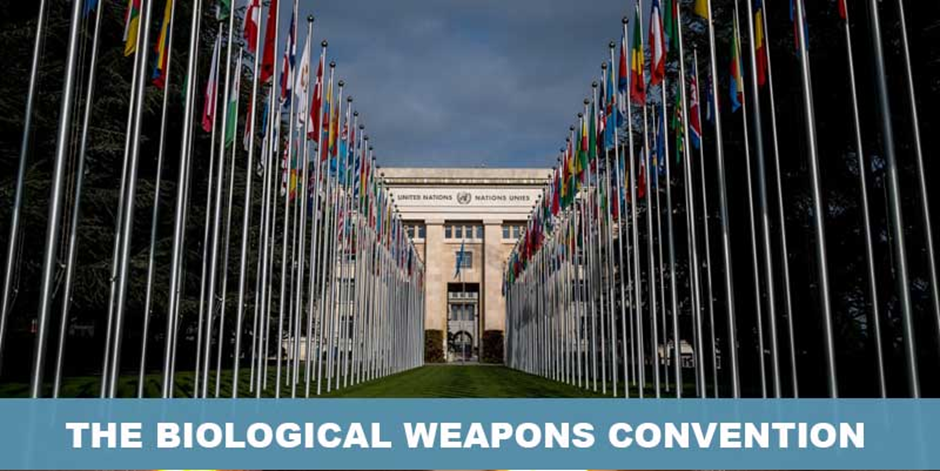
External Affairs Minister S. Jaishankar cautioned that the world remains “not adequately prepared” to counter bioterrorism. & Highlighted rising risks posed by non-state actors using biological agents.
What is the BWC?
Convention on the Prohibition of the Development, Production and Stockpiling of Bacteriological (Biological) and Toxin Weapons and on their Destruction.
- Core Mandate: It acts as the first multilateral disarmament treaty banning an entire category of Weapons of Mass Destruction (WMD).
- Definition of Bio-Weapons: Weapons using disease-causing organisms (bacteria, viruses, fungi, prions) or toxins (animal/plant poisons) to harm humans, animals, or plants.
- Genesis & Timeline:
- Negotiated in Geneva (1969–1971) within the Conference of the Committee on Disarmament (CCD).
- Entered into Force: 1975.
- Membership Status:
- Near Universal: 188 States Parties.
- India: Signed and Ratified in 1974.
- Outliers: A few nations like Israel, Chad, Djibouti, and Eritrea remain outside the full purview (either non-signatories or not ratified).
2. The Mandate:
Prohibitions: Effectively bans development, production, acquisition, transfer, and stockpiling of biological agents.
- Relation to Geneva Protocol (1925): The BWC supplements the 1925 Protocol.
- Note: The 1925 Protocol only banned the use of bio-weapons; the BWC bans possession and development.
- Institutional Support:
- Review Conferences: Held every 5 years to review operations.
- Implementation Support Unit (ISU): Established in 2006 to provide administrative support and assist in universalization.
3. India’s Role:
India ensures compliance through a robust legal and regulatory framework:
- WMD Act, 2005: Weapons of Mass Destruction and their Delivery Systems (Prohibition of Unlawful Activities) Act prohibits unlawful manufacturing, transport, or transfer of WMDs.
- SCOMET List (Trade Control):
- Full Form: Special Chemicals, Organisms, Materials, Equipment and Technologies.
- Function: India’s National Export Control List for dual-use items.
- Relevance: Category 2 of SCOMET specifically regulates micro-organisms and toxins.
- Environmental Rules (1989): Regulates the manufacture and storage of hazardous micro-organisms/genetically engineered cells.
- Global Initiative (Article VII):
- India and France jointly proposed a database to facilitate assistance under Article VII.
- Article VII: Mandates assistance to any State Party exposed to danger due to a violation of the BWC.
4. Why is it termed a ‘Toothless Tiger’?
- The Verification Vacuum:
- Unlike the Chemical Weapons Convention (CWC), the BWC has NO verification mechanism.
- Reason: The Dual-Use Dilemma—biotechnology equipment (e.g., fermenters) used for vaccines can easily be switched to produce bio-weapons, making accounting-based verification difficult.
- Institutional Weakness: The ISU is severely understaffed (only 4 staff members), limiting its operational capacity.
- Data Deficit:
- Relies on Confidence-Building Measures (CBMs) which are politically binding, not legally enforceable.
- Low Compliance: Only ~50% of nations submit CBM reports regularly.
- National Authority Gap: While India has a National Authority for Chemical Weapons Convention (NACWC), it lacks a similarly centralized, dedicated executive body for BWC.
5. Future Roadmap: Strengthening the Shield
- Modular Verification: Adopt an incremental approach using modern scientific tools for verification rather than waiting for a grand treaty overhaul.
- Institutional Expansion: Proposal to appoint a rotating Expert Verification Group under the UN Secretary-General.
- Tech-Driven Compliance: Utilize Artificial Intelligence (AI) and text mining to simplify and universalize CBM submissions.
- Non-State Actors: Integrate BWC protocols with UNSC Resolution 1540 to prevent terrorists from accessing bio-agents.