

Why in the News?
- Despite an increase in non-fossil installed capacity (over 50% as of June 2025), India’s grid carbon emission factor (GEF) has risen, not fallen, making the grid “dirtier” even as the share of renewables increases.
- This paradox brings the focus to the crucial role of energy efficiency in achieving clean energy goals and deep decarbonisation.
- Policymakers and experts are urging urgent expansion of efficiency measures, in line with recent government and international commitments.
Context and Background
- India’s Energy Transition: Progress and Paradox
- As of June 2025, India’s installed power capacity reached 476 GW, with 235.7 GW from non-fossil sources—five years ahead of its Paris Agreement pledge.
- Village electrification is complete, grid connectivity is rising, and India is now among the top 4 globally in both solar and wind installations.
- Despite this, fossil fuels (mainly coal) still dominate actual electricity generated (over 70%), driving up emissions and undermining clean energy gains.
- Policy Context
- India has outlined ambitious decarbonisation targets—reduce emissions intensity of GDP by 33-35% (vs 2005) by 2030 as part of the Paris Agreement.
- Policies such as the Energy Conservation Act (2001), UJALA Scheme, PAT Scheme, National Mission for Enhanced Energy Efficiency (NMEEE), and the recent State Energy Efficiency Index (SEEI) underpin India’s efficiency drive.
- The rapid urbanisation, climate commitments, energy security threats, and frequent power demand spikes frame this discussion.
The Core Challenge: Capacity-Generation Mismatch
- Structural Mismatch
- Installed renewable capacity far exceeds its share in actual annual electricity generation—solar/wind utilization at 15-25% versus 65-90% for coal/nuclear.
- Fossil fuels thus remain the backbone for evening/peak loads and grid stability, locking in emissions.
- The Carbon Emission Factor (GEF) rose from 0.703 tCO₂/MWh (2020-21) to 0.727 tCO₂/MWh (2023-24).
- Capacity vs Generation
| Parameter | Solar/Wind | Coal/Nuclear | Hydro |
| Installed Cap. | High (~50%) | Moderate (~45%) | 22% |
| Annual Utilization | Low (15-25%) | High (65-90%) | Varies |
| Peak Role | Low (daytime only) | Critical (peak/evening) | Flexible |
The Role and Potential of Energy Efficiency
- Meaning and Importance
- Energy efficiency (EE), called the “first fuel,” aims to reduce energy required for the same output, lowering demand, and flattening peaks before new supply must be built.
- EE interventions—efficient appliances, industrial processes, demand management—reduce reliance on coal at critical hours, improve integration of renewables, and drive economic savings.
- Impact (with Data)
- Bureau of Energy Efficiency estimates (2017-2023): 200 million tonnes oil equivalent energy saved, 1.29 GT CO₂ avoided, ₹7.6 lakh crore in savings.
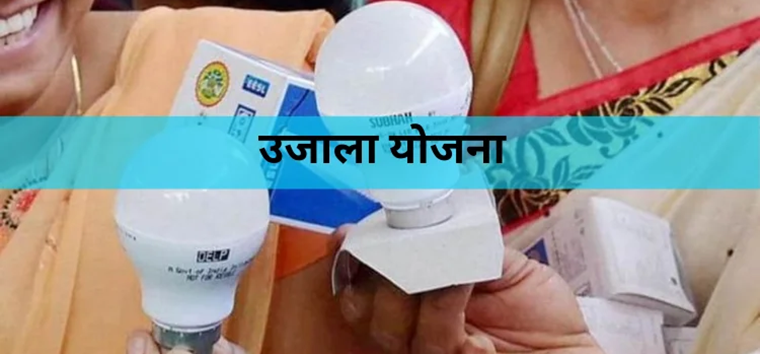
- UJALA scheme: Over 37 crore LED bulbs distributed as of Jan 2025, reducing annual peak demand by >1,500 MW and saving $10 billion in avoided capacity additions (19 coal-fired plants
- States like Maharashtra, Andhra Pradesh, and Kerala lead the State Energy Efficiency Index (SEEI), demonstrating federal best practices.
- Advantages
- Reduces total, peak, and per-unit carbon intensity of power.
- Delays/avoids expensive capacity additions, improves energy security.
- Supports inclusive growth by reducing household and MSME power costs.
Obstacles to Energy Efficiency Expansion
- Technical, Policy, and Social Barriers
- Low market penetration of energy-efficient appliances, especially among MSMEs and low-income households.
- Grid integration: Flexible, smart grid infrastructure and batteries remain under-deployed; renewables still risk being stranded at off-peak times.
- Policy fragmentation, lack of awareness, and inefficient delivery by DISCOMs.
Current Strategies and Government Initiatives
| Scheme/Policy | Objective/Mechanism |
| UJALA Scheme | Mass distribution of LED bulbs, efficient fans & appliances |
| PAT Scheme (BEE) | Emission reduction via tradable energy savings certificates |
| NMEEE | Market-based incentives, R&D, and policy support for EE |
| State Energy Efficiency Index (SEEI) | Competitive benchmarking, encourages state-level accountability |
| Energy Efficiency in Buildings | ECBC Code, mandatory star ratings for household/commercial use |
What More Needs to Be Done: Advanced Policy Pathways
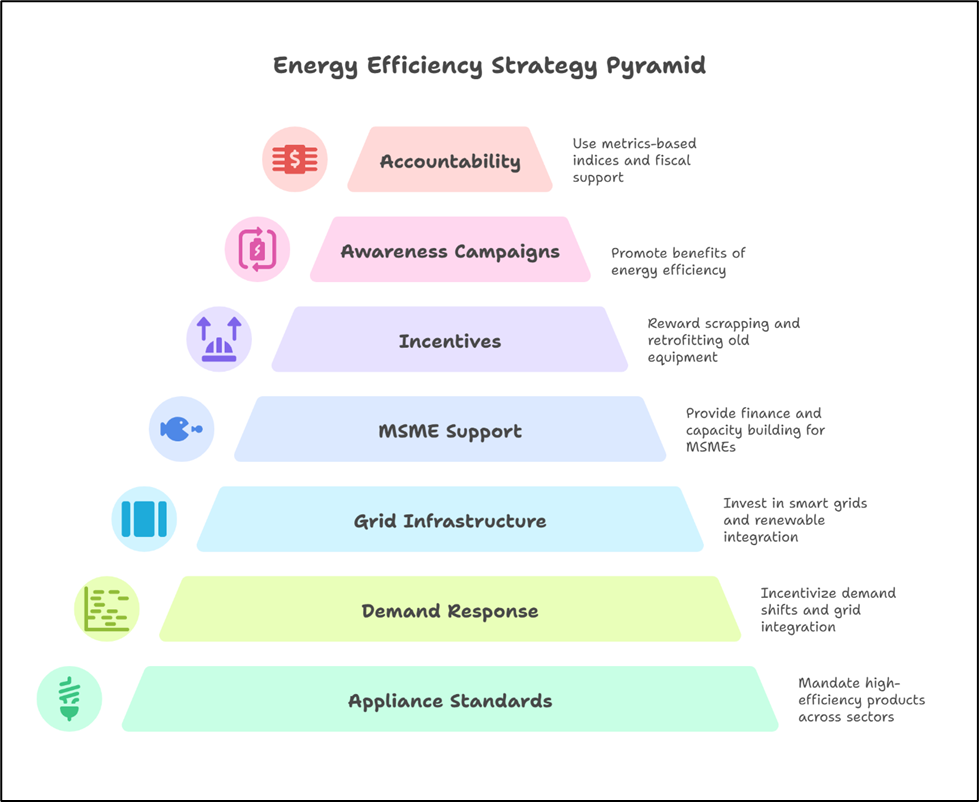
Accelerate Appliance and Equipment Standards
- Mandate & Enforce Star Ratings: All major appliances—air conditioners, refrigerators, fans, motors—should be covered under mandatory, with progressive upgrades to 4- and 5-star benchmarks. Enforcement must shift from voluntary to compulsory registration, especially for energy-intensive sectors.
- Expand Coverage: Star labelling, initially for select appliances, should be widened to include industrial motors, pumps, and commercial kitchen equipment. ECBC (Energy Conservation Building Code) provisions must become standard for all new constructions, beyond just large commercial buildings.
- Periodic Upgradation: Benchmark standards must be reviewed every two years to reflect technology advances and global best practices. For instance, the MTEE arm of NMEEE periodically pushes higher efficiency thresholds and affordable access to efficient products.
- Example: The Super-Efficient Equipment Program (SEEP) facilitated the commercial launch of ultra-efficient fans, which consume 30–50% less energy than average models.
Promote Demand Response & Virtual Power Plants
- Flexible Tariffs: Introduce dynamic pricing (Time-of-Use tariffs) that rewards consumers for using power during periods of renewable surplus. DISCOMs should pilot “Green Tariffs” and net metering for rooftop solar users.
- Grid-connected Batteries: Encourage homes and offices to install distributed battery storage, adding resilience and supporting grid stability during high demand or low renewable supply. These distributed assets can be aggregated as “virtual power plants” to help flatten demand peaks.
- Digital Integration: Implement smart meters nationwide to offer accurate, real-time data, enabling automated demand response and consumer choice.
- Example: Delhi’s pilot with smart meters allowed over 3 lakh consumers to opt for variable tariffs—flattening local peaks and cutting emissions.
Upgrade Grid and Storage Infrastructure
- Smart Grids: Accelerate unified, countrywide rollout of smart grid infrastructure, building on National Smart Grid Mission foundations.
- Transmission Investment: Invest in interstate transmission corridors for integrating solar- and wind-rich regions. This requires upgrading existing substations and transmission lines—critical for supporting RTC (Round-the-Clock) renewable energy integration.
- Energy Storage: Incentivize large-scale deployment of battery energy storage systems (BESS) and pumped hydro to balance intermittent renewables, minimize curtailment, and ensure reliability.
- Example: The Grid-Connected Energy Storage System pilot in Andhra Pradesh supported 1 GW of solar and wind integration, reducing grid curtailment in 2024.
Support for MSMEs and Low-Income Groups
- Access to Finance: Develop and expand “credit lines for energy efficiency” and low-interest green loans via SIDBI, NABARD, and public sector banks. Encourage pooling/bulk procurement to lower costs for MSMEs and village-level enterprises.
- Capacity Building: Extend BEE and EESL’s training programs in regional languages, ensuring MSMEs and rural entrepreneurs understand the benefits and access to EE technologies.
- Dedicated Schemes: Roll out national and state missions targeting MSMEs (such as ADEETIE and MSME Energy Saving Certificate pilots), providing direct subsidies for switching to efficient motors and pumps.
- Example: Under ADEETIE, hundreds of textile and ceramic MSMEs in Gujarat shifted to high-efficiency motors, achieving up to 30% reduction in energy bills
Scrappage and Retrofit Incentives
- Financial Rewards: Launch national-level scrappage policy for outdated, energy-guzzling appliances, offering trade-in bonuses and direct rebates (similar to FAME for vehicles).
- Retrofit Grants: Partner with municipal bodies and utilities to subsidize retrofits of older buildings and replace legacy equipment with high-efficiency alternatives, targeting government facilities as showcases.
- Circular Economy: Encourage recycling of old appliances, in line with the National Manufacturing Mission’s critical minerals policy.
- Example: The Union Budget 2025 waived basic customs duty on lithium-ion battery and cobalt scrap to catalyze the domestic recycling industry, supporting appliance upgrades.
Behavioural Change Campaigns
- Mass Communication: Regular, large-scale drives (similar to UJALA) using digital platforms, television, and local outreach to educate citizens, SMEs, and schools about energy-saving habits.
- Institutional Partnerships: Labs, NGOs, and student groups should spearhead grassroots campaigns, with national recognition for successful state and community programs.
- Nudges & Incentives: Use bill nudges, green points, and rewards in utility bills to gamify and incentivize behaviour change.
- Example: UJALA’s scheme distributed over 37 crore LED bulbs; aggressive marketing and awareness led to LED prices dropping from ₹310 to ₹40, driving mass adoption.
Robust Monitoring and State Accountability
- Energy Efficiency Index: Institutionalize the State Energy Efficiency Index (SEEI), tying central energy allocations and fiscal support to state performance. Ratings should be public and updated annually.
- Integrated Data Systems: Develop online dashboards (like BEE’s Urja Dakshata Tool) for real-time tracking of sector-wise energy savings, compliance, and program outcomes.
- Incentivize Leadership: Fast-track rewards, extra funding, and technology access for high-performing states and districts.
- Example: Under SEEI, leading states such as Maharashtra, Andhra Pradesh, and Kerala received additional central funds for exceeding EE benchmarks, showcasing competitive federalism.
Terms & Concepts
| Term | Explanation |
| Energy Conservation Act (2001) | Legislative base for national energy efficiency action |
| Perform, Achieve & Trade (PAT) | Market-based tradable certificate scheme for large industries |
| ECBC | Energy Conservation Building Code for buildings |
| State Energy Efficiency Action Plans (SEEAPs) | State-level blueprints under SEEI |
| Grid Emission Factor | Carbon emission per MW/h—core indicator of grid greenness |
| Round-the-Clock Renewables | Renewable sources able to supply power 24×7 |
Conclusion
India’s energy transition cannot rely on supply-side measures alone. In a context of rising demand, fossil dominance, and climate urgency, efficiency is the most available, reliable, and cost-effective tool. Deepening regulatory, financial, and structural support for energy efficiency—across industries, buildings, transport, and MSMEs—is imperative.
International evidence and local data show that large-scale energy savings are possible with focused policy, innovation, and behavioral change. India’s success in energy efficiency will determine whether its green power revolution delivers both growth and deep decarbonisation.
UPSC CSE PYQ
| Year | Question |
| 2018 | “Access to affordable, reliable, sustainable and modern energy is the sine qua non to achieve Sustainable Development Goals (SDGs).” Comment on the progress made in India in this regard. |
| 2018 | “With growing energy needs should India keep on expanding its nuclear energy programme? Discuss the facts and fears associated with nuclear energy.” |
| 2025 | “Write a review on India’s climate commitments under the Paris Agreement (2015) and mention how these have been further strengthened in COP26 (2021). In this direction, how has the first Nationally Determined Contribution (NDC) intended by India been updated in 2022?” |