
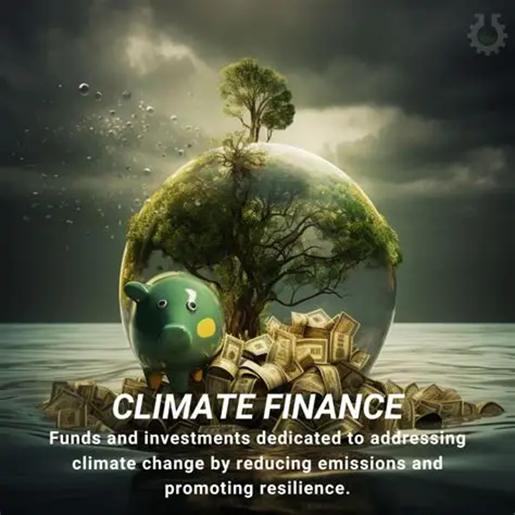
What is Climate Finance?
- Climate finance is all funding specifically directed at combating climate change—through projects, investments, loans, or grants for both reducing emissions (mitigation) and building resilience (adaptation).
- It comes from governments (central/state), private companies, foreign aid, climate-focused banks, and multilateral agencies.
Why Does India Need Climate Finance?
- India faces frequent floods, droughts, cyclones, and heatwaves—making climate spending a necessity, not a luxury.
- Ambitious national targets: Net Zero by 2070, 50% energy from clean sources by 2030, emission intensity to fall 45% by 2030.
- Estimated total requirement: US$2.5 to 3 trillion by 2030 to meet all national climate commitments.
Key Sources of Climate Finance
a) Government Funds (Public Sector)
- Union Budget, National Clean Energy Fund, and National Adaptation Fund for Climate Change.
- Innovative state-level budget tagging—for example, Kerala and Odisha separate climate/adaptation spending in annual plans.
b) Private Sector Funds
- Domestic banks and NBFCs (HDFC, SBI, SIDBI financing green projects).
- Private equity, corporate green bonds (ReNew Power, Tata Cleantech).
c) International Finance
- Major climate funds: Green Climate Fund (GCF), Global Environment Facility (GEF), World Bank, Asian Development Bank.
- Example: GCF funded solar microgrids in rural Andhra Pradesh; World Bank’s $500M adaptation fund for cyclone-hit coasts.
d) Blended and Innovative Finance
- Combining public and private funds to reduce risk—used in solar parks, climate-resilient agriculture projects.
- Social/impact bonds to support climate health or water projects.
Where Does Climate Finance Go?
| Sector | Example Projects / Focus Areas |
| Clean Energy | Solar parks (Rewa, Bhadla), wind projects (Gujarat, Tamil Nadu), bioenergy |
| Transport | Electric buses (Delhi, Mumbai), FAME incentives for EVs, metro rail |
| Industry | Energy-efficient upgrades in steel/cement, green building retrofits |
| Urban Infrastructure | Stormwater drains, coastal protection, urban green zones |
| Agriculture | Micro-irrigation, drought-resilient seeds (Punjab, Maharashtra) |
| Adaptation | Cyclone shelters (Odisha), flood management, health and water security |
| Innovation/MSMEs | Tech incubators, microfinance, farmer producer organizations |
Major Challenges of Climate Finance in India

1. Massive Funding Gap
- Description: The scale of finance needed (up to $2.5–3 trillion by 2030) far exceeds the current annual flow (about $50 billion). Most funding is for mitigation (solar, wind), while adaptation (floods, droughts, farmers) is heavily underfunded.
- Example: Assam and Odisha face regular floods, but adaptation finance to improve embankments and climate-resilient agriculture in these states is a tiny fraction of energy investments.
2. Low Private Sector Participation & Risk Aversion
- Description: Private investors are reluctant due to long payback, unclear policy, lack of credit guarantees, and complex project appraisal.
- Example: MSMEs and FPOs (Farmer Producer Organizations) in rural India struggle to borrow for solar, micro-irrigation, or biogas—data from SIDBI shows less than 10% of “green” funds reach these groups.
- Example: Professional climate bonds for large clean energy developers (like ReNew Power) attract global funds, but not for rural solar or adaptation.
3. Data, Measurement, and Tracking Gaps
- Description: Lack of reliable, project-level data and transparent reporting makes it hard to assess impact, avoid duplication, or reach the most vulnerable.
- Example: RBI’s new CRIS (Climate Risk Information System) was launched in 2025 to fix this, but most state/district projects still have poor or delayed reporting.
4. Institutional and Regulatory Fragmentation
- Description: Climate finance rules, approvals, and roles are split across central ministries (finance, power, environment), RBI, SEBI, state governments.
- Example: A 2023 Rajasthan solar project was delayed over clearance disputes between state and central authorities and confusion over “green” classification.
5. Greenwashing and Loose Definitions
- Description: Some projects are labeled ‘green’ or ‘climate-adaptive’ for marketing but don’t deliver real carbon reduction or resilience.
- Example: SEBI’s 2024 green bond tightening came after bond proceeds were misused by a large infrastructure company to fund standard metro, not a low-carbon upgrade.
6. Weak Access to International Finance
- Description: Attracting climate FDI is hard due to regulatory friction, documentation, currency risk.
- Example: World Bank’s $1B adaptation funding for Indian coastal resilience required multiple years of negotiation, demonstrating how slow “blended” finance can be in practice.
Best Practices in Climate Finance (India & International)
- Global Best Practices
- EU Green Taxonomy: Scientific, unambiguous classification of ‘green’ projects has set a global standard for credibility in climate finance, now guiding India’s taxonomy.
- Caribbean Catastrophe Risk Insurance Facility: Regional pool funds that pay out rapidly after hurricanes/cyclones, preventing post-disaster liquidity crises. India can adapt this for vulnerable coastal states.
- UK Green Investment Bank: Publicly-backed entity focused on crowding in private money for renewable energy and efficiency projects; facilitates high-risk and early-stage investments.
- China’s Green Credit Policy: Banks are mandated to lend a portion of their portfolio to green projects, backed by government risk-sharing—a tool for scaling finance to MSMEs and rural areas.
- Indian Best Practices
- Climate Budget Tagging in Odisha and Kerala: Every budget line (adaptation/mitigation) is tracked for impact, improving transparency and fund targeting.
- Draft Climate Finance Taxonomy (2025): For the first time, India has a system to prevent greenwashing and boost investor confidence.
- Digital Monitoring (Rewa Solar Park): Real-time dashboards track generation, finance, and climate impact—now being scaled to other projects.
- Resilience Bonds Pilots: Indian insurance companies have begun piloting region-focused ‘resilience bonds’ to protect vulnerable towns from extreme weather.
Way Forward
1. Mobilize and Diversify Flows
- Expand blended finance tools—government-backed guarantees, first-loss mechanisms for risky but high-impact projects.
- Example: Maharashtra’s Drought Impact Bond, combining public money and impact investment, funds water-saving tech for farmers.
- Launch state-level “Green Infrastructure Funds” to speed up adaptation and clean energy rollouts at the local level.
2. Fix Data, Tracking, and Impact Measurement
- Mandate district-level reporting on all public/private climate finance; use digital tools for real-time transparency.
- Example: Odisha’s climate budget portal and RBI-CRIS should be linked for seamless tracking.
- Require all climate bond issuers to publish third-party-verified impact reports.
3. Prioritize Adaptation and Social Equity
- Set “adaptation minimums” for all major public finance programs (e.g., 30% to flood/cyclone resilience, health, water security).
- Example: Kerala’s adaptation funds focus explicitly on women’s groups and smallholder farmers to ensure equity.
- Launch regional insurance schemes for disaster-hit populations, modeled on the Caribbean’s catastrophe pools.
4. Scale Private and International Investment
- Provide tax incentives for private investments in adaptation, SME green loans, and resilience infra.
- Harmonize state and central rules for faster approvals and reduced regulatory delays.
- Example: Telangana’s “Single Window Clearance” for green project loans reduced average approval times for solar micro-enterprises by 50%.
5. Build Local and Institutional Capacity
- Train state/district officials and SHGs/FPOs in proposal writing, climate finance mechanisms, and project management.
- Example: TREC-STEP’s incubator in Tamil Nadu offers technical assistance to women entrepreneurs adopting climate-resilient tech.
- Develop more public-private knowledge hubs for climate finance literacy and innovation.
6. Align with Global Standards and Partnerships
- Operationalize India’s taxonomy fully and update with global best practices regularly.
- Engage actively in UNFCCC finance discussions; negotiate stronger technology/finance transfers from developed nations.
- Example: Ongoing India-EU “Sustainable Finance Dialogue” brings technical expertise to taxonomy development.
Conclusion
Climate finance is the key ingredient for India’s green and resilient future. Every rupee spent should be well-tracked, make a real impact, and build confidence for more private and foreign investors. By bridging funding gaps, scaling adaptation, ensuring better data, fostering innovation, and making use of both Indian and global best practices, India can guarantee climate safety, equity, and prosperity for every citizen.
UPSC CSE PYQ
| Year | Question |
| 2021 | Describe the major outcomes of the 26th session of the Conference of the Parties (COP) to the UNFCCC. What are the commitments made by India in this conference? |