

Why in the News?
Recent advancements in Artificial Intelligence (AI) have increasingly shifted frontier research from public institutions to large private corporations. Breakthroughs once driven by universities and publicly funded laboratories now often rely on private cloud infrastructure, vast computing resources, and proprietary datasets controlled by a few technology companies.
This growing corporate control over essential research infrastructure has raised important concerns:
- Who owns the outputs of publicly financed research when it is developed using private infrastructure?
- How can equitable access, scientific transparency, and public benefit be ensured?
- What policy framework is needed to maintain openness and accountability in such research?
Background / Context
- Over the years, public funding and academic expertise have laid the foundation for major AI and machine learning breakthroughs. However, deploying and scaling these ideas increasingly depend on privately owned data centres, cloud systems, and specialised hardware such as GPUs and TPUs.
- This dependence shifts scientific control from open academic spaces to closed corporate environments. While theoretical work may still originate in universities, training and deployment of large models—such as those developed by OpenAI, Google DeepMind, and others—take place on private servers.
- As a result, public contributions to innovation risk becoming locked behind corporate structures, altering how knowledge is produced, shared, and governed.
Key Issues and Implications
1. Publicly Funded Research Locked Behind Private Infrastructure
- Public funds often support early theoretical work, fellowships, and datasets. However, large-scale training and implementation depend on corporate compute power.
- This leads to a situation where publicly funded research outputs are not fully accessible to the public.
2. Erosion of Reproducibility and Scientific Openness
- Reproducing frontier AI research now requires enormous computing power and proprietary tools that most academic institutions cannot access.
- This undermines the scientific principle of reproducibility and creates an imbalance between public and private research capacity.
3. Concentration of Power and Skewed Research Priorities
- Corporate control over compute and datasets centralizes decision-making about what problems get solved and for whom.
- Research tends to focus on commercially lucrative applications rather than socially critical areas like healthcare accessibility or local-language AI models.
4. Weak Accountability and Public Benefit Mechanisms
- Companies may justify withholding research artifacts (like model weights) under claims of “responsible release,” reducing transparency.
- Without contractual or policy obligations, public institutions cannot ensure that taxpayer-funded research delivers societal benefits.
Arguments for Public Access and Policy Principles
Case for Public Access
- Publicly funded research must yield public returns.
- Data, code, model weights (where appropriate), and benchmarks should be shared through open-access frameworks.
- Public agencies should make openness a condition for grants, funding, and collaborations.
Reducing Bottlenecks
- Structural advantages held by corporations due to private compute access must be reduced.
- Governments should fund shared computing resources (national or regional clusters) for academia, nonprofits, and startups.
Balancing Openness and Safety
- Distinguish between commercial and scientific use cases.
- Where full openness poses risks, controlled release and third-party audits can maintain safety without secrecy.
Stakeholder Responsibilities and Levers
| Stakeholder | Key Concern | Policy Levers / Actions |
| Public Agencies | Ensure public benefit from grants | Include openness clauses in funding and procurement; fund public compute infrastructure |
| Universities & Research Labs | Reproducibility and recognition | Provide subsidized compute access; mandate open data and code |
| Private Corporations | Commercial competitiveness | Incentivize openness through tax benefits or preferential procurement |
| Civil Society | Transparency and accountability | Promote independent audits and open reporting frameworks |
| Journalists & Watchdogs | Validation of claims | Mandate disclosure of compute budgets, data usage, and evaluation standards |
Challenges
- Balancing Public Good with Private Incentives
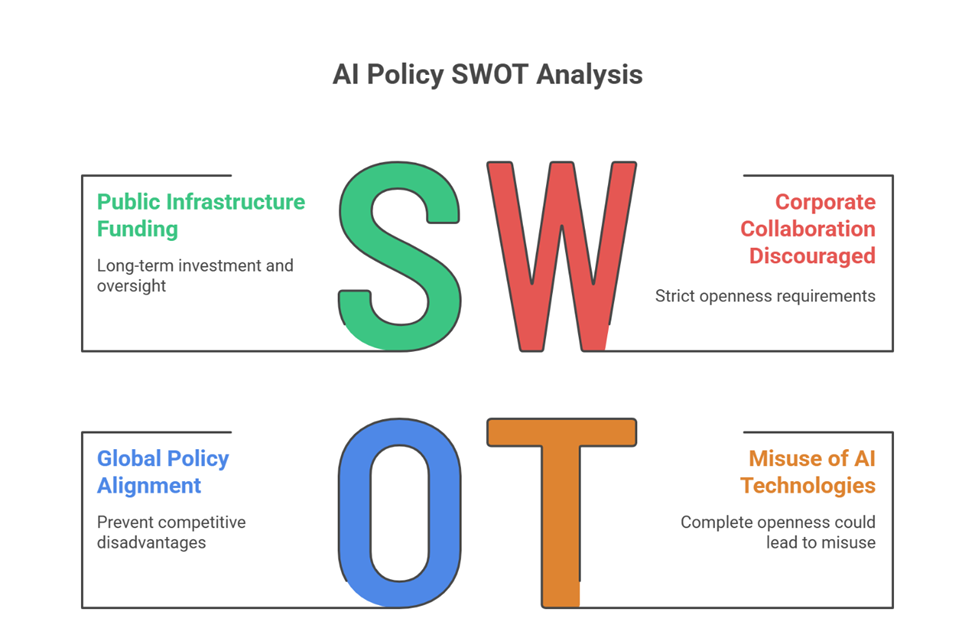
- Overly strict openness requirements may discourage corporate collaboration or investment.
- Safety and Dual-Use Risks
- Complete openness could lead to misuse of AI technologies.
- Controlled or tiered release mechanisms are required.
- Funding and Governance of Public Infrastructure
- Establishing and maintaining shared compute systems requires significant long-term investment and oversight.
- Global Coordination
- Technology markets are global; policies must align internationally to prevent competitive disadvantages or duplication.
Way Forward
- Open Access Mandates: All publicly funded AI research should publish datasets, benchmarks, and, where possible, model details for verification and reuse.
- Public Compute Commons: Develop shared cloud platforms and supercomputing facilities accessible to academia and public-interest organizations.
- Conditional Funding and IP Regulations: Attach conditions to government grants that require open licensing or affordable access for public benefit.
- Transparent Benchmarks and Audits: Establish independent centres to test and verify AI systems’ claims, promoting scientific accountability.
- Public–Private Collaboration for Public Good: Encourage corporate partnerships where firms contribute resources, datasets, or compute credits to the public research ecosystem.
- Promoting Research Diversity: Support smaller labs, domain-specific institutions, and developing-country researchers to prevent monopolization of innovation.
Conclusion
The intersection of public knowledge and private infrastructure represents a defining challenge for the future of science and technology governance. While private firms have enabled remarkable progress in AI, unchecked concentration of research resources risks turning publicly funded discoveries into private assets.
Ensuring that publicly financed knowledge remains accessible, reproducible, and accountable requires thoughtful policy design — combining open-access mandates, shared computing infrastructure, and balanced regulatory safeguards.
Ultimately, the goal should be to reaffirm a simple principle: publicly supported science must produce public benefit. By aligning incentives, transparency, and collaboration, societies can ensure that innovation remains both inclusive and equitable in the age of corporate-driven research.
UPSC CSE PYQ
| Year | Questions |
| 2014 | Scientific research in Indian universities is declining, because a career in science is not as attractive as business professions, engineering, or administration, and the universities are becoming consumer-oriented. Critically comment. |
| 2015 | Discuss the advantage and security implication of cloud hosting of servers vis-a-vis in-house machine-based hosting for government business. |
| 2015 | India’s Traditional Knowledge Digital Library (TKDL) which has a database containing formatted information on more than 2 million medicinal formulations is proving a powerful weapon in country’s fight against erroneous patents. Discuss the pros and cons of making the database publicly available under open-source licensing. |