
Introduction
Precision medicine refers to tailoring medical treatment based on an individual’s genetic, molecular, environmental, and lifestyle profile. It is emerging as one of the fastest‑growing frontiers in healthcare, transforming disease diagnosis, drug development, and personalised therapies.
Global Market Overview
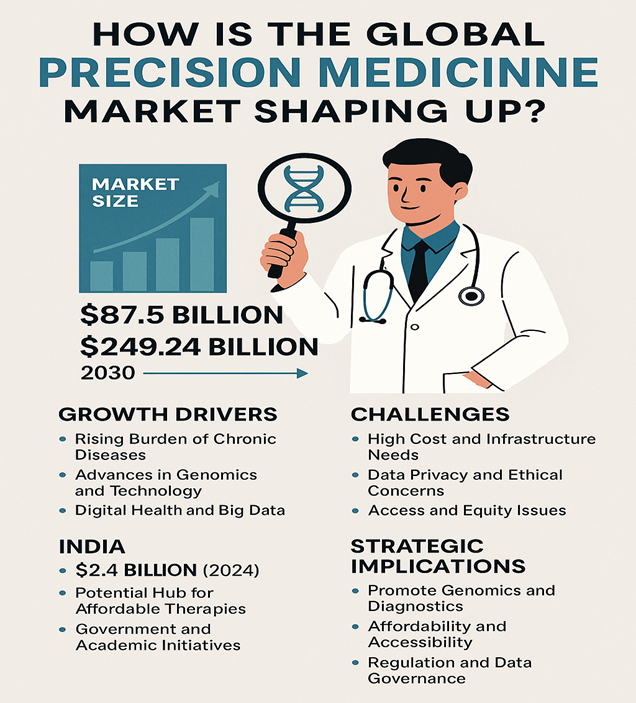
- Global market size (2023): ~USD 87.5 billion.
- Projected market size (2030): ~USD 249 billion.
- CAGR: 13–16%.
- North America leads (>50% share), while Asia‑Pacific is the fastest-growing region.
- Drivers include genomics, AI, big data, cancer therapeutics, and biomarker‑based diagnostics.
Why the Global Market is Growing
- Rising global burden of NCDs such as cancer, diabetes, cardiovascular diseases.
- Rapid reduction in genomics sequencing costs.
- AI and machine learning enabling advanced molecular analysis.
- Growth of digital health infrastructure.
- Expansion of targeted therapies and companion diagnostics.
- Strong policy support in major economies like the U.S., EU, Japan, and South Korea.
Challenges and Risks
- High cost & infrastructure requirements: Precision medicine often involves expensive diagnostics, data-analytics set-ups, specialised therapies — which many low/middle-income countries (LMICs) may struggle with.
- Data-privacy, ethical & regulatory issues: Massive personal/genetic data collection raises issues around consent, privacy, security. The regulatory regimes in many countries are still evolving.
- Access & equity issues: There’s a risk that precision medicine could widen healthcare inequalities — only affluent patients or countries may benefit initially.
- Clinical translation lag: Although many diagnostics/therapies exist in research, translation into routine clinical care at scale and cost-effectively remains a barrier.
- Workforce & skills gap: Need for trained genomics, bioinformatics, genetic-counselling professionals.
- Evolving business-models: For emerging economies, designing viable models (public-private, insurance integration) is non-trivial.
India’s Position
- Indian precision medicine market (2024): ~USD 2.4 billion.
- Market expected to reach ~USD 7.3 billion by 2034.
- India has unique advantages:
- Large and genetically diverse population.
- Cost‑effective biotech and pharmaceutical ecosystem.
- Growing digital health infrastructure (ABDM, e‑health records).
- India is emerging as a major hub for genome sequencing, low‑cost diagnostics, and bioinformatics.
Strategic Implications for India — What should be done?
- Promote genomics & diagnostics infrastructure: Strengthen centres of excellence, public-private partnerships, subsidise sequencing/diagnostic costs, build bio-databases.
- Regulation & data governance: Establish clear regulatory frameworks for genomic data privacy, ethics of targeted therapies, insurance coverage of precision approaches.
- Affordability & access: Design business/model innovations so precision medicine is not limited to elite – e.g., tiered pricing, generic/stat-based models, inclusion in public health programmes.
- Workforce capacity-building: Train healthcare professionals, bioinformaticians, genetic counsellors.
- Research & indigenous innovation: Promote domestic R&D, reduce dependency on imported technologies, utilise India’s genetic diversity for local innovation.
- Integration into public-health: Use precision medicine not just for advanced therapies but also to stratify risk in populations (preventive genomics), early detection programmes, targeted screening.
- Global collaboration: Engage in global consortia, licencing, technology-transfer – position India as not just a recipient but a contributor/innovator.
Policy Recommendations
- Create a national precision medicine roadmap.
- Strengthen genomic data governance and privacy laws.
- Subsidise advanced diagnostics to ensure equitable access.
- Invest in genomics research, biobanks, and AI platforms.
- Build a skilled workforce in genetic counselling and bioinformatics.
- Encourage Make‑in‑India manufacturing of precision diagnostics and tools.
Conclusion
Precision medicine is reshaping the future of healthcare globally. For India, it presents both a technological opportunity and a public‑health necessity. With the right regulatory, scientific, and investment ecosystem, India can position itself as a global leader in affordable precision therapeutics and diagnostics.