
Context: External Affairs Minister S. Jaishankar met Qatar’s Amir/PM in Doha to discuss strengthening strategic cooperation.
Why Qatar Matters for India
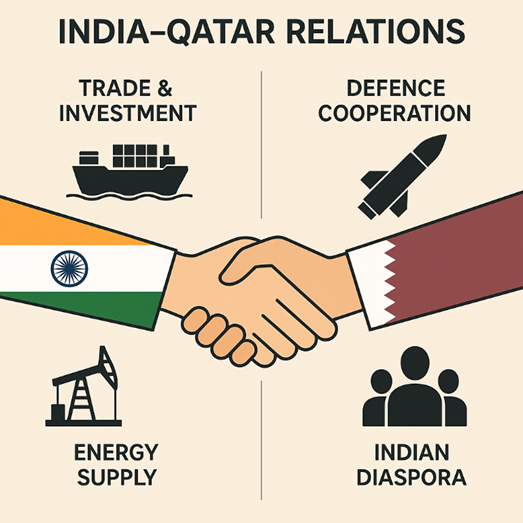
(a) Energy Security
- Qatar is India’s largest LNG supplier, with long-term commitments to supply 7.5 million tonnes per year starting 2028—critical for India’s energy transition and gas-based economy ambitions.
(b) Trade & Investment
- India–Qatar have been working to upgrade to a “strategic partnership” with a goal to double trade to USD 28 billion (Drishti IAS).
- Qatar Investment Authority (QIA) is a significant investor in Indian infrastructure, startups, and utilities.
(c) Indian Diaspora
- Qatar hosts ~800,000 Indians, contributing significantly in remittances and skilled labour markets.
- Welfare of expatriates is a critical pillar of bilateral diplomacy.
(d) Defence and Security
- Mutual defence cooperation, joint exercises, port calls, and security coordination with the Gulf region are rising priorities.
- ForumIAS notes defence ties are a significant dimension of the relationship, including cooperation on counter-terrorism and maritime security.
(e) Geopolitical Importance
- Qatar’s role in the Gulf Cooperation Council (GCC), its strategic gas reserves, mediation diplomacy (e.g., regional crises), and its relations with US/Iran make it central to India’s ‘Act West Policy’.
Key Themes Discussed in the Meeting
(A) Energy Cooperation
- Strengthening LNG partnerships and exploring long-term pricing stability.
- Potential collaboration in green hydrogen, renewables, and energy transition.
(B) Strategic Partnership Expansion
- Both sides emphasised expanding “strategic ties,” as mentioned in ToI reporting.
- Includes defence, digital cooperation, cybersecurity, and maritime security.
(C) Trade and Investment
- Efforts to attract Qatari sovereign wealth into Indian infrastructure, manufacturing, and digital sectors.
(D) Diaspora Protection and Labour Mobility
- Ensuring safety and welfare of the large Indian workforce—including labour law reforms, visa/contract support.
(E) Regional Dynamics
- West Asian security, Iran–GCC dynamics, Israel–Gaza tensions, and shipping security in the Persian Gulf.
CHALLENGES IN INDIA–QATAR RELATIONS
1. Regional Instability in West Asia
- The Gulf region remains fragile due to Iran–Saudi tensions, Israel–Gaza conflict, and Red Sea instability.
- Any escalation affects energy shipments, diaspora safety, and trade routes.
2. Energy Security Vulnerability
- India depends heavily on Qatar for LNG.
- LNG prices are volatile; renegotiating long-term contracts is complex.
- Competition from China, Japan, and Europe could reduce India’s bargaining power.
3. Labour Welfare and Human Rights Concerns
- 8 lakh Indians work in Qatar (construction, services, hospitality).
- Issues: contract violations, wage withholding, passport confiscation, living conditions.
- Although reforms have been introduced, implementation remains inconsistent.
4. Overdependence on a Single Sector (Energy)
- Relationship still heavily tilted toward LNG imports.
- Need diversification into strategic sectors: digital, defence, startups, food security.
5. Limited Strategic Convergence
- Qatar maintains independent foreign policy often diverging from Indian positions.
- Example:
- Qatar’s closeness with Turkey and certain Islamist groups may occasionally affect strategic alignment.
- Its mediation roles (Taliban–US talks) have mixed strategic implications.
6. Geopolitical Balancing by Qatar
- Qatar must balance relations with U.S., Iran, Turkey, and GCC states.
- This “multi-vector diplomacy” sometimes complicates India’s strategic expectations.
7. Diaspora Issues & Legal Cases
- Isolated legal cases involving Indian citizens can quickly become diplomatic flashpoints.
- Labour disputes and delayed justice affect community morale and require continuous intervention.
8. Slow Progress on Defence Cooperation
- Defence ties exist but lag behind India’s partnerships with UAE, Saudi Arabia, Oman.
- Limited joint exercises and defence exports.
9. Trade Barriers & Bureaucratic Hurdles
- Qatar’s regulatory system is evolving; visa, labour, and investment approvals often take time.
- Indian businesses face challenges in taxation clarity, standards, and compliance requirements.
10. Competition from Other Gulf Countries
- UAE, Saudi Arabia, and Bahrain are aggressively courting investment and partnerships.
- India risks Qatar partnerships being overshadowed by stronger ties with these regional heavyweights.
UPSC MAINS PYQ
“Discuss the significance of India’s relations with Gulf countries in the context of its foreign policy objectives, regional stability, and economic interests. Highlight the strategies adopted by India to strengthen its engagement with the Gulf region.” 2023