
Conceptual Framework:
- Definition: A telecommunications network providing global internet connectivity via orbiting satellites, bypassing traditional terrestrial infrastructure (cables and towers).
- Core Objective: To bridge the digital divide by delivering high-speed, reliable access to remote, rural, and underserved regions.
Operational Mechanism
- Constellation Network: Utilizes a mesh of interconnected satellites to ensure continuous coverage.
Signal Relay:
- Uplink: User terminals transmit data to the nearest satellite.
- Processing: Satellites relay signals to other satellites (inter-satellite links) or directly to Earth-based gateways.
- Downlink: Ground stations connect the satellite signal to the global terrestrial internet backbone.
- resilience: Offers robust connectivity that remains operational during natural disasters when ground infrastructure is compromised.
Orbital Classifications
Low Earth Orbit (LEO)
- Altitude: 180 km – 2,000 km.
- Characteristics: Low latency and high speed due to proximity to Earth. Requires large constellations (thousands of satellites) for continuous coverage.
Geostationary Orbit (GEO)
- Altitude: ~35,786 km (matches Earth’s rotation).
- Characteristics: Provides wide-area coverage with fewer satellites (stationary position). Suffers from high latency (>500 ms), impacting real-time applications like gaming.
The Indian Landscape
- ISRO’s Role: Deployment of high-throughput communication satellites (e.g., GSAT series) to strengthen national telecommunication infrastructure.
- Private Sector Entry: Collaboration with global players (e.g., OneWeb) to deploy satellite constellations targeting rural connectivity.
- Policy Integration: Aligns with the Digital India initiative to ensure broadband accessibility in geographically difficult terrains (Himalayas, North-East India).
Challenges and Limitations
- Capital Intensity: High costs associated with satellite manufacturing, launching, and constellation maintenance.
- Space Debris: Proliferation of LEO satellites increases the risk of collision and orbital debris (Kessler Syndrome).
- Technical Hurdles: Susceptibility to signal attenuation due to weather or physical obstructions (dense urban areas, mountains).
- Regulatory Complexity: Challenges in international spectrum allocation and frequency management.
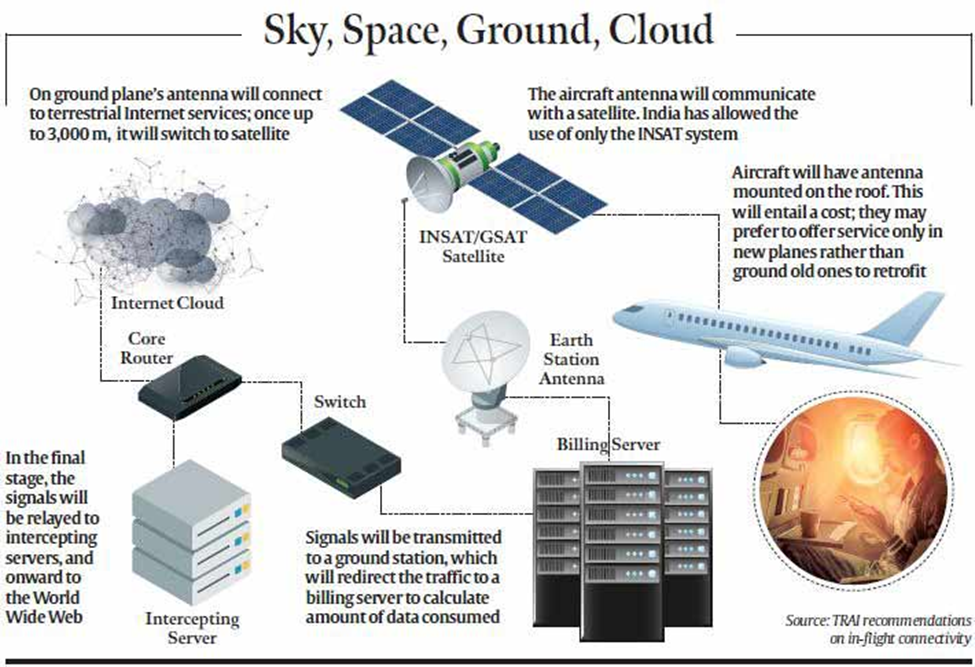
Mechanisms of In-Flight Connectivity:
Internal Cabin Architecture
- User Interface: Passengers connect personal devices to wireless access points distributed throughout the cabin.
- Signal Aggregation: Data is routed from these access points to a central onboard server, which manages the connection between the aircraft and external networks.
External Transmission Technologies
Air-to-Ground (ATG) Systems
- Infrastructure: Utilizes antennae mounted on the ventral (belly) fuselage to establish a link with terrestrial cellular towers.
- Operational Scope: Functions similarly to terrestrial mobile networks; connectivity remains stable provided the aircraft is within the line of sight of ground infrastructure.
- Limitations: Service is disrupted over large bodies of water, remote terrain, or regions with sparse tower density.
Satellite-Based Systems
- Infrastructure: Employs dorsal (top-mounted) antennae to communicate with geostationary or orbiting satellites.
- Operational Scope: Facilitates ubiquitous coverage, ensuring connectivity over oceans and remote geographical areas where ground towers are absent.
- Market Trend: Adoption is increasing due to superior reliability and global reach compared to ATG systems.
Data Transmission Pathways
Satellite Protocol:
1. The onboard server transmits data to the dorsal antenna.
2. Signals are relayed to an orbiting satellite.
3. The satellite forwards the data to a ground station (teleport) for internet access, with the response following the reverse trajectory.
ATG Protocol:
1. The onboard server routes data to the ventral antenna.
2. Signals are transmitted directly to the nearest ground-based cellular tower.
3. The tower processes the request and returns data to the aircraft.
Performance and Outlook
- Current Constraints: Bandwidth and latency currently lag behind standard terrestrial broadband.
- Technological Trajectory: Ongoing advancements in satellite throughput and network infrastructure are progressively enhancing connection speeds and stability.