
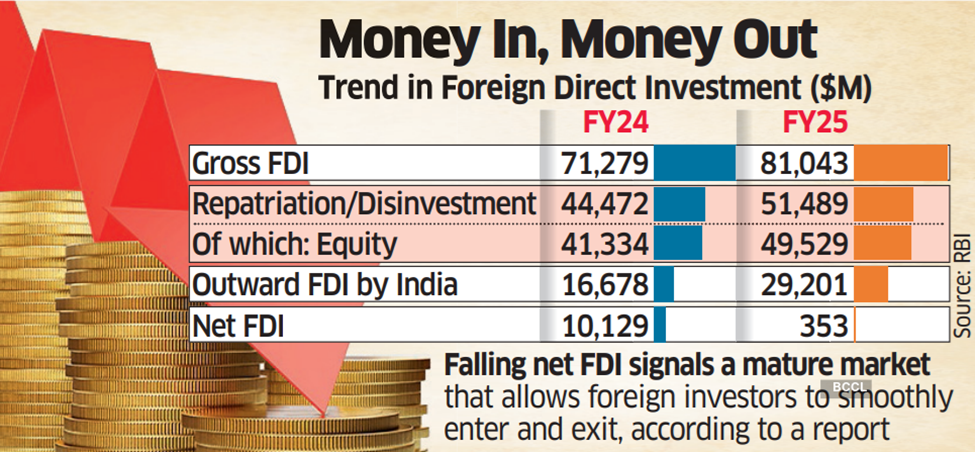
Context: For the second consecutive month (September 2025), India recorded a Negative Net Foreign Direct Investment (FDI).
Conceptual Framework and Regulation
- Definition: FDI refers to investment through equity instruments by a non-resident entity in an unlisted Indian company, or 10% or more of the paid-up equity capital in a listed Indian company.
- Regulatory Architecture: Governed by the Consolidated FDI Policy (2020) and FEMA (Non-Debt Instruments) Rules, 2019.
Gross vs. Net FDI:
- Gross FDI: Total direct investment inflows into productive assets.
- Net FDI: Gross Inflows minus Outflows (Repatriation of profits + Outward Direct Investment by Indian firms).
Investment Routes and Prohibitions
- Automatic Route: No prior approval required from the RBI or Government. Currently, 90% of FDI enters via this route.
- Permitted Sectors: Agriculture, Telecom, Oil & Gas, Airports (Greenfield), Industrial Parks, etc.
- Government Route: Mandatory prior approval required to ensure compliance with specific conditions.
- Prohibited Sectors: Lottery, Gambling/Betting (including casinos), Chit Funds, Nidhi Companies, and sectors closed to private players (e.g., Atomic Energy, Railway Operations).
Strategic Significance of FDI
- Non-Debt Capital: Serves as a sustainable, long-term financial resource that facilitates technology transfer and strategic development.
- Economic Stability: Bolsters forex reserves; as of May 2025, reserves cover 11+ months of imports and 96% of external debt (RBI Bulletin).
- Greenfield Growth: Capital expenditure in greenfield projects is projected to rise by ~25% to USD 110 billion in 2024 (UNCTAD WIR 2025).
- Sustainable Finance: India leads as the largest issuer of carbon credits in the Verra Registry.
Analysis: Reasons for Declining Net FDI
- Despite robust gross inflows, Net FDI has faced downward pressure due to:
- Surge in Outward Investment (ODI): Indian entities are investing globally, aided by liberalized Overseas Direct Investment (ODI) guidelines (2022). FY25 saw Indian ODI rise to $12.5 billion.
- Increased Repatriation: Higher profit-booking and exit by foreign investors indicate a maturing market cycle.
Global Headwinds:
- Geopolitical Tension: Rising trade tariffs (specifically by the USA) and weak global demand.
- Global Decline: Worldwide FDI contracted by 11% (YoY) in 2024.
Government Interventions and Reforms
- Sectoral Liberalization: Increased FDI caps in strategic sectors (e.g., Union Budget 2025 raised Insurance sector FDI to 100%).
- Regulatory Ease: The Jan Vishwas Act, 2023 decriminalized 183 provisions to improve the business climate.
- Institutional Support: Establishment of Project Development Cells (PDCs) and promotion of Competitive Federalism via BRAP and LEADS rankings.
- Strategic Agreements: Signing of Bilateral Investment Treaties (UAE, Uzbekistan) and TEPA with EFTA.
Way Forward :
- Policy Stability: Emulate models like Vietnam’s 10-year economic plans to offer regulatory predictability.
- Digital Economy: Leverage the 14% global rise in digital economy investments by shaping coherent multilateral rules.
- Fiscal Incentives: Utilize targeted tax breaks and subsidies to steer capital into high-priority sectors.
- International Reform: Advocate for a reformed international financial system to manage global investment risks and hybrid capital lending.