
Why is this in the News?
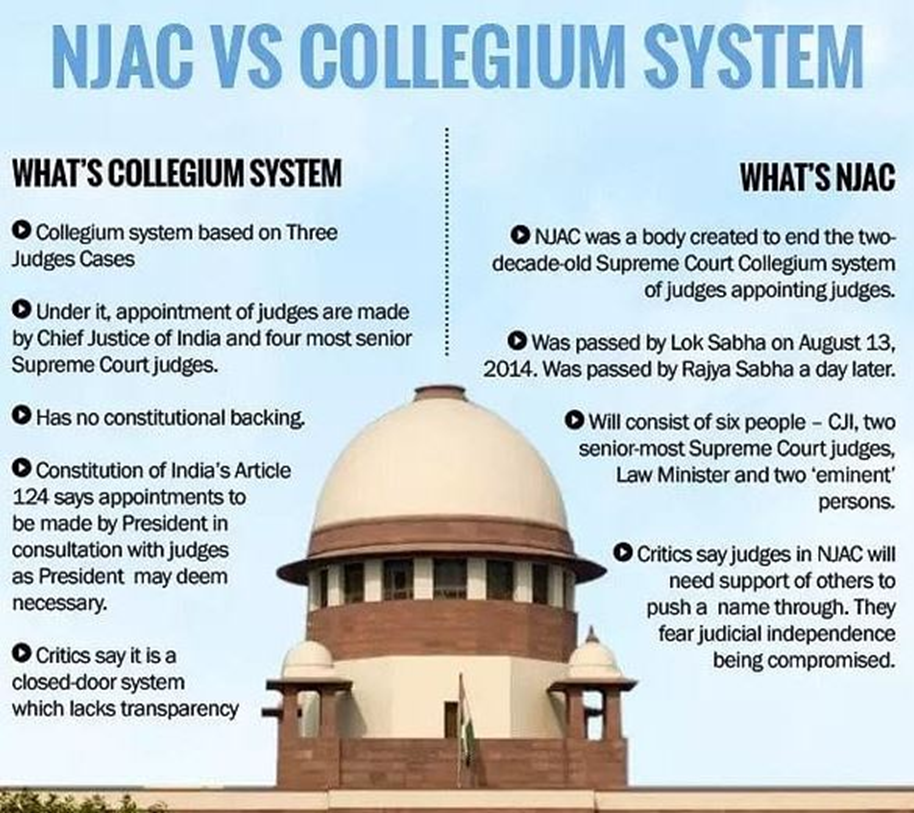
The Supreme Court, led by CJI Surya Kant, has orally agreed to consider a plea seeking to revive the National Judicial Appointments Commission (NJAC). The plea challenges the 2015 Supreme Court verdict which struck down the NJAC and reinstated the Collegium System.
The Core Legal Challenge:
- Contention: The plea argues that the 2015 judgment (Fourth Judges Case) undermined the “will of the people” by prioritizing judicial opinion over Parliamentary mandate.
- Objective: It seeks to declare the judgment void ab initio (invalid from the start) and restore the 99th Constitutional Amendment.
THE NJAC ACT & THE 99th AMENDMENT: AN OVERVIEW
1. Legislative Context: What was the 99th Amendment?
- Enactment: The 99th Constitutional Amendment Act, 2014 established the National Judicial Appointments Commission (NJAC).
- Objective: To replace the opaque Collegium System with a transparent, broad-based constitutional body for judicial appointments.
- New Articles Inserted:
- Article 124A: Established the NJAC and defined its composition.
- Article 124B: Defined the functions of the Commission.
- Article 124C: Empowered Parliament to regulate the NJAC’s procedure.
CONSTITUTIONAL FRAMEWORK FOR JUDICIAL APPOINTMENTS
2. Articles Govern Judicial Appointments?
- Article 124: Appointment of Judges to the Supreme Court.
- Article 217: Appointment of Judges to High Courts.
- Article 222: Transfer of High Court Judges (consultation with CJI).
- Article 368: The amending power used to introduce the NJAC.
STRUCTURE & COMPOSITION
3. Who Constituted the NJAC (Article 124A)?
The NJAC was designed as a six-member body to balance the Executive and Judiciary:
- Chairperson: Chief Justice of India (Ex-officio).
- Judicial Members: Two senior-most Supreme Court Judges (Ex-officio).
- Executive Member: Union Minister of Law and Justice (Ex-officio).
- Civil Society Members: Two Eminent Persons.
- Selection of “Eminent Persons”:
- Selection Committee: Prime Minister, Chief Justice of India, and Leader of Opposition (or leader of the single largest opposition party).
- Diversity Clause: One eminent person must belong to SC/ST/OBC/Minorities or be a woman.
- Tenure: 3 years; not eligible for re-nomination.
MANDATE & POWERS
4. What were the Functions of NJAC (Article 124B)?
- Recommendations: To recommend persons for appointment as CJI, SC Judges, Chief Justices of High Courts, and HC Judges.
- Transfers: To recommend the transfer of Chief Justices and Judges of High Courts.
- Eligibility Check: To ensure selected candidates meet criteria of merit, integrity, and legal expertise.
JUDICIAL SCRUTINY & VERDICT
5. Why was the NJAC Struck Down? (The 2015 Verdict)
In Supreme Court Advocates-on-Record Association v. Union of India (2015), a 5-judge bench declared the NJAC unconstitutional by a 4:1 majority.
- Violation of Basic Structure: The Court held that “Independence of Judiciary” is part of the Basic Structure. The involvement of the Executive (Law Minister) in appointments violated this principle.
- The Veto Problem: The provision that any two members could veto a recommendation essentially gave the Executive or non-judicial members the power to block judicial consensus.
- Reciprocity Issues: Concerns were raised that judges might feel beholden to the Executive for their appointments, compromising impartiality.
What were the Structural Flaws?
- Erosion of Judicial Primacy: The composition diluted the judiciary’s collective opinion, reducing it to just one of several stakeholders.
- Ambiguity of “Eminent Persons”: The criteria for selecting “eminent persons” were vague, raising fears of political appointees without legal acumen.
- Deadlock Risks: The veto power created potential for frequent stalemates between the Judiciary and the Executive.
Why is this in the News?
The Supreme Court, led by CJI Surya Kant, has orally agreed to consider a plea seeking to revive the National Judicial Appointments Commission (NJAC). The plea challenges the 2015 Supreme Court verdict which struck down the NJAC and reinstated the Collegium System.
The Core Legal Challenge:
- Contention: The plea argues that the 2015 judgment (Fourth Judges Case) undermined the “will of the people” by prioritizing judicial opinion over Parliamentary mandate.
- Objective: It seeks to declare the judgment void ab initio (invalid from the start) and restore the 99th Constitutional Amendment.
THE NJAC ACT & THE 99th AMENDMENT: AN OVERVIEW
1. Legislative Context: What was the 99th Amendment?
- Enactment: The 99th Constitutional Amendment Act, 2014 established the National Judicial Appointments Commission (NJAC).
- Objective: To replace the opaque Collegium System with a transparent, broad-based constitutional body for judicial appointments.
- New Articles Inserted:
- Article 124A: Established the NJAC and defined its composition.
- Article 124B: Defined the functions of the Commission.
- Article 124C: Empowered Parliament to regulate the NJAC’s procedure.
CONSTITUTIONAL FRAMEWORK FOR JUDICIAL APPOINTMENTS
2. Articles Govern Judicial Appointments?
- Article 124: Appointment of Judges to the Supreme Court.
- Article 217: Appointment of Judges to High Courts.
- Article 222: Transfer of High Court Judges (consultation with CJI).
- Article 368: The amending power used to introduce the NJAC.
STRUCTURE & COMPOSITION
3. Who Constituted the NJAC (Article 124A)?
The NJAC was designed as a six-member body to balance the Executive and Judiciary:
- Chairperson: Chief Justice of India (Ex-officio).
- Judicial Members: Two senior-most Supreme Court Judges (Ex-officio).
- Executive Member: Union Minister of Law and Justice (Ex-officio).
- Civil Society Members: Two Eminent Persons.
- Selection of “Eminent Persons”:
- Selection Committee: Prime Minister, Chief Justice of India, and Leader of Opposition (or leader of the single largest opposition party).
- Diversity Clause: One eminent person must belong to SC/ST/OBC/Minorities or be a woman.
- Tenure: 3 years; not eligible for re-nomination.
MANDATE & POWERS
4. What were the Functions of NJAC (Article 124B)?
- Recommendations: To recommend persons for appointment as CJI, SC Judges, Chief Justices of High Courts, and HC Judges.
- Transfers: To recommend the transfer of Chief Justices and Judges of High Courts.
- Eligibility Check: To ensure selected candidates meet criteria of merit, integrity, and legal expertise.
JUDICIAL SCRUTINY & VERDICT
5. Why was the NJAC Struck Down? (The 2015 Verdict)
In Supreme Court Advocates-on-Record Association v. Union of India (2015), a 5-judge bench declared the NJAC unconstitutional by a 4:1 majority.
- Violation of Basic Structure: The Court held that “Independence of Judiciary” is part of the Basic Structure. The involvement of the Executive (Law Minister) in appointments violated this principle.
- The Veto Problem: The provision that any two members could veto a recommendation essentially gave the Executive or non-judicial members the power to block judicial consensus.
- Reciprocity Issues: Concerns were raised that judges might feel beholden to the Executive for their appointments, compromising impartiality.
What were the Structural Flaws?
- Erosion of Judicial Primacy: The composition diluted the judiciary’s collective opinion, reducing it to just one of several stakeholders.
- Ambiguity of “Eminent Persons”: The criteria for selecting “eminent persons” were vague, raising fears of political appointees without legal acumen.
- Deadlock Risks: The veto power created potential for frequent stalemates between the Judiciary and the Executive.