
Why is this in the News?
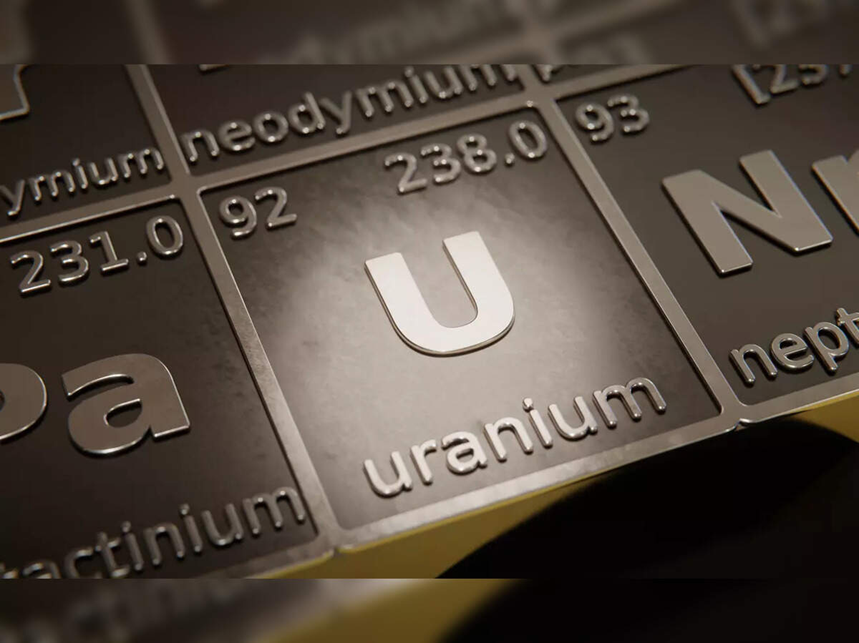
Context : India and Canada are close to finalising a $2.8 billion (approx. ₹23,000 Crore) pact for the long-term supply of uranium.
KEY HIGHLIGHTS OF THE PACT :
- Supplier: The uranium will likely be supplied by the Canadian mining giant Cameco Corp.
- Duration: The agreement is expected to span the next decade (10 years).
- Objective: To fuel India’s expanding fleet of nuclear power reactors, ensuring energy security and reducing carbon reliance.
- Diplomatic Thaw: This deal signals a “reset” in India-Canada relations, moving past recent diplomatic strains to focus on trade, energy, and technology.
ATOMIC MINERALS: DISTRIBUTION & SIGNIFICANCE
1. URANIUM: THE PRIMARY FISSILE FUEL
Properties & Isotopes
- Nature: Silvery-gray metallic radioactive element; naturally formed in supernova explosions.
- Isotopes: Natural uranium consists of U-238 (99.27%) and U-235 (0.72%).
- Fissility: While all isotopes are radioactive, only U-235 is fissile (sustains a neutron-mediated chain reaction).
- Commercial Viability: Found everywhere in traces, but commercial extraction is limited to high-concentration deposits.
Global Distribution
- Major Reserves: Australia, Kazakhstan, and Canada hold the largest viable deposits.
- Key Mines:
- Australia: Olympic Dam and Ranger mine.
- Canada: Athabasca Basin (High-grade deposits), Cigar Lake, McArthur River.
- Kazakhstan: Chu-Sarysu basin (Accounts for >50% of the country’s resources).
Indian Scenario
- Status: India has no significant reserves; largely dependent on imports (Russia, Kazakhstan, France).
- Production: Accounts for only 2% of global production (Reserve estimate: ~30,480 tonnes).
- Key Occurrences:
- Jharkhand: Singhbhum and Hazaribagh districts.
- Rajasthan: Copper mines of Udaipur.
- Andhra Pradesh/Telangana: Recent discoveries between Seshachalam forest and Srisailam.
- Others: Gaya (Bihar), Sedimentary rocks in Saharanpur (UP).
- Secondary Source: Monazite sands (Kerala coast) contain estimated 15,200 tonnes of uranium.
2. THORIUM: INDIA’S STRATEGIC ASSET
Properties & Occurrence
- Abundance: Estimated to be 3 to 4 times more abundant than uranium in Earth’s crust.
- Source: Chiefly refined from Monazite sands (contains ~2.5% Thorium).
- Isotopes: Th-232 is the most stable and naturally occurring isotope.
- Potential: Predicted to replace uranium as nuclear fuel (Stage III of India’s Nuclear Program).
Distribution
- Global Dominance: India and Australia possess more than half of the world’s thorium reserves. The USA also holds significant reserves.
- Indian Distribution:
- Primary: Kerala Coast (Largest concentration of Monazite).
- Other Producers: Jharkhand, Bihar, Tamil Nadu, and Rajasthan.
- Minerals: Monazite and Thorianite.
Strategic Advantages over Uranium
- Proliferation Resistance: Weapons-grade material (U-233) is hard to retrieve safely due to the presence of U-232 (strong gamma radiation).
- Waste Management: Produces 10 to 10,000 times less long-lived radioactive waste. Toxic lifespan is centuries, not millennia.
- Efficiency: Higher burn-up capability makes it cheaper; produces a single pure isotope requiring no enrichment.
- Safety: Cannot sustain a chain reaction without priming (fission stops automatically in accelerator-driven systems).
3. Monazite & Rare Earth Elements (REE)
- Composition: Reddish-brown phosphate mineral containing Rare Earth Metals and Thorium.
- Significance of REEs: A group of 17 elements vital for modern technology (electronics, clean energy, defense).
- Properties: Unique magnetic, luminescent, and electrochemical qualities allowing for miniaturization and energy efficiency.
| Mineral | Key Use/Property | Indian Distribution |
| Beryllium | Used as a ‘Moderator’ in nuclear reactors. | Reserves are sufficient for India’s needs. |
| Lithium | Light metal; found in minerals Lepidolite and Spodumene. | Mica belts of Jharkhand, Madhya Pradesh, and Rajasthan. |
| Zirconium | Used in nuclear applications. | Kerala coast, Alluvial rocks of Ranchi and Hazaribagh (Jharkhand). |