
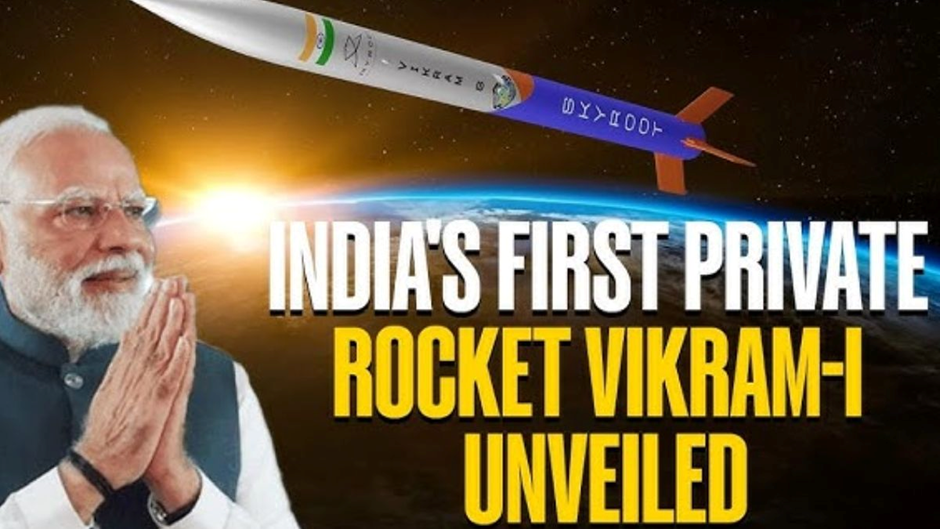
I. Unveiling the Milestone:
- Launch: Unveiled recently by the Prime Minister of India.
- Developer: Built by Skyroot Aerospace, marking a significant stride in India’s private space industry.
- Classification: An orbital-class launch vehicle named in honor of Dr. Vikram Sarabhai, the father of the Indian space program.
II. How is it Designed?
- Material Composition: Features an all-carbon composite structure, ensuring a high strength-to-weight ratio.
- Thrust Profile: Capable of generating a peak thrust of 1,200 kN.
- Rapid Deployment: Designed for simplicity and speed, possessing the capability to launch within 24 hours from any location.
III. Propulsion Dynamics:
- Staging Architecture: A four-stage vehicle comprising a mix of solid and liquid propulsion.
- Initial Boost (Stages 1-3): Powered by solid fuel to provide robust thrust during the initial atmospheric ascent.
- Precision Injection (Stage 4): A liquid-fuelled upper stage utilizing hypergolic propellants (MMH fuel and NTO oxidiser) for precise orbital adjustments.
- Engine Technology: The final stage employs a cluster of four Raman engines, which ignite instantly upon chemical contact.
IV. Mission Capabilities: What Can It Carry?
- Target Segment: specifically optimised for the small-satellite market, with the ability to deploy multiple satellites in a single mission.
- Payload to LEO: Capable of lifting 350 kg to Low Earth Orbit (500 km inclination).
- Payload to SSO: Capable of lifting 260 kg to Sun-Synchronous Orbit.
V. Technological Edge:
- Manufacturing: Utilizes 3D-printed engines to reduce manufacturing time and cost.
- Separation Systems: Deploys ultra-low-shock pneumatic systems for smooth stage separation.
- Guidance: Equipped with advanced avionics for real-time trajectory correction.