
I. Who was Sant Kabir?
- Timeline: A prominent 15th-century Indian mystic poet and saint.
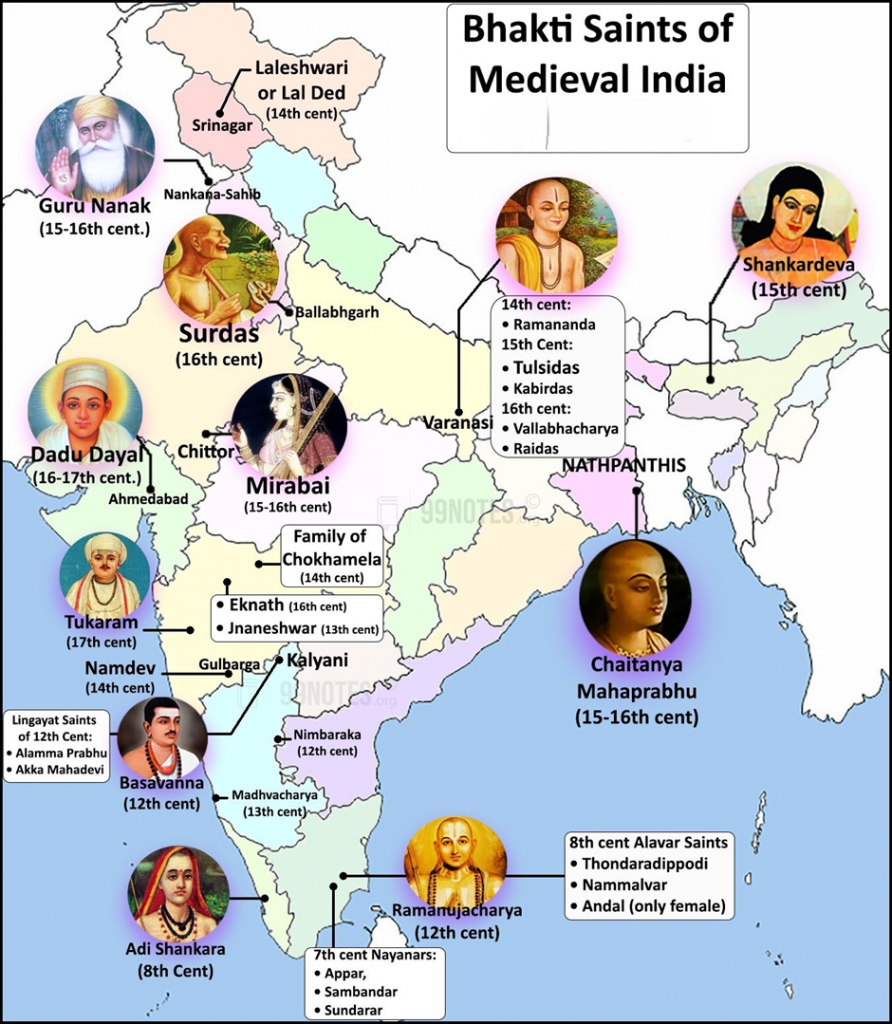
- Background: Born in Varanasi, Uttar Pradesh, to a Hindu family but raised by a Muslim weaver couple, embodying a syncretic heritage.
- Followers: Revered by both Hindus and Muslims; his distinct sect of followers is known as “Kabir Panthis.”
II. What was his role in the Bhakti Movement?
- The Movement: A pivotal figure in the Bhakti Movement, which emphasised personal devotion and love for the divine.
- Evolution: While the movement originated in South India (7th Century), Kabir was instrumental in its propagation across North India during the 14th and 15th centuries.
- Approach: Along with contemporaries like Ramananda, he democratised religion by composing devotional songs in vernacular languages rather than Sanskrit.
III. Who shaped his Philosophy?
- Mentorship: Sought spiritual guidance from diverse teachers, including the Vaishnava saint Ramananda and the Sufi Pir Sheikh Taqi.
- Philosophy: This dual influence shaped his unique philosophy that rejected rigid orthodoxy and caste distinctions.
IV. What are his Major Works?
- Key Texts: His profound philosophical insights are compiled in:
- Kabir Bijak: A collection of poems and verses.
- Kabir Parachai and Sakhi Granth.
- Kabir Granthawali: Popular in the Rajasthan tradition.
- Sikhism Connection: A significant portion of his verses is incorporated into the Adi Granth (Guru Granth Sahib), the holy scripture of Sikhism.
V. Linguistic Contribution:
- Dialects: composed primarily in Brajbhasha and Awadhi.
- Legacy: His works significantly influenced the evolution of the Hindi language and the broader landscape of Indian literature.