
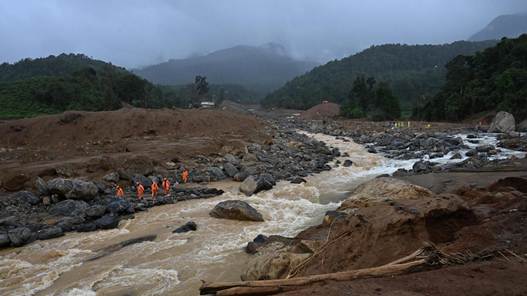
Why in the News?
- The article highlights growing concerns over India’s disaster-response financing framework after the Wayanad landslides in July 2024.
- Despite Kerala’s estimated loss of ₹2,200 crore, the Union released only ₹260 crore for immediate relief (~11% of the claimed amount), raising questions on federalism, equity, and efficiency in disaster management.
- The Supreme Court and policymakers are increasingly debating whether India’s fiscal federalism in disaster response is conditional and centralized, instead of cooperative and state-responsive.
Background/Context
India’s Disaster Response Framework
- India’s disaster response is governed primarily by the Disaster Management Act, 2005.
- Two main funds:
- State Disaster Response Fund (SDRF): Jointly financed by Centre & States in 75:25 ratio (90:10 for Himalayan & northeastern states), for immediate relief (shelter, food, medical care, compensation).
- National Disaster Response Fund (NDRF): Fully funded by the Union government, supplements SDRF in severe disasters.
Observed Problem
- Disasters are becoming fiscal stress tests for States due to climate change intensifying extreme events.
- Rising conditionality and central control are reducing state autonomy in rapid disaster response.
Key Issues Highlighted
1. Drifting Towards Centralized Control
- Relief norms are outdated and rigid:
- Compensation ceilings: ₹4 lakh for each life lost, ₹1.2 lakh for fully damaged houses.
- Focused on subsistence needs, not reconstruction or rehabilitation.
- Procedural delays due to sequential approvals from State memorandum → Central assessment → High-level clearance.
2. Ambiguity in Disaster Classification
- Disaster severity is vaguely defined, giving wide discretion to the Centre for NDRF eligibility.
- Kerala’s Wayanad landslide took months to be classified as “severe,” delaying aid.
3. Weak Allocation Criteria
- Current formula: Based on population + total geographic area.
- Flaws:
- Ignores actual hazard exposure.
- Vulnerability proxied by poverty, not risk indices (exposure to floods, cyclones, landslides).
- Example: States like Tamil Nadu & Karnataka faced delayed disaster funds despite high damages during Cyclone Gaja (2018) & floods (2019).
4. SDRF Procedural Constraints
- SDRF releases are not automatic, and funds often arrive late in the fiscal year.
- Funds are restricted for immediate relief, limiting reconstruction or livelihood restoration.
- States forced to retain reserves for liquidity, reducing their operational flexibility.
Analysis of India’s Disaster Response Framework
| Issue | Current Scenario | Impact on Federalism | Suggested Reform |
| Disaster Classification | Ambiguous, subjective | Delays state access to funds | Define severity with clear objective indicators |
| Funding Mechanism | SDRF/NDRF with conditionality | Centre dominates fund flow | Use grant-based allocation with state operational control |
| Allocation Criteria | Population + Area | Misaligns actual exposure & need | Introduce vulnerability & hazard risk index |
| Procedural Delay | Sequential approvals | Slows immediate response | Automated triggers for quick release |
| Reconstruction Support | Limited | Focus on subsistence only | Allow funds for rehabilitation & livelihood |
Federalism Under Strain
- Cooperative federalism eroded: Central oversight dominates procedural approvals.
- Conditionality limits states’ autonomy and efficiency in disaster relief.
- Financial misalignment creates disparity across states in relief allocation.
Learning from Global Practices
- USA (FEMA): Data-driven, transparent triggers for federal support.
- Mexico (FONDEN): Automatic fund release based on rainfall/wind thresholds.
- Philippines: Quick-response funds triggered by rainfall/fatality indices.
- Australia: Federal aid linked to state revenue, ensuring accountability and speed.
- Africa & Caribbean: Insurance facilities using satellite data for rapid payouts.
Lesson for India:
- Move to objective triggers for disaster assistance, reducing discretion and delays.
- Prioritize grant-based transfers, not debt-based, with state-led operational control.
Rebuilding the Federal Spirit
Recommendations
- Update Relief Norms: Reflect current costs, not decade-old estimates.
- Objective Allocation: Introduce comprehensive vulnerability index to guide funding.
- Strengthen Grant-based Model: Disaster aid should remain grant, not loan-based, enhancing state autonomy.
- Operational Control to States: Union’s role should be post-audit verification, not prior approval.
- Speed & Rules-Based Response: Systematic triggers to ensure swift, equitable, and accountable aid.
Core Idea: Disaster management must reinforce cooperative federalism, balancing central oversight with state autonomy.
Conclusion
The Wayanad landslide underscores the need for a paradigm shift in India’s disaster-response framework. Current fiscal mechanisms, procedural rigidity, and discretionary aid highlight an imbalance in cooperative federalism, undermining states’ ability to act promptly. Strengthening objective, transparent, and grant-based disaster financing, coupled with clear operational autonomy for states, is essential not only for efficient relief but also for preserving the federal spirit in India’s evolving disaster management landscape.
Source: India’s disaster response, a slippery slope for federalism – The Hindu
UPSC CSE PYQ
| Year | Question |
| 2024 | What is disaster resilience? How is it determined? Describe the elements of a resilience framework. Flooding in urban areas is an emerging climate-induced disaster. Discuss the causes of this disaster. Mention features of two major floods in the last two decades in India. Describe the policies and frameworks in India that aim at tackling such floods. |
| 2023 | Dam failures are always catastrophic and have widespread social, economic, and environmental impacts. Analyze the causes of dam failures in India. Give two examples of large dam failures in the last two decades. |
| 2022 | Explain the mechanism and occurrence of cloudburst in the Indian subcontinent. Discuss two recent examples of cloudburst events in India. |
| 2020 | Discuss the recent measures initiated in disaster management by the Government of India departing from the earlier reactive approach. |
| 2018 | Describe various measures taken in India for the Sendai Framework for Disaster Risk Reduction (2015-2030) before and after signing it. How is this framework different from the earlier Hyogo Framework for Action (2005)? |
| 2017 | On December 26, 2004, a tsunami affected India and other countries. Discuss the factors responsible for the occurrence of such a disaster. Explain the effects on life and economy. In light of the National Disaster Management Authority Guidelines (2010), describe the mechanisms for preparedness to reduce disaster risk. |
| 2015 | The frequency of earthquakes appears to have increased in the Indian subcontinent. Discuss various aspects of India’s preparedness for earthquake hazards and the measures that need to be taken. |
| 2014 | Drought is recognized as a disaster due to its slow onset and long-term effects. With focus on the National Disaster Management Authority Guidelines of September 2010, discuss the mechanisms for preparedness to deal with likely El Niño or La Niña fallouts in India. |
| 2013 | How important are vulnerability and risk assessment for pre-disaster management? As an administrator, what are the key areas you would focus on in a Disaster Management System? |