
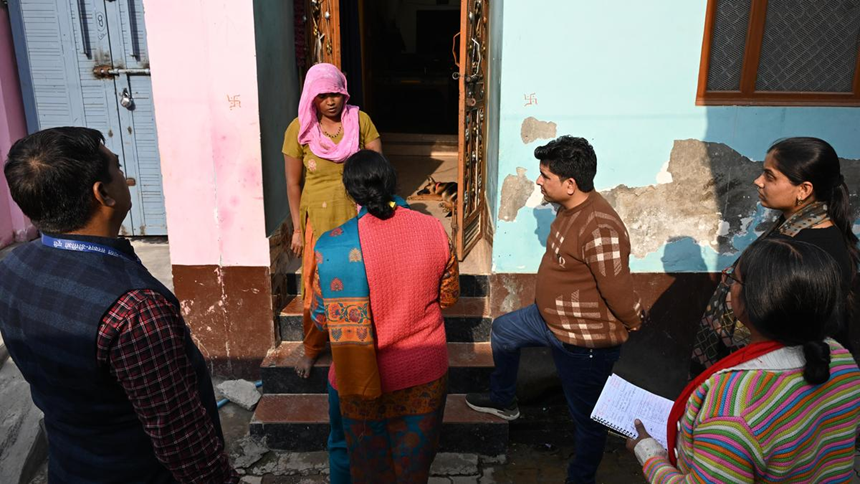
Why in the News?
The 2027 Census of India marks a significant milestone as the world’s largest administrative exercise, delayed from 2021 due to the pandemic. It introduces innovative approaches to urban data collection, addressing the limitations of traditional methods.
Evolution of Census and Urbanization in India
- India’s census has been a cornerstone of national planning since 1872, offering decennial snapshots of demographic, economic, and social realities. The 2011 Census highlighted a 6% increase in urban population to 377 million, yet it exposed flaws in the existing classification system.
- Traditional definitions—based on population size (>5,000), density (>400 persons/sq km), and workforce composition (>75% non-agricultural)—often fail to capture transitional areas, leading to undercounted urban footprints and distorted planning.
- Building on this, the 2027 Census proposes transitional steps to maintain comparability with 2011 data while adopting global best practices. For instance, it aligns with the UN’s “Degree of Urbanisation” framework, which views areas on a continuum rather than strict binaries.
- This evolution is essential because rapid urbanization has blurred boundaries, with peri-urban villages increasingly integrated into city economies. Historical data shows that official figures may miss up to 53 million urban dwellers, affecting everything from infrastructure funding to service delivery.
Key Features of the 2027 Census Approach
To overcome past limitations, the 2027 Census incorporates advanced technologies and methodologies, ensuring efficiency and accuracy in data capture. This builds a foundation for long-term trend analysis and policy integration.
Technological Innovations
- At the core are digital tools like mobile geo-tagging apps, which allow enumerators to map buildings in real-time using GPS. A centralized platform will handle data collection, validation, and open-access dissemination, minimizing errors from manual processes.
- These innovations not only enhance monitoring but also create visual dashboards for stakeholders, revealing the true spatial extent of urban agglomerations.
Spatial Grid Methodology
- A key shift is the use of static spatial grids (e.g., 1 km x 1 km cells) to transcend irregular administrative boundaries. This method offers several advantages: it enables longitudinal tracking of urban sprawl, protects privacy through aggregated data, and supports intersectional analysis by overlaying themes like housing, services, and climate hazards.
- Globally, similar approaches are seen in the UK’s grid-based environmental data or Canada’s geo-statistical surveys. In India, this aligns with the 2022 National Geospatial Policy’s 4m x 4m grid system, facilitating climate-proof investments and hazard mapping.
Focus on Urban Dynamism
- The census will emphasize agglomeration insights, such as Delhi’s projected rise to the world’s fifth-largest urban area by 2027 (UN estimates). It extends beyond demographics to cover economic binaries (formal vs. informal), service gaps, and environmental indicators.
- Inclusivity is prioritized, with measures to enumerate marginalized groups like migrants, ensuring comprehensive coverage of blended urban-rural conditions.
| Challenge | Impact on Urban Planning | Mitigation Strategy |
| Boundary Distortions | Underestimates peri-urban growth, leading to inequitable fund allocation. | Adopt UN-style agglomeration metrics with GIS overlays. |
| Privacy Risks | Potential misuse of geo-data, eroding public trust. | Implement differential privacy techniques and ethical guidelines. |
| Digital Divide | Tech gaps hinder accurate tagging in underserved areas. | Use hybrid models: digital for urban centers, manual for remote zones. |
| Inter-Sectoral Coordination | Siloed ministries delay scheme integration. | Establish a national data coordination body. |
Analysis: Implications for India’s Urban Future
The 2027 Census has far-reaching implications, serving as a tool for transformative governance. By providing dynamic data, it enables targeted actions that connect economic growth, social equity, and environmental resilience.
Policy and Governance Reforms
Granular insights will refine resource devolution, prioritizing high-density areas for initiatives like water and sanitation schemes. It supports inclusive growth by highlighting informal sectors, aligning with self-reliance goals. On sustainability, grid-based analysis can model resilient cities, integrating with national frameworks to meet global commitments like SDGs.
Opportunities for Innovation
This opens avenues for public-private partnerships in urban analytics, fostering data ecosystems similar to international models. Globally, it positions India as a leader in geospatial standards, enhancing monitoring of development goals.
Critical Evaluation
Success depends on balanced execution: over-reliance on technology risks excluding offline populations, while undercounting (as in 2011) could skew outcomes. Ultimately, the census redefines urban planning as predictive and equitable, paving the way for a resilient future.
Conclusion
The 2027 Census is far more than a headcount; it is a foundational reimagination of how India sees, governs, and plans its cities. By replacing static administrative silos with dynamic spatial grids and agglomeration lenses, it promises to resolve decades-old distortions in urban data and resource allocation. If executed with robust privacy safeguards, inclusive enumeration, and seamless inter-governmental coordination, this census can become the bedrock of equitable, climate-resilient, and economically vibrant urban India in the Amrit Kaal.
Source: Capturing urban dynamism in the 2027 Census – The Hindu
UPSC CSE PYQ
| Year | Question |
| 2013 | Discuss the various social problems which originated out of the speedy process of urbanization in India. |
| 2015 | What are ‘Smart Cities’? Examine their relevance for urban development in India. Will it increase rural-urban differences? Give arguments for ‘Smart Villages’ in the light of PURA and RURBAN Mission. |
| 2015 | National Urban Transport Policy emphasizes on ‘moving people’ instead of ‘moving vehicles.’ Discuss critically the success of the various strategies of the Government in this regard. |
| 2016 | Rehabilitation of human settlements is one of the important environmental impacts which always attracts controversy while planning major projects. Discuss the measures suggested to solve the problems. |
| 2019 | How is efficient and affordable urban mass transport key to the rapid economic development of India? |
| 2020 | The frequency of urban floods due to high intensity rainfall is increasing over the years. Discussing the reasons for urban floods, highlight the mechanisms for preparedness to reduce the risk during such events. |
| 2023 | Does urbanisation lead to more segregation and/or marginalisation of the poor in Indian metropolises? Give reasons with examples in support of your answer. |
| 2024 | Why do large cities tend to attract more migrants than smaller towns? Give reasons with examples in support of your answer. |
| 2024 | Does urbanization lead to more segregation and/or marginalization of the poor in Indian metropolises? Give reasons with examples in support of your answer. |