
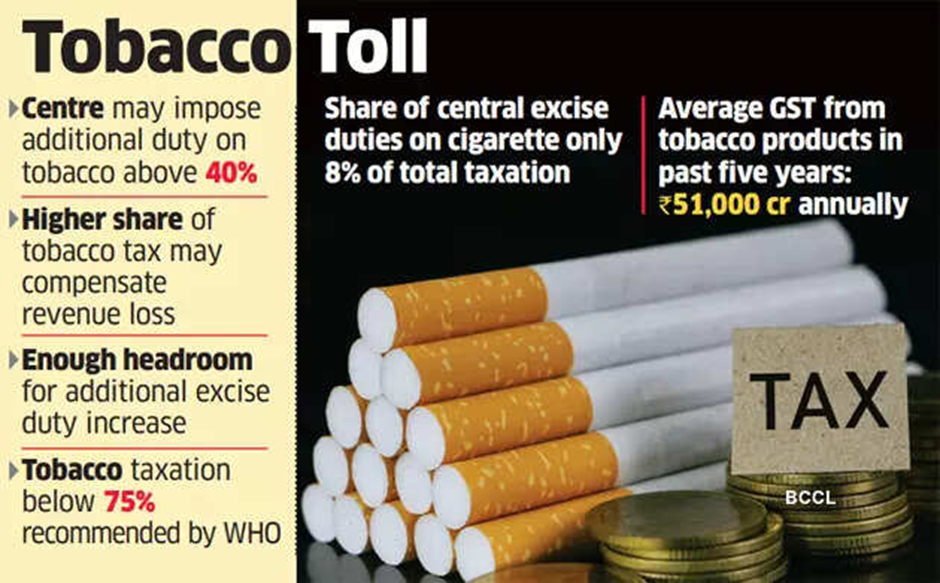
- The Union Government has introduced two significant legislations in Parliament:
- The Central Excise (Amendment) Bill, 2025
- The Health Security se National Security Cess Bill, 2025
- Primary Objective: To maintain the tax incidence on tobacco products and pan masala as the GST Compensation Cess is set to be discontinued shortly.
2. Background: The GST Compensation Cess
- Origin: Introduced in 2017 during the rollout of the Goods and Services Tax (GST).
- Purpose: To compensate States for revenue losses arising from the transition to GST for a period of five years.
- Extension: The levy was extended beyond five years to repay loans borrowed by the Centre to compensate States during the COVID-19 revenue shortfall (2020-22).
- Current Status: The cess is being discontinued as the loan repayment is nearing completion.
3. Decoding the New Legislations
A. Central Excise (Amendment) Bill, 2025
- Rationale: Once the GST Compensation Cess is removed, the effective tax rate on tobacco would drop, leading to revenue loss and potentially higher consumption (health risk).
- Mechanism: The Bill creates fiscal space to increase the Basic Central Excise Duty on tobacco products.
- Outcome: It ensures the total tax burden (Tax Incidence) remains the same even after the cess is removed.
B. Health Security se National Security Cess Bill, 2025
- Target Commodity: Primarily targets Pan Masala manufacturing (and other notified goods).
- Usage of Funds: Proceeds will be earmarked for Public Health and National Security expenditure.
- Key Feature: Capacity-Based Taxation
- Instead of taxing the actual quantity produced, the cess is levied based on the production capacity of machines installed in the factory.
- Self-Declaration: Manufacturers must declare their machinery; the cess is calculated on the aggregate capacity.
- Logic: This method curbs tax evasion in sectors prone to under-reporting production (like pan masala and gutkha).
Static Linkages:
| Concept | Explanation |
| Cess vs. Tax | A Tax goes into the Consolidated Fund of India (CFI) and can be used for any purpose. A Cess is a tax on tax, earmarked for a specific purpose (e.g., Education Cess, Health Cess). |
| Article 270 | Cess and Surcharges are NOT shareable with State Governments (unlike basic Income Tax or GST). The Centre retains 100% of the proceeds. |
| Excise Duty | An indirect tax levied on the manufacture/production of goods within the country. (Tobacco attracts both GST and Central Excise Duty). |