
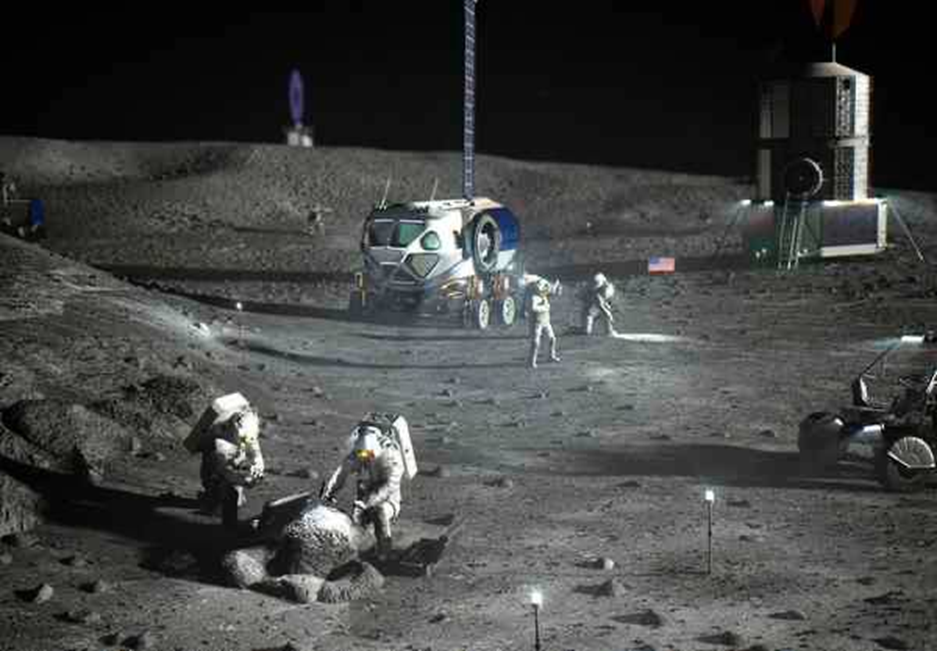
The USA has announced the Lunar Fission Surface Power Project, aiming to deploy a small nuclear reactor on the Moon by the early 2030s.This marks the first attempt to establish a permanent nuclear power source beyond Earth’s orbit, addressing the limitations of solar energy for sustained human presence.
Why Nuclear over Solar?
While solar energy powers most current missions, it faces critical constraints on the Moon and Mars:
- Lunar Nights: Last for two weeks, leaving solar-powered equipment in darkness.
- Shadowed Regions: The poles (potential water ice sites) receive scarce sunlight.
- High Energy Demand: Industrial operations like In-Situ Resource Utilisation (ISRU) (converting ice to fuel/oxygen) require over 1 MW of continuous power, which solar cannot reliably provide.
From RTGs to Fission
| Technology | RTG (Radioisotope Thermoelectric Generator) | Fission Surface Power (New Focus) |
| Mechanism | Converts heat from the natural radioactive decay of Plutonium-238 into electricity. | Uses nuclear fission (splitting atoms) in a compact reactor (size of a shipping container). |
| Power Output | Low (Few hundred watts). Good for instruments. | High (Tens to Hundreds of Kilowatts). Good for habitats & industry. |
| Example | Voyager spacecraft, Curiosity Rover. | Lunar Fission Surface Power Project. |
Future Propulsion Systems:
1.Nuclear Thermal Propulsion (NTP):
- Mechanism: A nuclear reactor heats a propellant (like hydrogen), which expands and is expelled through a nozzle to create thrust.
- Benefit: High thrust; could shorten travel time to Mars, reducing crew exposure to cosmic rays.
- Project: US DRACO programme plans to test this by 2026.
2.Nuclear Electric Propulsion (NEP):
- Mechanism: Reactor-generated electricity is used to ionise a propellant (like Xenon gas) to create thrust.
- Benefit: High efficiency, suitable for long-duration deep-space cargo missions.
The Legal Vacuum:
Current international laws are insufficient for the modern nuclear space age.
- The 1992 UN Principles (UNGA Resolution 47/68):
- Scope: Applies only to RTGs and fission reactors for electricity, not propulsion.
- Nature: Non-binding guidelines; no enforcement mechanism.
- Key Principles: Principle 3 (Safety design), Principle 4 (Risk assessment), Principle 7 (Emergency notification).
- Other Treaties:
- Outer Space Treaty (1967): Bans WMDs but is silent on peaceful nuclear propulsion.
- Liability Convention (1972): Vague on liability for nuclear accidents beyond Earth orbit.
- The Gap: No binding technical standards for reactor design, safety zones, or end-of-life disposal, raising risks of radioactive contamination of celestial bodies.
India’s Strategic Opportunity
- Collaboration: Potential alliance between ISRO and the Department of Atomic Energy (DAE).
- Applications:
- Powering operations in permanently shadowed lunar craters.
- Enabling ISRU on Mars.
- Diplomatic Role: India can champion a new multilateral oversight mechanism (modelled on the IAEA) to certify designs and verify compliance, ensuring the peaceful and safe use of nuclear energy in space.