
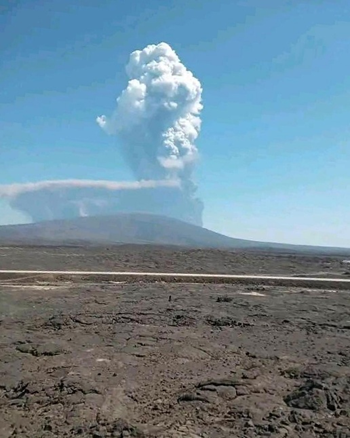
Why in the News?
A recent large volcanic eruption injected vast amounts of ash into high-altitude wind streams, which then drifted across major international flight corridors. This forced airlines to reroute, cancel, or delay flights, while aviation regulators issued urgent safety advisories to avoid affected airspace. The event highlighted how quickly volcanic ash can disrupt aviation safety and exposed gaps in monitoring, forecasting, and coordinated response.
What is Volcanic Ash?
- Fine particles of glass, rock, and crystalline minerals
- Formed by explosive eruptions
- Size: mostly <2 mm, especially dangerous <63 μm
- Can travel thousands of km at cruise altitudes
- Often invisible to onboard weather radar
A hazard that can appear suddenly and without pilot detection.
Why Volcanic Ash is Dangerous?
Multiple linked safety threats
| Aircraft System | How Ash Affects It | Impact on Safety |
| Jet Engines | Melts → clogs cooling ducts → erodes blades | Thrust loss, surging, engine shutdown |
| Windshields | Abrasion of glass surface | Poor visibility during landing |
| Air-Data Sensors | Pitot/static blockage | Wrong altitude/airspeed → control risk |
| Environmental Systems | Contaminates bleed air | Smoke/odour, pressurisation issues |
| Airframe Surface | Abrasion of leading edges | Reduced aerodynamic performance |
| Runways/Ground Ops | Ash deposition | Skidding risk, operational shutdown |
Engine failure remains the most critical concern.
How Ash is Detected and Monitored?
| Mechanism | Function |
| Satellites (IR sensing) | Detect ash clouds & altitude |
| VAACs (Volcanic Ash Advisory Centres) | Track movement & forecast trajectories |
| SIGMETs / NOTAMs | Operational warnings to aircraft |
| Volcano Observatories | Eruption data & plume height measurement |
| Pilot Reports (PIREPs) | Real-time encounter confirmation |
| Ground Lidar at some airports | Near-airport plume detection |
Forecast + alert + operational action must be swift.
Aviation Response Protocols
Immediate Measures
- Avoid airspace containing ash
- Change altitude if a safe level exists
- Divert to nearest suitable airport after encounter
Post-Exposure Measures
- Mandatory borescope turbine inspection
- Cleaning and calibration of sensors
- Runway and equipment decontamination
Operational disruptions often last days to weeks.
Past Incidents — Lessons Learned
| Event | Key Insight |
| 1982 — Indonesia (KLM 747) | Multiple engine flameouts → global procedural reforms |
| 1989 — Alaska (Redoubt) | All four engines stopped → proved catastrophic potential |
These incidents led to ICAO standards and creation of VAACs.
Challenges That Persist
- Ash clouds may not be visible to pilots
- Early forecasts carry high uncertainty
- Congested air routes limit rerouting choices
- Maintenance facilities rapidly over-stretched
- Economic pressure may undermine conservative decision-making
- Need stronger coordination among: Volcanologists → Meteorology → Aviation Regulators → ATC → Airlines
Strengthening Preparedness: The Way Forward
1️⃣ Science & Technology
- Improved satellite ash-detection algorithms
- Lidar/radar deployment at major airports
2️⃣ Response & Coordination
- Fast alert chains and crisis simulations
- Clear SOPs for diversion + immediate inspection
3️⃣ Capability & Regulation
- Regional engine-inspection hubs
- Insurance/liability support for safety-first decisions
- Frequent training for crew, ATC & dispatchers
Safety must remain above commercial considerations.
Conclusion
Volcanic ash is a high-impact aviation hazard capable of disabling multiple aircraft systems within minutes. Because ash clouds are often invisible and fast-spreading, safety depends on early detection, rapid warnings, strict avoidance, and coordinated operational response. Investing in monitoring technology, preparedness drills, and strong regulatory oversight ensures that such rare but serious events do not turn into aviation disasters.
Source: Why is volcanic ash a safety concern for flights? | Explained – The Hindu
UPSC CSE PYQ
| Year | Question |
| 2013 | What are the consequences of increasing frequency of natural hazards? What steps can be taken for mitigation? |
| 2013 | What do you understand by the term ‘disaster preparedness’? Describe essential components of disaster preparedness. |
| 2016 | Discuss the role of Social Capital in Disaster Management. |
| 2019 | What are the reformative steps taken by the Government to make Disaster Management more effective? |
| 2021 | Disaster preparedness is the first step in any disaster management. Explain. |
| 2023 | Discuss the significance of volcanic activity in the development of world landforms. |
| 2024 | Analyse the impact of emerging climate-linked hazards on transport infrastructure in India. |