
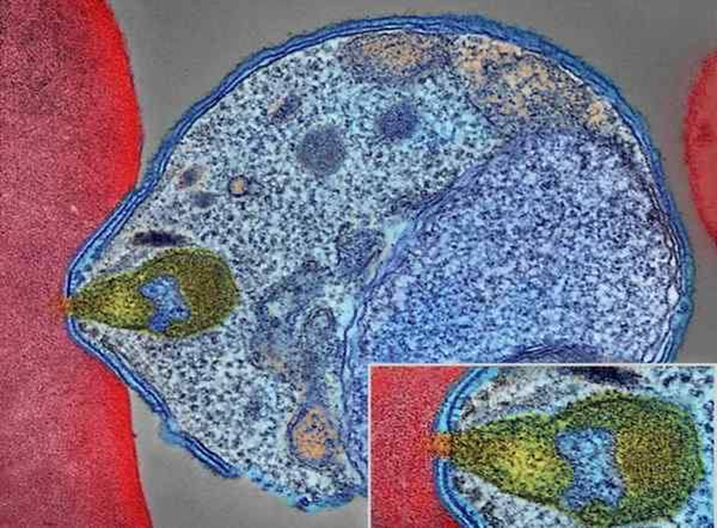
Recent studies on malaria parasites (Plasmodium sporozoites) have revealed that their corkscrew-like (helical) motion is not merely a biological quirk but a sophisticated evolutionary adaptation to navigate noisy microscopic environments. This finding bridges the gap between biological observation and physics-based mathematical modelling.
Navigating the ‘Noisy’ Micro-World
For microscopic organisms, moving in a straight line is inefficient due to Rotational Diffusion—the tendency of random collisions with surrounding molecules to disorient the organism within seconds.
- The Obstacle: “White Noise” (random energy bursts) and internal biological fluctuations constantly push the organism off course.
- The Necessity: Parasites like Plasmodium must maintain a consistent trajectory for tens of seconds to locate blood vessels and capillaries.
The Evolutionary Solution: The ‘Corkscrew’ Strategy
To overcome this instability, malaria parasites have evolved to move in right-handed helices.
- Displacement Efficiency: In a noisy 3D environment, a helical path allows the organism to cover a larger effective distance than a straight-line swimmer moving at the same speed.
- Averaging Fluctuations: The rotating path helps “average out” internal engine fluctuations, keeping the overall direction stable.
- Geometric Fit: The helical pitch (approx. 13 micrometers) and radius (approx. 3 micrometers) align with the dimensions of small blood vessels, aiding in navigation.
‘Colored Noise’ vs. White Noise
The study introduces a nuanced understanding of how these parasites manage “noise.”
- Ornstein-Uhlenbeck (OU) Process: Unlike “White Noise” (which is completely random), the parasite’s internal fluctuations are described as “Colored Noise.”
- Significance: This means the noise has “memory”—the current fluctuation depends on the recent past. The parasite’s helical motion exploits this predictability to maintain a “straighter than straight” effective path over time.
Technological Implications: Bio-Mimicry
- Micro-Robotics: This biological mechanism serves as a blueprint for designing artificial nanobots and micro-swimmers.
- Medical Application: Engineers can design drug-delivery devices with controlled rotational components to navigate complex human tissues and capillaries more effectively.
About Malaria:
- Causative Agent: Plasmodium parasites (P. falciparum and P. vivax are the most dangerous).
- Vector: Infected female Anopheles mosquitoes.
- Transmission: Non-contagious; spread via bites, infected blood, or contaminated needles.
Symptoms & Impact
- Incubation: Symptoms (fever, chills, headache) typically appear 10–15 days post-infection.
- Severity: If untreated, it can lead to jaundice, seizures, respiratory distress, and death.
Prevention & Treatment
- World Malaria Day: Observed on April 25.
- Theme (2025): “Malaria Ends With Us: Reinvest, Reimagine, Reignite”.
- Therapeutics:
- ACTs (Artemisinin-based Combination Therapies): Standard for P. falciparum.
- Chloroquine: Used for P. vivax (where effective).
- Primaquine: Prevents relapse in P. vivax and P. ovale.