
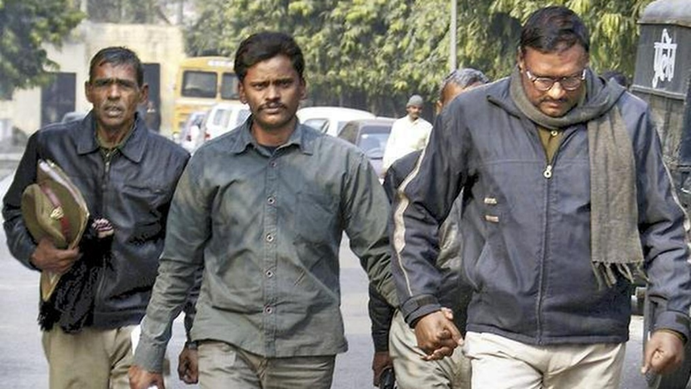
Why in the News?
The Supreme Court of India recently acquitted Surendra Koli, the prime accused in the horrific Nithari killings (uncovered in 2006), in the final pending case against him. This verdict, delivered through the extraordinary curative jurisdiction, concluded nearly two decades of litigation. Having been acquitted in 12 other connected cases based on the same set of facts and evidence, the court ruled that allowing a conviction to stand on evidence already rejected as involuntary or inadmissible would amount to a “manifest miscarriage of justice.”
Constitutional Imperatives & Judicial Review
- Due Process and Equality: The Supreme Court emphasized that to maintain a conviction on evidence discredited in connected cases violates Article 21 (Right to Life and Liberty) and Article 14 (Equality before the Law) of the Constitution. Arbitrary disparity in outcomes on an identical record is “inimical to equality.”
- Curative Jurisdiction: The invocation of this rarest form of judicial review highlights its role in averting “manifest injustice,” especially in cases concerning the death penalty and life imprisonment, where legal consistency is paramount.
- Proof Beyond Doubt: The court reiterated the fundamental principle that “Suspicion, however grave, cannot replace proof beyond reasonable doubt.”
Systemic Failures in the Criminal Justice System
The final acquittal, while upholding due process, has brought into sharp focus the systemic failures within the criminal justice machinery, particularly concerning the police and investigating agencies.
- Flawed and Perfunctory Investigation:
- Involuntary Confession: Koli’s key confession (Section 164 of the Criminal Procedure Code) was found to be inadmissible, having been recorded after approximately 60 days of uninterrupted police custody without proper legal safeguards, thus violating fundamental constitutional rights.
- Tainted Evidence Chain: The recovery of skulls and bones (Section 27 of the Indian Evidence Act), which was critical evidence, was found to be legally unsound. The prosecution failed to prove the recovery was made solely based on the accused’s confidential disclosure, destroying the chain of evidence. The crime scene was also reportedly left unsecured.
- Missing Links: The investigation was criticized for failing to adequately examine obvious witnesses, secure post-mortem material, and properly pursue material leads, including the organ-trade angle flagged by a government committee.
- Judicial Accountability Deficit: The prolonged and contradictory legal trajectory, where Koli was initially convicted in 13 cases by the trial court, then acquitted in 12 by the High Court, and finally in the last case by the Supreme Court, demonstrates a crucial issue of inconsistency threatening the integrity of adjudication.
Unresolved Paradox & The Path Ahead
The judicial record concludes that the prosecution failed to establish the guilt of the accused “beyond a reasonable doubt.” This creates a profound and tragic paradox: while the murders unquestionably occurred and the suffering of the families is immense, the identity of the actual perpetrator could not be established “in a manner that meets the legal standards.”
The case serves as a pivotal study on the need for systemic reform:
- Police Reforms: Urgent need for professional, timely, and constitutionally compliant investigations that adhere strictly to procedural mandates for confessions and evidence recovery.
- Forensic Upgradation: Ensuring proper crime scene management, prompt and competent forensic analysis, and the use of expert testimony to establish the provenance and reliability of evidence.
- Judicial Consistency: Establishing enforceable standards and accountability mechanisms to prevent arbitrary disparity in outcomes on identical evidentiary records.
The acquittal, therefore, is a legal victory for due process but a lamentable failure for justice, as the actual offender remains at large, shielded by the negligence that “corroded the fact-finding process” and foreclosed avenues to the truth.
Criminal Justice System in India
Introduction
The Criminal Justice System (CJS) in India refers to the set of agencies and institutions responsible for maintaining social control, preventing and investigating crime, prosecuting offenders, delivering justice and ensuring reformation. It operates under the Constitution, criminal laws (IPC, CrPC, Evidence Act), and other statutory rules.
Objectives of the Criminal Justice System
- Protection of rights and security of citizens
- Ensuring fair trial and due process
- Ensuring rule of law
- Deterrence and punishment of offenders
- Reformation and rehabilitation
Components of the Criminal Justice System
A. Police (Investigation)
- Entry-point of the system — registers FIRs, investigates crimes
- Governed by: CrPC, Police Acts (1861 & State laws)
- Role: Evidence collection, interrogation, charge-sheet submission
B. Prosecution
- Ensures legally sustainable case presentation in courts
- Public Prosecutors act independently of police (in principle)
C. Judiciary (Adjudication)
- Constitutional guardian of justice, ensures fair trial
- Hierarchy: SC → HC → District & Subordinate Courts
- Ensures protection of fundamental rights under Articles 20, 21 & 22
D. Correctional Administration (Prisons & Rehabilitation)
- Governed by Prisons Act, 1894 (archaic)
- Focuses on custodial management & reformation
E. Legal Aid Mechanism
- National Legal Services Authority (NALSA)
- Access to justice for marginalized groups (Article 39A)
Constitutional & Legal Foundations
| Aspect | Constitutional Provision |
| Protection against arbitrary arrest | Article 22 |
| Right to life & fair procedure | Article 21 |
| Equality before law | Article 14 |
| Legal aid | Article 39A (Directive Principle) |
| Separation of judiciary from executive | Article 50 |
Criminal laws include:
- Indian Penal Code, 1860
- Criminal Procedure Code, 1973
- Indian Evidence Act, 1872
Major Challenges / Systemic Failures
(Linkable to cases like Nithari, Hashimpura, Priyadarshini Mattoo)
A. Police-Related Issues
- Colonial structure & political interference
- Custodial torture, forced confessions
- Poor forensics and crime scene management
- Shortage of personnel, lack of training
B. Investigative & Prosecution Gaps
- Low conviction rates
- Weak evidence handling & chain of custody issues
- Delay in filing chargesheets
C. Judicial Inefficiency
- Huge pendency (Over 4 crore cases pending)
- Understaffed courts
- Frequent adjournments
D. Prison Overcrowding & Undertrial Crisis
- ~75% inmates are undertrials
- Poor healthcare, mental trauma, lack of legal aid
E. Accountability Deficit
- Low police accountability
- Lack of checks on prosecutorial misconduct and trial delays
Reform Measures Suggested
A. Police Reforms
- Supreme Court directives in Prakash Singh v. Union of India, 2006
- State Security Commission
- Fixed tenure for DGP
- Police Complaints Authority
- Separate investigation from law & order
- Modernisation of police & forensics
B. Judicial Reforms
- Fast Track / Special Courts
- Digital courts, e-FIR, e-proceedings
- Strengthening lower judiciary capacity
C. Prosecution & Legal Reforms
- Independent prosecution directorate
- Witness protection (Witness Protection Scheme, 2018)
- Revamping Evidentiary rules
D. Prison and Rehabilitation Reforms
- Implementation of Mulla Committee & Krishna Iyer Committee
- Non-custodial sentencing for minor offenses (probation, community service)
E. Forensic Strengthening
- Mandatory forensic examination in heinous crimes
- National Forensic Science University expansion
Government Initiatives
- Criminal law reform underway (Committees + New Indian Penal Code draft proposals)
- Smart Policing Mission
- ICJS: Interoperable Criminal Justice System
- Modernisation of Police Forces Scheme
- One Nation One Police Uniform (proposed)
Way Forward
- Victim-centric justice
- Accountability + transparency
- Strengthened coordination across agencies
- Human rights compliance
- Technology integration (AI, biometrics, digital evidence management)
- Prioritizing reformative justice
Conclusion
The Indian Criminal Justice System stands at a critical juncture. To uphold the constitutional promises of justice, liberty, equality and dignity, reforms must ensure:
- speedy justice,
- professional investigation,
- humane incarceration, and
- unwavering protection of due process.
“Justice must not only be done but must also be seen to be done.”
Source: What the Nithari acquittals reveal about the justice system – The Hindu
UPSC CSE PYQ
| Year | Question |
| 2019 | Criminal Justice System in India (CJSI) has been in a state of peril. Identify the major issues and suggest policy measures to reform the CJSI. |
| 2023 | Examine the current challenges faced by the Criminal Justice System in India and propose measures to enhance its efficiency and fairness while addressing the need for reforms. |
| 2021 | Police reform is the need of the hour to make Indian justice delivery system more efficient. Comment. |