
LINK: https://www.thehindu.com/business/Economy/lessons-from-recent-transport-crises/article70377676.ece
Why in the News?
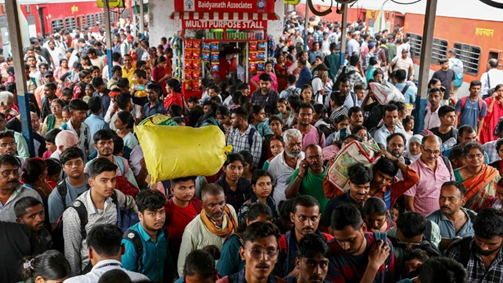
- Recently, the Indian transport infrastructure witnessed massive strain, highlighted by two major, simultaneous events: an immense rush on trains bound for Bihar during Chhath Puja and Bihar elections, and the mass cancellation of Indigo flights, leading to stranded passengers and inflated airfares.
- These crises serve to explain the reaction of prices and the responses of government and private players to demand and supply shocks, indicating the constraints imposed on welfare within a neo-liberal economic framework.
Background and Context
- During recent months, transport infrastructure in India has been placed under massive strain, with rail and air transport systems struggling to absorb sudden demand and supply shocks.
- In railways, mass festival and election-related migration towards Bihar generated unprecedented demand for trains, while capacity remained constrained, leading to overcrowding and safety concerns.
- In aviation, regulatory non-compliance by Indigo regarding crew norms triggered wide-scale cancellations, which reduced available seat capacity sharply and contributed to sharp fare escalation for remaining flights in presence of near-monopoly conditions.
Demand Shock and Government Services (Indian Railways)
- Nature of Demand Shock:
- Sudden surge in demand for Bihar-bound trains in October and November has been identified as classic demand shock, where demand curve shifted sharply upward while short-run supply of trains remained fixed.
- Under standard economic theory, if prices remain fixed due to policy, the outcome would be excess demand, overcrowding, and hazardous travelling conditions, exactly as observed in unreserved compartments.
- Role of Low Prices and Excess Demand:
- Government intervention in keeping rail fares low for social and welfare reasons prevented market-driven fare escalation, but this resulted in a number of travellers far exceeding train capacity, leading to rampant overcrowding and inefficiency.
- Standard criticism of public services has been highlighted, where low administered prices are blamed for excess demand and poor service quality.
- Investment-based Alternative:
- Criticism focusing only on low prices is argued to miss the fundamental issue, as the solution does not lie in raising prices, rather in increasing supply through government investment.
- For essential services such as health, education, and train travel, affordable prices must be maintained for welfare, but this must be complemented by significant state investment to expand infrastructure and access.
Neo-Liberal Constraints on Public Investment
- Fiscal Limits and Policy Framework:
- Expansion of public investment is described as difficult under neo-liberal economic regime, which imposes strict constraints on government intervention, especially through numerical limits on fiscal deficit.
- The state’s capacity to expand railway infrastructure and increase number of trains is restricted, even when social need is evident.
- Progressive Taxation of Top 1%:
- A route proposed for raising resources without breaching deficit limits is through higher wealth and income taxation of top 1% population, enabling strengthening of welfare state.
- Work of Thomas Piketty and collaborators has been cited to show that modest progressive taxation on richest 1% could generate substantial resources for public investment in welfare services, but such measures are described as politically unacceptable to domestic and global capital.
Monopolies and Indigo Flight Cancellations
- Nature of Supply Shock:
- The Indigo crisis has been characterised as supply shock, where withdrawal of large number of flights occurred, leading to a sharp rise in fares and welfare losses for passengers.
- The near-monopoly status of Indigo amplified price increases for alternative flights, as competition remained limited.
- Monopoly Power and Welfare Loss:
- Supply restrictions by one firm would not have resulted in systemic disruption if market structure had been genuinely competitive.
- Near-monopoly power enabled airlines to raise fares substantially in the face of supply shortfall, producing large consumer surplus loss and inequitable outcomes.
- Global Illustration: U.S. Inflation Episode:
- Non-competitive pricing power has been cited as a major factor in rapid inflation during former U.S. President Joe Biden’s term, where dominant firms used market power to inflate margins, creating a cost-of-living crisis.
- This situation highlights how monopoly power in neo-liberal economies can have macroeconomic and political consequences.
Neo-Liberal Economy and Structural Constraints
Asymmetry between State and Market
- The two crises are interpreted as outcomes of the neo-liberal economic model which restricts state intervention while encouraging deregulation of the private sector.
- Under this model, the state is constrained from raising taxes on the wealthy, expanding spending, and investing in public infrastructure, leaving it with limited options such as keeping prices low without expanding capacity, which leads to overcrowding and degraded service quality in sectors like railways.
Rise of Monopolies through Deregulation
- Simultaneously, deregulation of private sector activities has been argued to promote concentration of capital, enabling the formation of monopolies or oligopolies, as visible in the aviation sector.
- Instead of enhancing consumer welfare, such unregulated private markets with monopoly power can reduce welfare through higher prices, service disruptions, and vulnerability of users.
Common Thread between Rail and Aviation Crises
- While railway overcrowding and flight cancellations may appear qualitatively different, both have been presented as logical outcomes of the same economic framework that prioritises private interests and underplays public provisioning.
- The crises yield mirrored welfare failures in public and private domains, driven by underinvestment in public infrastructure and monopolistic pricing in deregulated concentrated markets, respectively.
Way Forward
- Expansion of public investment must be undertaken to ensure that essential services such as railways, aviation, health, and education are capable of meeting surging demand without compromising on quality or safety.
- Affordable pricing should be maintained, but it must be supported by adequate infrastructure and supply augmentation, rather than relying solely on low fares to achieve welfare objectives.
- Fiscal capacity of the state must be strengthened through sustainable resource mobilisation, including progressive taxation of top-income groups, to enable greater government spending on welfare and transport infrastructure.
- Regulatory oversight must be enhanced to prevent the rise of monopolies in critical sectors such as aviation and to ensure compliance with safety and operational standards, avoiding sudden withdrawal of services.
- Efficient planning mechanisms should be established to handle seasonal and election-related surges in passenger traffic, thereby reducing overcrowding and travel hazards.
- Public-private coordination frameworks should be developed to ensure that private market operations do not compromise consumer welfare, while allowing for efficient resource allocation.
- Monitoring and evaluation systems must be instituted to continuously assess service delivery, price stability, and infrastructure capacity, enabling timely interventions during crises.
Conclusion
- Recent railway overcrowding and Indigo flight cancellations are presented as illustrative crises that reveal the limits of the neo-liberal economic framework in delivering reliable, equitable, and welfare-enhancing transport services.
- It has been shown that low prices without investment and deregulated prices under monopoly both reduce welfare, especially for ordinary citizens and migrants.
- Unless underlying tendencies towards monopolies, fiscal constraints on public investment, and devaluation of public services are addressed, similar mass disruptions in transport systems are likely to reappear, with significant economic, social, and political consequences for India.
UPSC MAINS PYQs
- Why is Public Private Partnership (PPP) required in infrastructural projects? Examine the role of PPP model in the redevelopment of Railway Stations in India. (2022)
- The setting up of a Rail Tariff Authority to regulate fares will subject the cash strapped Indian Railways to demand subsidy for obligation to operate non-profitable routes and services. Taking into account the experience in the power sector, discuss if the proposed reform is expected to benefit the consumers, the Indian Railways, or the private container operators. (2014)