
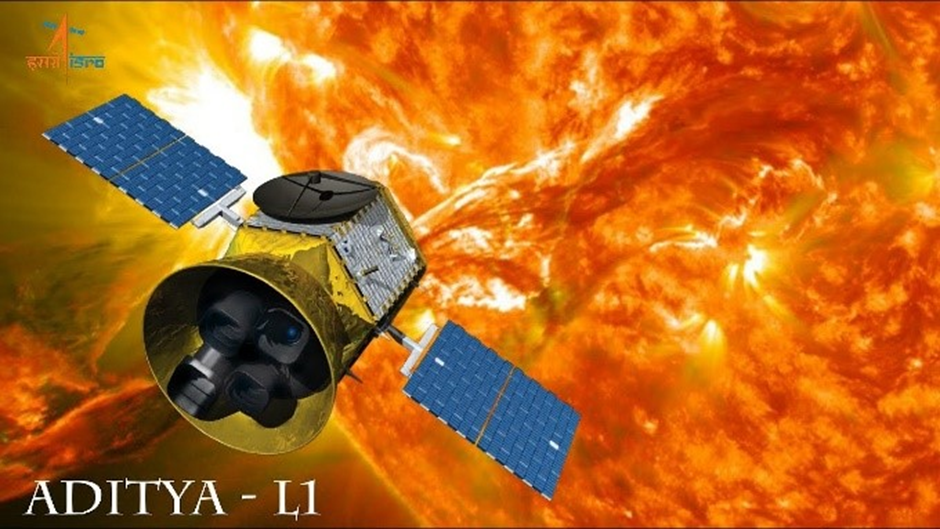
- India’s Aditya-L1, in collaboration with six U.S. satellites (including NASA’s Parker and Wind), has decoded the unusual behavior of the May 2024 Solar Storm (Gannon’s Storm).
- The Phenomenon: The mission observed a rare event where two Coronal Mass Ejections (CMEs) collided, triggering a process known as Magnetic Reconnection.
What did the Mission Reveal about Solar Storms?
- Magnetic Reconnection: Typically, CMEs carry twisted “magnetic ropes.” During this event, two CMEs collided, compressing the magnetic field lines until they snapped and rejoined.
- Scale of Event: The reconnection region was approximately 1.3 million km wide (nearly 100 times the size of Earth).
- Impact: This process caused a sudden reversal of magnetic fields, significantly intensifying the storm’s impact on Earth’s magnetic shield.
- Significance: This is the first recorded instance of such a massive magnetic breakup and rejoining observed inside a CME.
Key Features of the Aditya-L1 Mission?
- Objective: To study the Sun’s outermost layers: the Photosphere, Chromosphere, and Corona.
- Placement: Positioned in a Halo Orbit around the Lagrange Point 1 (L1), approx. 1.5 million km from Earth.
- Strategic Advantage: The L1 point allows for a continuous, uninterrupted view of the Sun without any occultation or eclipse.
- Payloads: It carries seven payloads to observe the Sun across various wavelengths (Visible, UV, X-ray) and measure particle flux/magnetic fields in situ.
How does Aditya-L1 compare to Global Missions?
- Parker Solar Probe (NASA): Closest mission to the Sun; studies the outer corona and solar wind.
- Solar Orbiter (ESA/NASA): Focuses on the Sun’s poles and the 11-year solar cycle.
- SOHO (NASA/ESA): Provides real-time data on space weather.
- ASO-S / Kuafu-1 (China): Studies solar flares and magnetic fields to understand Earth’s environmental impact.