
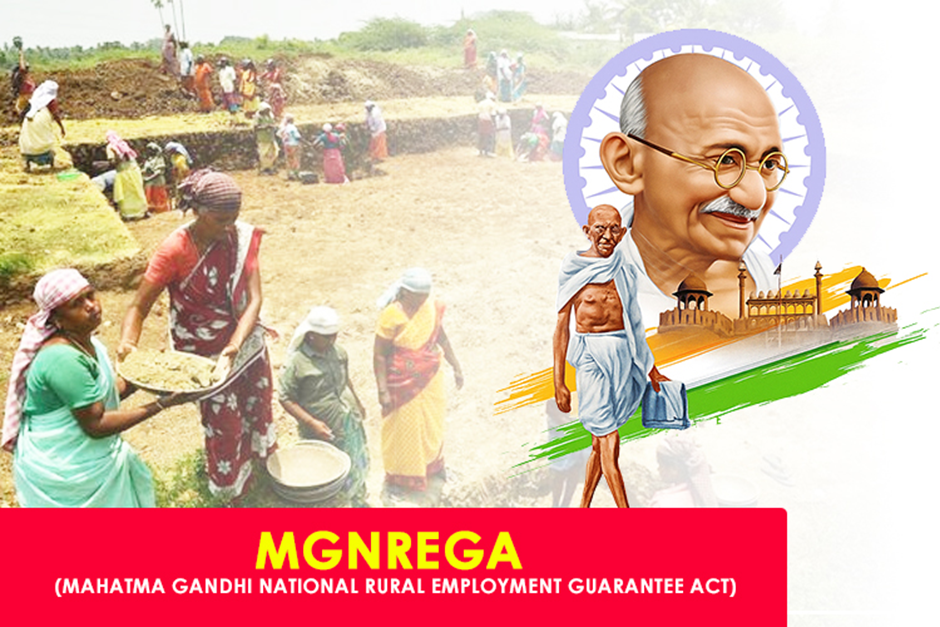
The Central Government is reportedly set to introduce a Bill in the ongoing Winter Session of Parliament to amend the Mahatma Gandhi National Rural Employment Guarantee Act (MGNREGA), 2005. The amendment proposes significant structural changes, including renaming the scheme to “Pujya Bapu Gramin Rozgar Yojana”.
What Are The Key Amendments Proposed?
- Renaming the Legislation: The original National Rural Employment Guarantee Act (renamed MGNREGA in 2009) is likely to be renamed “Pujya Bapu Gramin Rozgar Yojana”.
- Enhanced Employment Guarantee: The government plans to increase the guaranteed wage employment from the current 100 days to 125 days per financial year for every rural household.
- Structural Reforms: The Bill is expected to introduce exclusionary clauses based on the economic indices of States to address inter-state disparities in fund utilization.
The Reform Committee:
The proposed amendments rely heavily on the recommendations of the Amarjeet Sinha Panel (constituted in 2022).
- Mandate: To review the scheme’s implementation, specifically addressing why States with higher poverty rates showed lower expenditure under the scheme.
- Key Insight: The panel suggested rethinking the “one-size-fits-all” approach to better target economically distressed regions.
Key Statutory Provisions :
Legal Guarantee: The Act ensures a “Right to Work” for rural citizens.
Mandate: It guarantees 100 days (proposed 125) of unskilled manual work to every rural household whose adult members volunteer.
Eligibility:
- Must be a citizen of India.
- Must be 18+ years of age.
- Must reside in a rural household.
Unemployment Allowance: If work is not provided within 15 days of application, the applicant is entitled to an unemployment allowance (1/4th of minimum wage for the first 30 days; 1/2 thereafter).
Decentralized Implementation:
- Gram Sabhas are mandated to recommend works and must execute at least 50% of the projects.
- Work is typically provided within a 5 km radius of the village (travel allowance provided if beyond).
Social Audit: Section 17 of the Act mandates social audits for all works to ensure transparency and accountability.
Q. With respect to the implementation roles and allowance provisions under the rural employment act, consider the following statements:
- The Gram Sabhas are statutorily empowered to suggest works and are mandated to execute at least fifty percent of the total projects.
- In the event of a failure to provide employment within fifteen days, the applicant is entitled to an unemployment allowance equivalent to half of the minimum wage for the first thirty days.
- Section 17 of the Act mandates the conduct of social audits for all works executed under the scheme to ensure accountability.
How many of the statements given above are correct?
(a) Only one
(b) Only two
(c) All three
(d) None
Sol B
Statement 1 is correct. The article states that Gram Sabhas are given the authority to suggest work and are required to carry out at least half (50%) of the work.
Statement 2 is incorrect. The unemployment allowance is 1/4th of the minimum wage for the first 30 days, and 1/2 (half) for the period following that.
Statement 3 is correct. Section 17 of the MGNREGA specifically mandates a social audit of all works executed under the scheme.