
By reading this article you can solve the below UPSC PYQ-
What are the challenges before the Indian economy when the world is moving away from free trade and multilateralism to protectionism and bilateralism? How can these challenges be met?
                                                                                                                                                (GS-3) 2025
Context
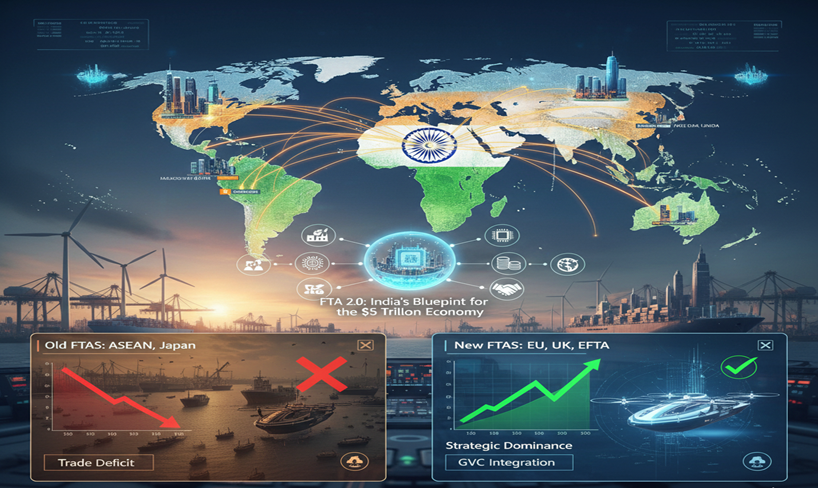
India’s strategy regarding Free Trade Agreements (FTAs) has undergone a crucial paradigm shift post-2019, moving from a cautious, defensive posture (e.g., withdrawal from RCEP) to an aggressive, proactive approach focused on securing “New Generation” FTAs with developed economies. This shift is integral to India’s ambition of becoming a 5 trillion Dollar economy and a major node in resilient Global Value Chains (GVCs).
Strategic Rationale Driving the New FTA Push
India’s accelerated pursuit of high-standard FTAs is driven by a mix of economic necessity and geopolitical strategy.
- Countering Global Protectionism: The primary economic driver is the need to secure preferential market access for Indian exporters in the face of rising global tariffs and trade barriers (e.g., American tariffs up to 50% on key exports).
- WTO Gridlock: The paralysis at the World Trade Organization (WTO) and the failure of the Doha Round have necessitated focusing on Bilateral and Regional Trade Agreements (RTAs) as the only viable mechanism to liberalize trade rules.
- Geopolitical Hedging and GVC Resilience: FTAs are used as a strategic tool to diversify supply chains and reduce reliance on single markets (like China). Pacts with partners like Australia, the UK, and EFTA are seen through the lens of Indo-Pacific cooperation and securing reliable sources of critical inputs and investment.
- Attracting Quality FDI and Technology: Agreements like the India-EFTA Trade and Economic Partnership Agreement (TEPA) are designed to be transactional, securing a binding investment commitment (e.g.$100 billion over 15 years from EFTA) in exchange for market access, thereby driving ‘Make in India’ and ‘Atmanirbhar Bharat’ goals by attracting advanced technology.
Critical Review of ‘First Generation’ FTAs
The current strategy is a course correction based on the mixed or unfavorable outcomes of older agreements (signed mainly during the “Look East” policy phase).
- Trade Deficit Widening: FTAs with ASEAN, Japan, and South Korea consistently resulted in a significant and widening trade deficit against India. For example, the trade deficit with ASEAN widened from about $10 billion in 2017 to nearly $44 billion by 2023.
- Structural Failures: The deficits arose primarily due to structural and policy flaws:
- Inadequate Negotiation of NTBs: India failed to secure adequate Mutual Recognition Agreements (MRAs) on quality standards, certifications, and Technical Barriers to Trade (TBT), preventing Indian exports from accessing partner markets easily.
- Weak Rules of Origin (ROO): Lax ROO provisions often allowed partners to re-route cheaper goods from third countries (e.g., China) through the FTA member, harming domestic industry.
- Low Utilization Rate: The average utilization rate of India’s FTAs is low (approx 25% compared to approx 70-80% globally), indicating insufficient domestic popularization and support for MSMEs to leverage preferential tariffs.
Major Ongoing / Active FTA Negotiations of India
1. India–European Union (EU) FTA
- Relaunched in 2022 after a gap of 9 years
- Covers trade in goods, services, investment, IPR, digital trade, sustainability
- EU is one of India’s largest trading partners
2. India–United Kingdom (UK) FTA
- Negotiations intensified post Brexit
- Focus areas:
- Services (IT, professionals)
- Reduction of tariffs on textiles, leather, gems & jewellery
- Also includes Double Contribution Convention (DCC)
3. India–Canada Comprehensive Economic Partnership Agreement (CEPA)
- Aims at:
- Services mobility
- Investment protection
- Education and skilled workforce cooperation
4. India–Gulf Cooperation Council (GCC) FTA
- GCC includes Saudi Arabia, UAE, Qatar, Kuwait, Oman, Bahrain
- Objective:
- Secure energy supply
- Boost trade in petrochemicals, food products, services
5. India–Eurasian Economic Union (EAEU) FTA
- Members: Russia, Kazakhstan, Belarus, Armenia, Kyrgyzstan
- Focus on:
- Pharmaceuticals
- Engineering goods
- Agriculture
Features of India’s ‘New Generation’ FTA Strategy
The new approach is holistic, high-standard, and tailored to India’s sectoral strengths.
I.Focus Shift- From tariff reduction on goods to deep integration in Services, Investment, and Non-Tariff Issues.
Example: Prioritisation of Professional Mobility (visa relaxation, social security exemptions) and IT/Services access.
II. Binding Investment- FTAs include explicit, binding commitments on FDI and job creation.
Example- EFTA’s $100 billion investment pledge linked to job targets.
III. New/Progressive Issues- Inclusion of high-standard chapters on labour rights, environmental protection, gender equity, and anti-corruption.
Example- Addressing the EU’s Carbon Border Adjustment Mechanism (CBAM) in negotiations, which targets carbon-intensive Indian exports (steel, cement).
IV. Custom-Designed Stance- Negotiations are shaped by intensive consultations with specific export sectors, moving away from generic agreements.
Example- Focus on services, seafood, and engineering goods for the US pact; protection of sensitive agricultural sectors (dairy, soya) through exclusion lists.
Challenges and Way Forward for FTA Success
A. Key Implementation Challenges
- Risk of Trade Deficit Repetition: Despite better negotiations, the inherent trade structure (India importing high-value capital goods) poses a continuous risk of widening deficits, especially with developed, high-tech economies like EFTA and Japan.
- Compliance with Progressive Clauses: Meeting the stringent labour and environmental standards demanded by the EU and UK could impose significant compliance costs on Indian MSMEs, potentially turning these progressive chapters into new Non-Tariff Barriers (NTBs).
- Safeguarding IPR and Pharmaceuticals: Negotiations on Intellectual Property Rights (IPR) with developed blocs threaten India’s generic pharmaceutical industry (e.g., concerns over data exclusivity clauses).
B. The Way Forward (Policy Imperatives)
- Strengthening Domestic Competitiveness: The arduous task of supporting India’s exporters must follow the pacts. This involves massive investment in standards infrastructure, technology upgrades, and quality testing facilities to meet partner countries’ regulatory requirements.
- Robust Monitoring of ROO: Establish strong institutional and legal mechanisms to strictly monitor the utilization of Rules of Origin to prevent trade deflection and safeguard domestic industry.
- Active FTA Outreach: Implement proactive campaigns by the Commerce Ministry to popularize FTAs among the MSME sector, providing easy-to-understand market intelligence and facilitating access to credit and logistics for exports.
- Strategic Ratification and Review: Establish a system for periodic review and renegotiation of existing FTAs to address imbalances and ensure they remain relevant to India’s evolving economic priorities.
Conclusion: India’s FTA strategy is a bold statement of its intent for global economic leadership. Its success, however, will be determined not just by the agreements signed, but by the domestic reforms, infrastructural investment, and targeted policy support that enable Indian industry to capitalize on the preferential access secured.