By reading this article you can solve the below Model questions for UPSC mains:
"The Blue Economy, in the context of the Indian Ocean Region (IOR), necessitates moving beyond traditional resource exploitation to a framework balancing economic prosperity and environmental sustainability." Explain.
                                                                                                                                             (GS-Paper-3)
Conceptual Shift: From Exploitation to Sustainability
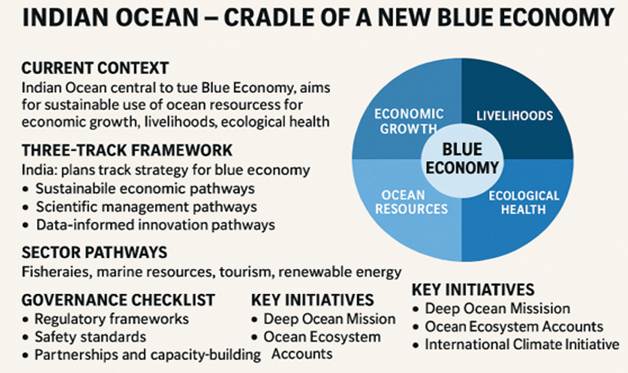
- New Paradigm: The Blue Economy moves beyond traditional ocean exploitation (like deep-sea fishing and oil drilling) to focus on the sustainable and responsible use of ocean resources for economic growth, improved livelihoods, and marine ecosystem health.
- Balancing Act: The core principle is achieving a balance between economic prosperity (Blue) and environmental conservation (Green).
- IOR’s Significance: The region, which hosts critical Sea Lanes of Communication (SLOCs) and is rich in biodiversity, must pioneer models of sustainable governance to serve as a global benchmark.
The Three Pillars of India’s Blue Ocean Strategy
India’s strategy rests on a framework designed for collective, sustainable, and resilient development in the Indian Ocean Region (IOR).
I. First Pillar: Stewardship of the Commons
- Core Principle: Asserting the Indian Ocean as a shared space, not a contested one, promoting cooperative management over competitive exploitation.
- Action Areas:
- Prioritising ecosystem restoration and biodiversity protection.
- Ensuring sustainable fisheries practices.
- Setting the tone for cooperative regional management.
II. Second Pillar: Resilience
- Core Principle: Focusing on adaptation and preparedness against the intensifying climate crisis.
- India’s Leadership Role: Establishing a Regional Resilience and Ocean Innovation hub to lead regional efforts.
- Key Initiatives:
- Strengthening ocean observation networks.
- Improving early warning systems (EWS).
- Facilitating technology transfer to Small Island Developing States (SIDS) and African coastal nations.
III. Third Pillar: Inclusive Growth
- Core Principle: Ensuring the Indian Ocean drives prosperity for all littoral states.
- Pathways to Development: Leveraging climate-compatible economic activities such as:
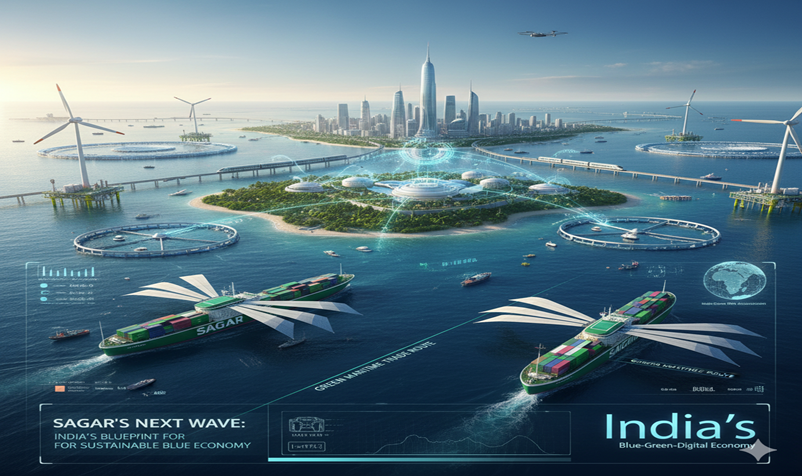
- Green shipping (decarbonisation of maritime transport).
- Offshore renewable energy (e.g., wind, tidal).
- Sustainable aquaculture (responsible farming).
- Marine biotechnology (innovations from marine life).
- Requirement: Realising this potential demands sustained investment and coordinated regional action.
SIGNIFICANCE OF THE BLUE OCEAN STRATEGY
I. Key Economic Sectors and Innovation
The focus is on leveraging technology to maximize resource utilization while minimizing environmental harm.
- Renewable Ocean Energy:
- Promoting the harnessing of offshore wind energy and exploring technologies like Ocean Thermal Energy Conversion (OTEC) and tidal/wave energy.
- Fisheries and Aquaculture:
- Implementation of the Pradhan Mantri Matsya Sampada Yojana (PMMSY) to promote sustainable and responsible fishing practices, cold-chain development, and value-addition.
- Emphasis on aquaculture expansion with a focus on environmental sustainability.
- Marine Biotechnology:
- Leveraging the vast and largely unexplored marine biodiversity of the IOR for innovation in pharmaceuticals, cosmetics, and industrial enzymes.
II. Sustainability and Climate Resilience
Protecting the IOR’s delicate ecosystems is central to the Blue Economy framework.
- Blue Carbon Ecosystems: Focus on the protection and restoration of coastal ecosystems—primarily mangroves and seagrass beds—which act as powerful Blue Carbon sinks, sequestering atmospheric CO2.
- Marine Spatial Planning (MSP): Developing a framework to organize and allocate space in the marine environment to minimize conflicts between economic activities (e.g., shipping, fishing, conservation) and achieve specific ecological objectives.
- Plastic Pollution Control: Implementation of effective strategies to manage and reduce marine plastic pollution, focusing on circular economy models for waste reduction and recycling.
Key Challenges to Realizing the Indian Ocean Blue Economy
I. Environmental and Climate Challenges (The Sustainability Crisis)
These challenges directly threaten the resource base upon which the Blue Economy must be built.
- Climate Vulnerability: The Indian Ocean is warming faster than any other ocean since the 1950s. This leads to:
- Rising Sea Levels and Extreme Weather: Increased frequency and intensity of cyclones, threatening coastal infrastructure and communities.
- Reduced Fish Stocks: Ocean warming and acidification are projected to reduce fish productivity, directly impacting livelihoods in coastal nations.
- Pollution and Habitat Degradation:
- Marine and Coastal Pollution: High levels of pollution from plastic waste, untreated sewage, and industrial run-off degrade marine health and coastal ecosystems.
- Unsustainable Practices: Overfishing, illegal, unreported, and unregulated (IUU) fishing, and habitat destruction (e.g., mangrove clearance)
- Regulatory Gaps: Relaxed coastal zone regulations (like the CRZ Notification) often prioritize real estate and large-scale development over conservation, increasing vulnerability.
II. Governance, Policy, and Institutional Hurdles
Effective execution is hampered by fragmented and uncoordinated mechanisms.
- Fragmented Governance: The Blue Economy involves multiple sectors (defense, trade, environment, energy) and jurisdictions (Central and State).
- Inter-Ministerial Coordination: Lack of strong institutional coordination across the 30+ ministries involved in the Indian Blue Economy agenda.
- Policy Gaps in Strategy: Initiatives like the SAGAR doctrine have been criticized for lacking a comprehensive white paper,
- Data and Technology Sharing:
- Maritime Domain Awareness (MDA): MDA is complicated by the collection and fusion of data. Littoral countries are often hesitant to share limited data due to national security concerns and mistrust.
- Technology Gaps: High upfront research and development costs for new sectors like Offshore Wind and Deep-Sea Exploration limit private investment and adoption.
III. Financial and Economic Constraints
Scaling up sustainable projects requires overcoming significant financial barriers.
- Financing Gap: Despite global pledges, successfully catalyzing public and private investments at scale into sustainable ocean sectors remains a major challenge, particularly for Small Island Developing States (SIDS).
- High Upfront Costs: Sectors like marine renewable energy and deep-sea exploration are characterized by high initial capital and technological costs, often deterring private investors.
- Infrastructure Deficit: Still require massive investment to match global standards and meet the demand of the ambitious Sagarmala and Maritime India Vision projects.
IV. Geopolitical and Security Threats
The IOR is a theatre of increasing great power competition, complicating regional cooperation.
- Geopolitical Rivalry: The escalating presence and strategic investments (like China’s Belt and Road Initiative – BRI) increase the pressure on India to balance cooperation with strategic competition, potentially diverting resources from pure Blue Economy development.
- Non-Traditional Security Threats: The IOR faces a persistent threat from Non-Traditional Security (NTS) issues that undermine economic stability and safety:
- Piracy and Armed Robbery: Despite recent decreases in some areas, incidents of piracy and armed robbery remain a risk, especially around critical chokepoints.
- Trafficking and Illegal Migration: The ocean is a route for drug smuggling, human trafficking, and illicit arms.
- IUU Fishing: Illegal, Unreported, and Unregulated fishing not only depletes fish stocks but also creates security issues and tensions among coastal states.
India’s Vision and Initiatives
India views the Blue Economy as a key pillar for national growth and regional stability, underpinned by major government programs.
- Deep Ocean Mission (DOM):
- Focus: A massive scientific and technological mission to explore and responsibly utilize deep-sea resources.
- Resource Mapping: Focus on mapping and developing technology for mining Polymetallic Nodules (PMN) in the Central Indian Ocean Basin.
- Human Presence: Development of the manned submersible vehicle, Matsya 6000.
- Infrastructure and Connectivity:
- Sagarmala Programme: Concentrates on modernizing ports, boosting port-led industrialization, and enhancing coastal shipping efficiency to reduce logistics costs.
- Green Port Mandate: Initiatives like the Harit Sagar Green Port Guidelines aim to decarbonize port operations and promote the use of cleaner fuels and renewable energy sources.
- Security and Regional Growth (SAGAR Doctrine):
- Diplomatic Framework: India’s policy of Security and Growth for All in the Region (SAGAR) underpins cooperation, capacity building, and maritime domain awareness across IOR littoral states.
- First Responder: Positioning India as the preferred security partner and ‘first responder’ for Humanitarian Assistance and Disaster Relief (HADR) in the region.
- India’s Opportunity and Proposed Fund
- Global Shift: These commitments demonstrate the ocean is now firmly on the global climate finance agenda.
- Call to Action for India: India must seize this momentum to channel global financing into IOR regional priorities.
- Proposed Mechanism: Creation of an Indian Ocean Blue Fund, to be:
- Seeded by India.
- Open to contributions from development banks, philanthropy, and the private sector.
- Serving as the institutional architecture to convert financial pledges into tangible projects.
Global Initiatives
I. Turning Financial Tide (Blue Economy Finance)
- Monaco Forum (June 2025): The Blue Economy and Finance Forum (BEFF) highlighted:
- A €25 billion pipeline of existing ocean investments.
- €8.7 billion in new commitments, with near-parity between public and private sources.
- Public Development Banks (PDBs):
- The Finance in Common Ocean Coalition (20 PDBs) announced annual pledges of $7.5 billion.
- The Development Bank of Latin America doubled its blue economy target to $2.5 billion by 2030.
- COP30 Commitment (Belém Action Agenda):
- The Brazilian Presidency launched the One Ocean Partnership.
- Commitment to mobilise $20 billion for ocean action by 2030.
WAYFORWARD
The Digital Enabler
The integration of digital technology is crucial for efficient and transparent Blue Economy operations.
- Ocean Data Systems: Utilization of AI, IoT, and satellite-based remote sensing for real-time monitoring of ocean health, fish stocks, and maritime traffic.
- Smart Ports: Deployment of digital solutions to automate and optimize port logistics, improving turnaround time and energy efficiency.
- Traceability: Using technologies like Blockchain to ensure the transparency and sustainability of seafood supply chains, allowing consumers to verify the origin and methods used
CONCLUSION
India must embrace its historic responsibility to establish the Indian Ocean as the Cradle of a New Blue Economy, vital for its journey to developed nation status. This requires a strategy focused on Resilience and Inclusive Growth, powered by advanced technology. By capitalizing on the surge in global climate finance through mechanisms like an Indian Ocean Blue Fund, India can accelerate investment in green shipping and offshore renewable energy, ensuring prosperity is built on a foundation of climate sustainability and regional solidarity.
RECAP