
After reading this article you can solve this UPSC model Question:
“Ethiopia occupies a pivotal position in India’s Africa policy.” In this context, examine the strategic, economic and diplomatic significance of India–Ethiopia relations. (250 words) GS-2 IR
Context:
Prime Minister Narendra Modi is on an official visit to Ethiopia (Dec 16-17, 2025) at the invitation of Ethiopian PM Dr. Abiy Ahmed Ali — his first full-fledged bilateral visit to Ethiopia in over a decade.
Introduction:
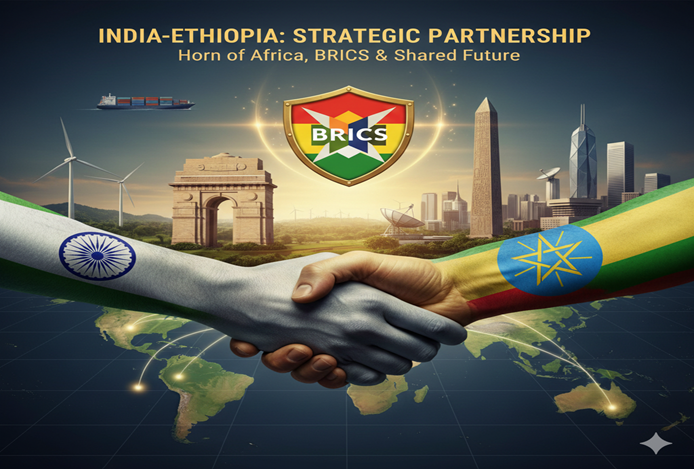
The relationship between India and Ethiopia, rooted in 2,000 years of civilizational ties dating back to the Axumite Empire, is entering a decisive phase. Ethiopia’s recent induction into BRICS (2024) and its strategic location in the Horn of Africa, coupled with high-level exchanges—including the Prime Minister’s first visit since 2011 (December 2025)—provide a critical juncture to elevate the partnership from traditional friendship to a comprehensive strategic engagement.
Historical and Political Foundations
Ancient Ties- Trade flourished since the 1st Century AD; Indian merchants exchanged silk and spices for gold and ivory. The presence of the Siddi community in India traces back to Ethiopian origins.
Modern Diplomacy- Established diplomatic relations in 1948. Ethiopia was the first African country to set up an embassy in New Delhi. Both nations shared a strong commitment to Non-Aligned Movement (NAM) principles.
Goodwill & Capacity- During Emperor Haile Selassie’s reign, a large number of Indian teachers developed significant goodwill, laying the foundation for Ethiopia’s modern education system. Many Ethiopian leaders and professionals are alumni of Indian universities.
Multilateral Cooperation- Both are strong partners in the Global South. Ethiopia has consistently supported India’s bid for a permanent seat on the UNSC and was a strong advocate for the African Union (AU)‘s permanent G20 membership (under India’s G20 Presidency, 2023).
Pillars of Contemporary Partnership (The ‘Boost’ Areas)
A. Economic and Trade Nexus
- Investment Powerhouse: India is the second-largest source of Foreign Direct Investment (FDI) for Ethiopia, with licensed investment exceeding $4 billion, creating over 75,000 jobs. Indian companies are dominant in Manufacturing (around 78%) and Agriculture.
- Trade Volume: Bilateral trade stood at USD 1.8 billion (2021). Indian exports mainly include pharmaceuticals, machinery, steel, and textiles. India imports pulses, oil seeds, and leather.
- Concessional Credit: India has extended Lines of Credit (LoC) worth over $1 billion for crucial sectors like rural electrification, sugar industries, and railways (e.g., three major sugar projects implemented).
B. Strategic and Security Cooperation
- Defence Engagement: The signing of a Defence Cooperation MoU (February 2025) and the inaugural Joint Defence Cooperation (JDC) meeting (October 2025) marked a new chapter.
- Areas of Focus: Collaboration in military training, joint exercises, defence industry engagement, and medical cooperation. This is critical for India’s strategic outreach into the Horn of Africa and the Western Indian Ocean region.
- Counter-Terrorism: Both countries share a common understanding of cross-border terrorism and can enhance intelligence and security cooperation in a volatile region.
C. Capacity Building and Digital Diplomacy
- ITEC & Scholarships: India remains a major capacity-building partner, training thousands of Ethiopian professionals and students under the Indian Technical and Economic Cooperation (ITEC) programme and ICCR scholarships.
- Pan-African e-Network: Ethiopia was the launchpad for the original Pan-African e-Network Project, pioneering tele-education and tele-medicine connectivity with India.
- Digital Public Infrastructure (DPI): Discussions are ongoing to explore Ethiopia’s adoption of India’s DPI model (like UPI, Aadhaar-like systems) to accelerate its digital economy.
D. Energy and Climate Collaboration
- International Solar Alliance (ISA): Ethiopia is a founding member of the ISA. India is supporting Ethiopia’s renewable energy goals through initiatives like the establishment of a Solar Technology Application Resource Center (STARC).
- Focus on Green Energy: The PM’s visit agenda prioritised cooperation in solar power, agriculture, and critical minerals, aligning with global energy transition goals.
Strategic Imperatives for India (The ‘Right Moment’)
- Horn of Africa Strategy: Ethiopia is a landlocked nation whose stability is key to the entire Horn of Africa region, which is vital for Indian Ocean trade and maritime security. Deeper engagement ensures India’s proactive presence.
- BRICS Alignment: As new BRICS partners, strengthening economic and political coordination with Ethiopia is essential to leverage the grouping for mutual benefit and to enhance the influence of the Global South.
- Countering Geopolitical Competition: Proactive engagement is necessary to maintain India’s position as a reliable and non-interfering development partner in the face of significant infrastructure and financial competition from other global powers.
- Food and Resource Security: Ethiopia is rich in resources and has vast agricultural land. Cooperation in agriculture and food processing can bolster India’s food security and help Ethiopia achieve its potential.
Challenges in India-Ethiopia Ties
The following are the key challenges that need to be navigated to realize the full potential of the strategic partnership:
- Internal Instability: Ethiopia has experienced periods of internal political dynamics and ethnic conflicts. This instability poses a risk to Indian investments and the continuity of bilateral projects, requiring careful monitoring.
- Project Delays: The successful execution of infrastructure projects funded through India’s Lines of Credit (LoC) has sometimes faced delays. Such setbacks can undermine India’s reputation as an efficient and reliable development partner.
- Logistical Bottlenecks: Being a landlocked country, Ethiopia faces inherent logistical challenges related to trade and connectivity. Dependence on the Djibouti-Ethiopia corridor can create bottlenecks for increased trade and investment flows.
- Chinese Competition: India faces intense competition from global powers, particularly China, which has massive financial capabilities and an established footprint in African infrastructure development, requiring India to offer a distinctive value proposition.
Way Forward
To overcome the challenges and strategically boost ties, the following recommendations are crucial:
- Strategic Project Focus: India must carefully monitor internal political dynamics and ethnic conflicts, choosing to focus development projects on stable regions to mitigate risks and ensure project longevity.
- Ensuring Timely Execution: The government must prioritize mechanisms to ensure timely execution of LoC-funded infrastructure projects. This is essential to uphold India’s reputation as a reliable and efficient development partner.
- Enhancing Connectivity: India should actively invest in enhancing connectivity, which could include potential equity or technical investments in the existing Djibouti-Ethiopia corridor or proactively exploring alternative routes, possibly via the Asia-Africa Growth Corridor (AAGC) framework.
- Differentiated Engagement Model: India must differentiate its engagement model from competitors by focusing on its unique strengths: capacity building, transparency, and demand-driven projects based on the South-South Cooperation model, rather than competing on the sheer volume of opaque, debt-heavy infrastructure deals.
Conclusion:
The India-Ethiopia relationship is at a critical inflection point. Leveraging Ethiopia’s new status as a BRICS member and its geopolitical importance in the Horn of Africa, India must strategically move beyond historical goodwill to establish a future-ready partnership.