
President Droupadi Murmu recently rejected the mercy petition of a convict sentenced to death for a heinous crime in Maharashtra. This marks the third mercy plea rejection during her tenure.
1. Constitutional Source of Power :
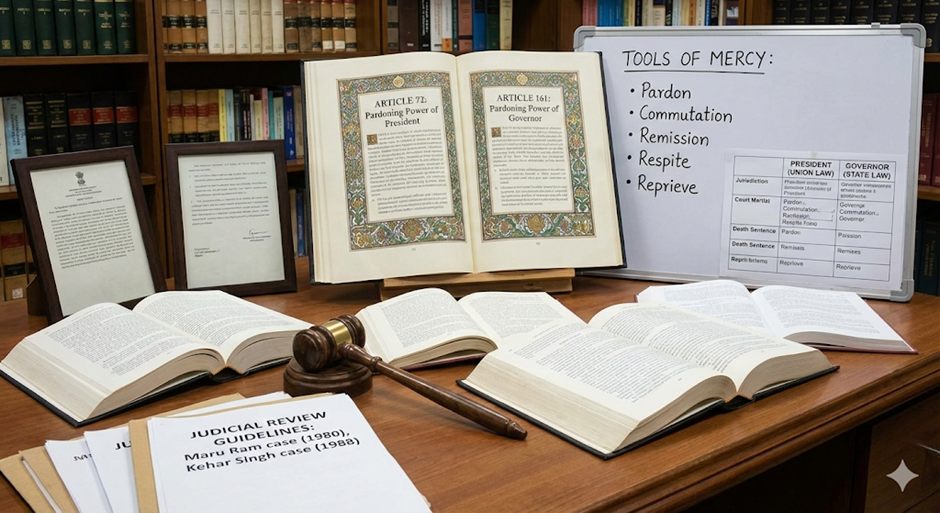
- Article 72: Empowers the President to grant pardons, reprieves, respites, or remissions of punishment or to suspend, remit, or commute the sentence of any person.
- Article 161: Empowers the Governor of a State to grant similar reliefs for offences against any law relating to a matter to which the executive power of the State extends.
2. Constitutional Tools of Mercy :
- Pardon: Completely absolves the convict from all sentences, punishments, and disqualifications. It removes both the sentence and the conviction.
- Commutation: Substitution of one form of punishment for a lighter form (e.g., Death sentence to Rigorous Imprisonment).
- Remission: Reducing the period of a sentence without changing its character (e.g., 2 years Rigorous Imprisonment to 1 year Rigorous Imprisonment).
- Respite: Awarding a lesser sentence due to a special fact (e.g., physical disability or pregnancy of the convict).
- Reprieve: A stay of the execution of a sentence (usually death) for a temporary period to allow the convict time to seek pardon.
3. Comparative Analysis: Article 72 vs. Article 161
| Feature | President (Article 72) | Governor (Article 161) |
| Jurisdiction | Offences against Union Law. | Offences against State Law. |
| Court Martial | Can pardon sentences given by a Military Court. | Cannot pardon sentences by a Military Court. |
| Death Sentence | Can pardon all death sentences (even if under State law). | Cannot pardon a death sentence. Can only suspend, remit, or commute it. |
4. Judicial Review & Established Precedents
The Supreme Court has laid down critical guidelines regarding the exercise of this power:
- Maru Ram vs. Union of India (1980):
- The President and Governor cannot exercise this power on their own discretion.
- They must act on the advice of the Council of Ministers.
- Kehar Singh vs. Union of India (1988):
- The petitioner has no right to an oral hearing by the President.
- The President can examine evidence afresh and take a view different from the court’s.
- Judicial Review: The decision is generally not subject to judicial review except where the decision is arbitrary, irrational, mala fide, or discriminatory.
Q. With respect to the jurisdiction over Court Martial sentences, consider the following statements:
- The President can grant pardons for punishments awarded by a Military Court.
- The Governor of a State possesses concurrent power to pardon sentences given by a Court Martial.
Which of the statements given above is/are correct?
(a) 1 only
(b) 2 only
(c) Both 1 and 2
(d) Neither 1 nor 2
SOL A
Statement 1 is correct: Article 72 explicitly empowers the President to pardon sentences awarded by a Court Martial.
Statement 2 is incorrect: The Governor acts under Article 161 and does not possess any power regarding sentences or punishments awarded by a Military Court.