
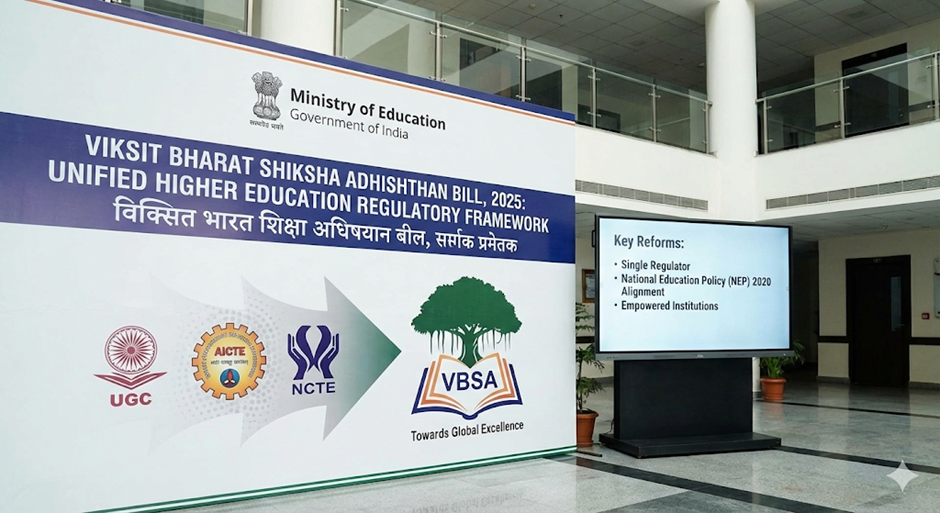
The Union Government has introduced the Viksit Bharat Shiksha Adhishthan (VBSA) Bill, 2025 in the Parliament. The Bill aims to replace the existing fragmented regulatory ecosystem with a single, unified umbrella body, operationalizing the vision of the National Education Policy (NEP) 2020.
1. The “One Nation, One Regulator” Approach
- Dissolution of Existing Bodies: The Bill proposes to subsume and replace three major statutory bodies:
- University Grants Commission (UGC)
- All India Council for Technical Education (AICTE)
- National Council for Teacher Education (NCTE)
New Apex Body: Establishment of the Viksit Bharat Shiksha Adhishthan (VBSA), a 12-member umbrella commission chaired by an eminent academician.
2. The Three-Tier Vertical Structure
The VBSA will function through three specialised autonomous councils, each with specific mandates:
- Viksit Bharat Viniyaman Parishad (Regulatory Council): Focuses on single-point regulation and governance norms.
- Viksit Bharat Gunvatta Parishad (Accreditation Council): Oversees the accreditation ecosystem, shifting focus from “inputs” to “learning outcomes.”
- Viksit Bharat Manak Parishad (Standards Council): Sets academic standards and harmonises quality benchmarks across institutions.
3. Jurisdiction & Exclusions: Who is Covered?
- Inclusions:
- All Central and State Universities.
- Institutions of National Importance (INIs) and Institutions of Eminence (IoEs).
- Colleges, Technical, and Teacher Education institutions.
- Exclusions :
- Medical and Legal Education: Professional courses like Medicine, Dentistry, Nursing, Pharmacy, and Law remain under their respective statutory bodies (e.g., NMC, BCI).
- Architecture: The Council of Architecture retains the power to set standards but will not have regulatory powers.
4. Key Statutory Changes
- Separation of Funding: Unlike the UGC, the VBSA will not have grant-giving powers. Financial grants will be disbursed directly through mechanisms devised by the Ministry of Education.
- Internationalisation: The Regulatory Council is empowered to:
- Notify regulations for Foreign Universities entering India.
- Facilitate Indian universities in setting up offshore campuses.
5. About National Education Policy (NEP) 2020: A Vision for the 21st Century
- Historical Significance: It is the first education policy of the 21st century, replacing the National Policy on Education (NPE), 1986.
- Drafting Committee: Formulated based on the recommendations of the committee led by Dr. K. Kasturirangan.
- Global Alignment: The policy is aligned with the 2030 Agenda for Sustainable Development.
- Core Objective: Aims to transform India into a global knowledge superpower by fostering a holistic, flexible, and multidisciplinary education system that nurtures the unique capabilities of every student.
6.What are the Quantifiable Targets?
- By 2025: Attain Foundational Literacy and Numeracy (FLN) skills through a National Mission.
- By 2030:
- Universalize education from Early Childhood Care and Education (ECCE) to the Secondary level (aligned with SDG 4).
- Achieve 100% Gross Enrolment Ratio (GER) in Pre-School to Secondary levels.
- Establish an Inclusive and Equitable Education System.
- By 2035: Increase GER in Higher Education to 50%.
- Institutional Goals:
- Reintegrate 2 crore children into the mainstream via the open schooling system.
- Complete teacher preparation for assessment reforms (Targeted for 2023).
Q. With reference to the institutional structure proposed under the Viksit Bharat Shiksha Adhishthan (VBSA) Bill, 2025, consider the following statements:
- The Bill proposes to subsume the UGC, AICTE, and NCTE into a single unified umbrella body.
- The VBSA Commission will be chaired by the Union Minister of Education.
- The VBSA will function through three specialised autonomous councils focusing on regulation, accreditation, and standards.
Which of the statements given above is/are correct?
(a) 1 and 2 only
(b) 1 and 3 only
(c) 2 and 3 only
(d) 1, 2 and 3
SOL B
- Statement 1 is correct: The Bill operationalizes the “One Nation, One Regulator” approach by dissolving the UGC, AICTE, and NCTE and replacing them with the VBSA.
- Statement 2 is incorrect: The VBSA will be a 12-member umbrella commission chaired by an eminent academician, not the Union Minister.
- Statement 3 is correct: The structure includes three vertical councils: the Regulatory Council, the Accreditation Council, and the Standards Council.