
After the reading of this article you can solve the UPSC Mains PYQ
With growing energy needs should India keep on expanding its nuclear energy programme? Discuss the facts and fears associated with nuclear energy.2018(GS 3 Science & Technology)
CONTEXT:
India’s nuclear policy is a sophisticated blend of strategic restraint and ambitious civilian energy expansion.It is essential to distinguish between the Nuclear Weapon Doctrine (security) and the Nuclear Power Programme (governance and energy).
Why need Civil Nuclear Programme:
I. The “Net Zero” & Decarbonization Imperative
India has committed to achieving Net Zero emissions by 2070.
- Data: In 2024–25, coal still accounted for roughly 75%–78% of India’s total electricity generation.
- Example: To decarbonize while demand grows, India needs “baseload” power that isn’t coal. Unlike solar/wind (which are intermittent), nuclear provides stable, 24/7 power with near-zero CO₂ emissions.
- Goal: The Nuclear Energy Mission aims to reach 100 GW of nuclear capacity by 2047 to replace aging coal plants.
II. Energy Security & Strategic Autonomy
Relying on imported oil and gas makes India vulnerable to global price shocks (e.g., the 2022-2025 energy price fluctuations).
- Data: India holds 25% of the world’s thorium reserves but only ~2% of global uranium.
- Example: India’s unique “Three-Stage Nuclear Power Programme” is designed specifically to eventually use its vast thorium deposits.
III. Economic Efficiency & Grid Stability
While the initial cost of building a nuclear plant is high, the long-term operational costs are significantly lower than fossil fuels.
- Data: In FY 2024–25, Indian nuclear plants achieved a Plant Load Factor (PLF) of 87%, significantly higher than the thermal (coal) PLF of ~60-70%.
Civil Nuclear Governance and Energy:
India’s civilian program is governed by the Atomic Energy Act, 1962.
Institutional Framework
- Department of Atomic Energy (DAE): Under the direct charge of the Prime Minister. It executes all nuclear-related activities.
- Atomic Energy Commission (AEC): The apex body for formulating policy and directing research.
- Atomic Energy Regulatory Board (AERB): An independent body that ensures nuclear safety and radiation protection.
- NPCIL & BHAVINI: Public sector units responsible for the construction and operation of nuclear power plants.
The 3-Stage Nuclear Power Programme
Designed by Dr. Homi Bhabha to utilize India’s vast thorium reserves (25% of global reserves) since uranium is scarce.
| Stage | Technology | Fuel Used | Key Feature |
| Stage 1 | Pressurized Heavy Water Reactors (PHWR) | Natural Uranium | Generates electricity and Plutonium-239. |
| Stage 2 | Fast Breeder Reactors (FBR) | Plutonium-239 | “Breeds” more fuel than it consumes. |
| Stage 3 | Thorium-Based Reactors (AHWR) | Thorium-232 + U-233 | Ultimate goal for energy independence. |
Current Developments:
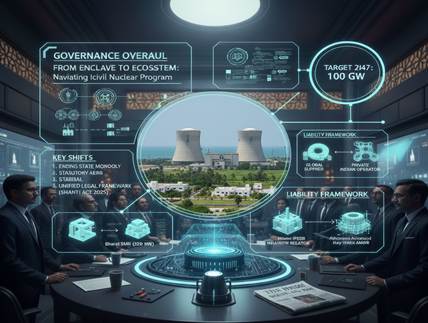
The SHANTI Bill, 2025: A Governance Overhaul
The Sustainable Harnessing and Advancement of Nuclear Energy for Transforming India (SHANTI) Bill was introduced to repeal and replace the Atomic Energy Act, 1962 and the Civil Liability for Nuclear Damage (CLND) Act, 2010.
I. Key Governance Shifts
- Ending State Monopoly: The Bill removes the exclusive mandate of the Nuclear Power Corporation of India (NPCIL) and BHAVINI. It allows private Indian companies and joint ventures to build, own, and operate nuclear plants.
- Statutory Status for AERB: For decades, the Atomic Energy Regulatory Board (AERB) functioned under the Department of Atomic Energy (DAE). The Bill finally confers statutory status to the AERB, aimed at enhancing its independence and safety oversight.
- Unified Legal Framework: By merging liability and operational laws into a single statute, the government aims to reduce “transaction costs” and “legal ambiguity” for new investors.
- Target 2047: Aiming for 100 GW of nuclear capacity by 2047 (currently ~8.8 GW).
II. Addressing the “Liability” Deadlock
- Supplier Accountability: The new Bill restricts the “Right of Recourse.” Operators can now only claim damages from suppliers if it is explicitly written in a contract or if there is “intent to cause damage.” This protects equipment suppliers (like GE or Westinghouse) from open-ended liability.
- Liability Caps: Maximum operator liability is now capped at ₹3,000 crore (approx. 300 million SDRs).
- The Central Government will cover damages exceeding this cap.
- For “severe breaches,” penalties are limited to ₹1 crore, a point of contention for some critics regarding its adequacy as a deterrent.
III. Governance Gaps & Concerns
A. Regulatory Independence
Despite statutory status, the AERB’s leadership appointments are still heavily influenced by the Atomic Energy Commission (AEC) and the Centre. True independence—essential for public trust—requires a selection process shielded from the executive branch of the DAE.
B. Public Accounting and Insurance
The Bill requires private operators to maintain insurance but exempts government-owned installations from the same. Critics argue this creates a dual standard and lacks transparency in public accounting for potential disasters.
C. Compensation Adequacy
The ₹3,000 crore cap is viewed by some as insufficient for “environmental remediation” and victim compensation in the event of a large-scale catastrophe, potentially shifting the financial burden onto the taxpayer.
IV. Strategic & Operational Reforms
- Small Modular Reactors (SMRs): Governance is pivoting toward “Bharat Small Reactors” (220 MW). These are easier to finance and can be located near industrial clusters (e.g., steel/cement) to provide captive green power.
- Foreign Participation: While foreign technology is welcome, the Bill ensures that sensitive fuel cycles (enrichment, reprocessing, and uranium mining) remain strictly under State Control to prevent proliferation risks.
- New Redressal Bodies: The Bill proposes an Atomic Energy Redressal Advisory Council and Claims Commissioners to handle disputes, moving away from traditional slow-moving civil courts.
Comparison: Old vs. New Governance
| Feature | Atomic Energy Act, 1962 | SHANTI Bill, 2025 |
| Operator | Only Govt PSUs (NPCIL/BHAVINI) | PSUs, Private Firms, JVs |
| AERB Status | Administrative Body (under DAE) | Statutory Body (Independent) |
| Supplier Liability | High (Right of Recourse) | Limited (Contractual only) |
| SMR focus | Minimal | High (Specialized Licensing) |
Key Challenges:
1. Legislative & Legal Challenges
The most significant debate in the current Winter Session of Parliament revolves around the dilution of liability norms.
- Dilution of Supplier Liability: Critics argue that by removing the “Right of Recourse” against suppliers for defective equipment (formerly Section 17(b) of the CLND Act), the government is granting a “free pass” to global vendors. This raises the risk of sub-standard technology entering the Indian market without legal accountability for the manufacturer.
- Exclusion of Civil Courts: Section 81 of the SHANTI Bill bars civil courts from hearing nuclear damage claims, vesting power solely in a Nuclear Damage Claims Commission. Opponents argue this undermines the “Right to Justice” and the doctrine of separation of powers.
- Penalties vs. Risks: The maximum penalty for a “severe breach” by an operator is capped at ₹1 crore. Critics argue this is a “pittance” compared to the catastrophic environmental and health risks involved in nuclear operations.
2. Safety & Regulatory Concerns
With the entry of private players, the regulatory burden on the state increases exponentially.
- AERB’s “Statutory” vs. “Real” Independence: While the Bill grants statutory status to the Atomic Energy Regulatory Board (AERB), it remains answerable to the Centre. Without financial and administrative autonomy from the DAE, there is a perceived “conflict of interest” where the promoter (DAE) and the regulator (AERB) are closely linked.
- Oversight of Private Players: Transitioning from a state-only model to a multi-operator model (JVs and private firms) requires a massive scale-up in specialized inspection manpower, which India currently lacks.
- Spent Fuel Management: The Bill keeps “spent fuel” and “enrichment” under state control. Managing a larger volume of high-level radioactive waste from private plants will put a severe strain on India’s storage and reprocessing infrastructure.
3. Financial & Economic Hurdles
The capital-intensive nature of nuclear power remains its Achilles’ heel.
- The Funding Gap: While the goal is 100 GW by 2047, requiring nearly ₹15 lakh crore, current budget outlays (e.g., ₹20,000 crore for the Nuclear Energy Mission) are a drop in the ocean.
- Commercial Viability of SMRs: Small Modular Reactors (SMRs) are “factory-built,” but the per-unit cost of electricity remains higher than solar and wind. Private players may be reluctant to invest unless the government provides Viability Gap Funding (VGF) or assured high-tariff Power Purchase Agreements (PPAs).
- Insurance Pool Limitations: The Indian Nuclear Insurance Pool (INIP) has a limited capacity. If multiple private plants are commissioned, the pool may be insufficient to cover the required liability insurance, forcing operators to look for expensive global re-insurance.
4. Strategic & Social Challenges
- The “NIMBY” Syndrome: “Not In My Backyard” protests remain the biggest hurdle to land acquisition. Protests seen in Kudankulam and Jaitapur are likely to intensify if private corporations are seen as profiting at the cost of local environmental safety.
- Uranium Dependency: India still relies on imports for 75% of its uranium requirements. Increasing nuclear capacity without securing long-term “fuel tie-ups” or joining the Nuclear Suppliers Group (NSG) makes our energy security vulnerable to global geopolitical shifts.
- Cyber-Security: Digitalizing nuclear controls to accommodate modern SMR designs increases the “attack surface” for state-sponsored cyber-terrorism, requiring a sophisticated Nuclear Cyber Command.
Way forward:
1. Strengthening the Regulatory Ecosystem
- Functional Independence of AERB: Granting statutory status is the first step. The way forward involves ensuring that the Atomic Energy Regulatory Board (AERB) has financial autonomy and a transparent selection process for its leadership, free from the influence of the Department of Atomic Energy (DAE).
- Harmonization with IAEA Norms: As private players enter, India must align its safety and inspection protocols with International Atomic Energy Agency (IAEA) standards to build global investor confidence.
2. Unlocking Private and Foreign Capital
- Operationalizing Joint Ventures (JVs): The government should expedite JVs between NPCIL and private giants (like Tata Power, Reliance, or Adani). The “49% minority equity” model needs clear guidelines on profit repatriation and operational risk-sharing.
- Global Strategic Partnerships: With the “Right of Recourse” deterrent removed, India should revive stalled projects like Jaitapur (France) and Kovvada (USA). This will bring in Light Water Reactor (LWR) technology to complement indigenous PHWRs.
3. Scaling Small Modular Reactors (SMRs)
- Industrial Decarbonization: SMRs (like the Bharat Small Reactor) should be deployed in Public-Private Partnership (PPP) modes near “hard-to-abate” sectors like steel and cement.
- Regulatory Sandbox: Create a “regulatory sandbox” for SMRs to test factory-based modular manufacturing, which can significantly reduce the 10-15year gestation period of traditional plants.
4. Public Trust and Social License
- Transparent Communication: Nuclear energy still faces the “Fukushima Shadow.” The government must move beyond top-down implementation to a stakeholder-led approach, involving local communities in environmental impact assessments (EIA).
- Enhanced Liability Fund: While the operator’s liability is capped at ₹3,000crore, the Nuclear Liability Fund must be robustly funded through a “Nuclear Cess” or insurance pools to ensure that in an extreme event, compensation is swift and sufficient.
5. Completing the Nuclear Fuel Cycle
- Uranium Security: While opening up mining, India must continue its “strategic hedging” by diversifying uranium imports (Kazakhstan, Canada, Australia) and securing long-term supply contracts.
- Stage 2 & 3 Acceleration: While the SHANTI Bill focuses on the immediate “Power” stage, the long-term way forward remains the commercialization of the Fast Breeder Reactor (PFBR) to eventually unlock the vast Thorium potential.
Conclusion
India’s nuclear policy is at a historic inflection point. The transition from the restrictive Atomic Energy Act of 1962 to the reformative SHANTI Bill of 2025 signals India’s intent to integrate nuclear energy into its broader “Viksit Bharat @ 2047” vision.
The shift toward a liberalized governance model—characterized by private sector participation, statutory regulatory independence, and Small Modular Reactors (SMRs)—is no longer a choice but a necessity to meet the Net-Zero 2070 commitments.