
After reading this article you can solve the Model question for UPSC Mains
"The India–US relationship has successfully transitioned from 'estranged democracies' to 'indispensable strategic partners.' However, India's pursuit of strategic autonomy and its legacy ties with Russia continue to act as a litmus test for this partnership. Discuss."- 250 words (GS 2 International Relations)
CONTEXT:
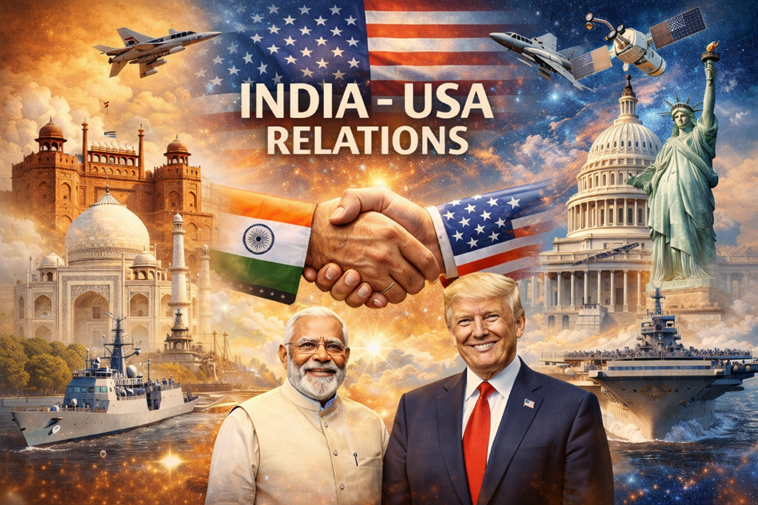
In 2005, India–U.S. relations entered a transformative phase, marked by American confidence in strengthening rising powers, symbolised by the civil nuclear deal and support for India’s global rise. The 2025 U.S. National Security Strategy reflects a sharp departure from this outlook. The U.S. now adopts a defensive, inward-looking posture, viewing global leadership as a burden. India is framed instrumentally, primarily within America’s China strategy, rather than as an end in itself. Cooperation remains important but increasingly transactional. Consequently, India’s emergence as a major power will depend on its own strategic confidence, autonomy, and capacity within a fragmented global order.
How Have India-USA Deepened Their Bilateral Relationship?
A. Defense Ties: From Buyer to Co-producer
The relationship is governed by the COMPACT (Catalyzing Opportunities for Military Partnership, Accelerated Commerce & Technology) framework.
- Key Procurement: Integration of MQ-9B Predator drones, P-8I Poseidon aircraft, and discussions for F-35 fighter jets.
- Co-production: Focus on GE F414 jet engines in India and the INDUS-X initiative which connects defense startups.
- Interoperability: Foundational agreements (LEMOA, COMCASA, BECA) are now fully operational, enabling real-time ISR (Intelligence, Surveillance, Reconnaissance) sharing.
B. Technology & Space: The New Frontier
Technology is now the “defining” pillar of the relationship.
- The TRUST Initiative: Rebranded from iCET, focusing on Semiconductors, AI Infrastructure, and Quantum Computing.
- Space Collaboration:NISAR Mission: The NASA-ISRO Synthetic Aperture Radar (NISAR) satellite was successfully launched in July 2025 to map Earth’s changes.
- Gaganyaan & ISS: NASA is facilitating the training and transport of Indian “Gaganyatris” (Group Capt. Shubhanshu Shukla) to the International Space Station (ISS) via the Axiom-4 mission.
C. Geopolitical Interests: The Indo-Pacific & Global Order
- The Quad: Continued commitment to a “Free and Open Indo-Pacific” to counter China’s maritime assertiveness.
- Middle East & I2U2: Collaboration in the Middle East via the I2U2 group (India, Israel, UAE, US) for food security and energy.
- Strategic Autonomy: India maintains its “neutral” stance on the Russia-Ukraine conflict, which remains a primary point of friction with Washington.
D. People-to-People & Business
- The Diaspora: 4.5 million Indian-Americans act as a “living bridge,” influencing U.S. policy through the “Samosa Caucus.”
- Tourism & Culture: The U.S. remains a top destination for Indian students and tourists, though H-1B visa caps and deportation debates continue to create anxiety.
- Investment: Massive investments by Apple, Micron (Semiconductors), and Microsoft ($17.5 Billion in 2025) underline the “China+1” strategy.
Geopolitical Significance for India:
1. Strategic Centrality: The “Net Security Provider”
India’s role in the Indian Ocean Region (IOR) and the broader Indo-Pacific is the cornerstone of its geopolitical importance.
- MAHASAGAR Doctrine (2025): Launched in March 2025, this extends the earlier SAGAR vision to the entire Global South, including Africa and the Pacific Islands. It positions India as a “steward of the ocean commons.”
- Maritime Leadership: As the IORA Chair (2025–27), India is the lead responder for Disaster Relief (HADR), counter-piracy, and maintaining sea lines of communication (SLOCs) through which 90% of its trade and the world’s energy pass.
- The “China+1” Strategy: Geopolitically, India is viewed as the primary alternative to China for global supply chain resilience, reinforced by initiatives like the Indo-Pacific Economic Framework (IPEF).
2. The India-US Geopolitical “Stress Test” (2025)
- The Tariff Crisis: In August 2025, the U.S. imposed 50% tariffs on Indian goods, citing India’s purchase of Russian oil and its rejection of U.S. mediation offers during the May 2025 India-Pakistan border tensions.
- Strategic Autonomy under Fire: India’s refusal to “pick sides” in the Russia-Ukraine conflict or the Israel-Gaza crisis has created a “values-gap” with Washington. However, India argues that its oil purchases stabilize global energy markets—a view previously supported by U.S. officials like Janet Yellen.
- Security Safety Net: Despite trade wars, the COMPACT (defense co-production) and TRUST (critical tech) initiatives continue, showing that the “strategic logic” of the partnership remains intact due to the shared “China Factor.”
3. Voice of the Global South
India has successfully leveraged its capacity to convene 125+ nations through the Voice of Global South Summits.
- Institutional Reform: India is leading the charge for UNSC and WTO reforms, arguing that the current global governance architecture is “passé” and must reflect the demographic realities of India and Africa.
- Economic Resilience: On November 21, 2025, India enacted four landmark Labour Codes, described as the most significant structural reform since 1991. This is a geopolitical move to build “domestic resilience” against external volatility like U.S. tariffs.
CHALLENGES OF US INDIA RELATION:
1. The 2025 Trade & Tariff Crisis
The single most visible challenge today is the collapse of trade predictability.
- The 50% Tariff Barrier: Since late August 2025, the U.S. has imposed a combined 50% tariff on most Indian exports (10% baseline + 15% reciprocal + 25% penalty for Russian oil imports). This has hit labor-intensive sectors like textiles, gems and jewelry, and auto components severely.
- Competitiveness Gap: Unlike India, competitors like Vietnam and Mexico have managed to maintain lower tariff access to the U.S. market, leading to a loss of market share for Indian exporters.
- Failure of Trade Deal: Despite multiple deadline extensions in 2025, a comprehensive trade agreement remains elusive due to disagreements over dairy access, medical device pricing, and India’s refusal to cut ties with Russia.
2. Strategic Divergence over Russia and Iran
India’s “Strategic Autonomy” is no longer just a diplomatic term; it is a friction point.
- The Russian Oil “Penalty”: The U.S. has explicitly linked its trade penalties to India’s continued imports of discounted Russian crude. This puts India in a bind between its Energy Security and its Trade Security.
- Defense Spares and CAATSA: With 60% of India’s military equipment being of Russian origin, the risk of U.S. “secondary sanctions” under CAATSA (Countering America’s Adversaries Through Sanctions Act) remains a persistent threat to India’s operational readiness.
- Iran & Chabahar: U.S. sanctions continue to hamper the full operationalization of the Chabahar Port, which is India’s strategic gateway to Central Asia and a counter to China’s Gwadar.
3. The “Pannun” and “Nijjar” Diplomatic Standoff
Issues of sovereignty and intelligence operations have entered the bilateral discourse.
- Transnational Repression Accusations: Allegations regarding the attempted assassination of separatist leader Gurpatwant Singh Pannun on U.S. soil have strained the “trust” between intelligence agencies.
- Values vs. Interests: This has reignited the debate in Washington on whether India is a “values-based” ally or merely an “interests-based” partner. The U.S. Congress has become increasingly vocal about human rights and “democratic backsliding,” adding a layer of political complexity.
4. Technology Alignment vs. Tech Autonomy
While initiatives like iCET and TRUST promote cooperation, there is a “hidden” conflict over standards.
- Export Controls: India still faces hurdles in accessing high-end dual-use technology due to the U.S.’s strict ITAR (International Traffic in Arms Regulations).
- Data Sovereignty: Disagreements over Data Localization laws in India and the U.S.’s demand for “unfettered data flow” continue to stall cooperation in the digital economy and AI.
5. Transactionalism in the “Trump 2.0” Era
The U.S. National Security Strategy (NSS) 2025 has signaled a shift toward Unilateralism.
- Burden Sharing: The U.S. expects India to act like a “treaty ally” (e.g., naval activism in the South China Sea) without providing the security guarantees or market access typically given to allies.
- Personalized Diplomacy: The relationship has become highly dependent on the personal chemistry between leaders (Modi and Trump), making it vulnerable to sudden policy shifts via “Executive Orders” rather than stable institutional agreements.
Way Forwards
1. Immediate: Breaking the Trade Deadlock
The priority is to convert the 50% tariff crisis into a predictable framework.
- Finalizing the Framework Deal: As per recent Commerce Ministry statements, India should aim to conclude the “first tranche” of the Bilateral Trade Agreement (BTA) by the end of 2025. This involves offering concessions on US farm goods (corn, soybean, dairy) in exchange for the removal of the 25% “Russian oil penalty” tariffs.
- Preferential Trade Agreement (PTA) as a Bridge: Since a full Free Trade Agreement (FTA) is time-consuming, a WTO-compatible PTA should be the fast-track vehicle to secure Indian supply chains (textiles, auto parts) in the US market.
2. Strategic: Strengthening “Trusted Ecosystems”
India must position itself as the indispensable “De-Sinicization Partner” for the US.
- Operationalizing COMPACT & TRUST: Moving the COMPACT (defense) and TRUST (tech) initiatives from joint statements to ground-level manufacturing. This includes the successful co-production of GE F414 engines and the launch of the INDUS Innovation bridge for space and AI.
- Strategic Petroleum Reserves: Expanding the 2025 arrangement for shared strategic oil reserves can mitigate US concerns over India’s reliance on Russian energy.
3. Diplomatic: Managing “Strategic Autonomy”
India needs to redefine its “multi-alignment” as a stabilizing force rather than a hedge.
- The “Bridge Power” Role: India can leverage its relationship with both the US and Russia to act as a peace facilitator in the Ukraine conflict, a role President Trump has recently signaled interest in.
- Institutionalizing Bipartisanship: India must engage with both the US Executive and Congress to ensure that defense designations like STA-1 (Strategic Trade Authorization) and the Major Defense Partner status are protected from seasonal trade disputes.
4. Economic: Building Domestic Resilience
Geopolitical significance is only as strong as the domestic economy.
- Labour & Land Reforms: Successfully implementing the 2025 Labour Codes is the internal “way forward.” It signals to US investors (like Apple and Micron) that India is a competitive and stable alternative manufacturing hub.
- The “Samosa Caucus” Leverage: Utilizing the 4.5 million-strong Indian diaspora to lobby for visa stability (H-1B) and to frame Indian immigration as a “merit-based asset” rather than a security loophole.
Conclusion
The India-US relationship in 2025 is no longer about “overcoming the hesitations of history,” but about “managing the frictions of proximity.” To move forward, both nations must decouple their strategic/defense convergence from their tactical/trade divergence.