
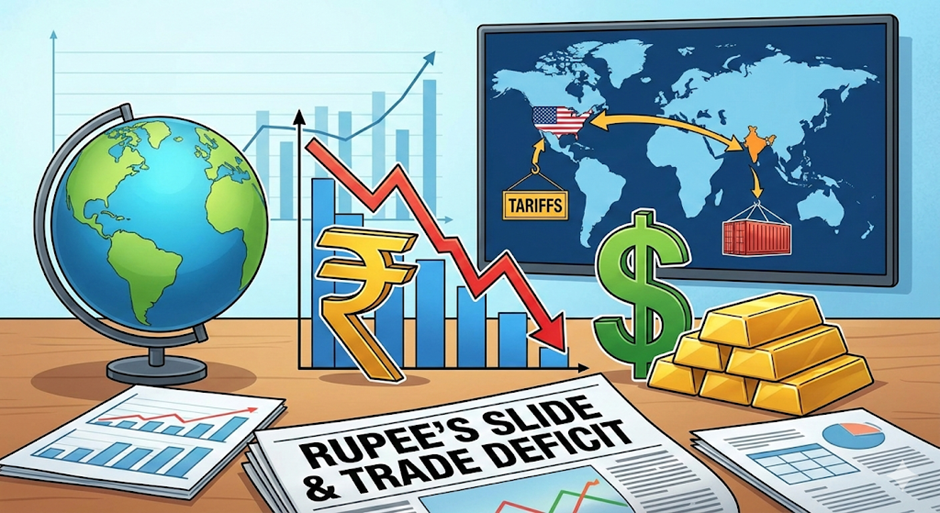
The Indian Rupee (INR) has faced a sharp 4.3% depreciation in the current calendar year, driven by “Twin External Shocks” of geopolitical tariffs and commodity price surges.
I. Key Drivers Of Depreciation
- Global Dollar Strength: Appreciation of the US Dollar (DXY Index) puts pressure on emerging market currencies.
- Tariff Shock: Imposition of 50% tariffs by the US has hit export competitiveness.
- Capital Flight: Depreciation is currently driven by capital outflows rather than weak fundamentals.
- Gold Import Surge: A sharp rise in gold imports ($14.72 bn in Oct) and a 200% spike in Gold ETF demand have widened the trade deficit to a record $41.7 billion.
Ii. Regional Performance Analysis
- Comparative Weakness: INR has underperformed against the Indonesian Rupiah and Philippine Peso.
- Chinese Yuan (CNY): Remained relatively stable due to strong intervention by the PBOC (People’s Bank of China).
- Major Currencies: INR has still performed better than structurally weak currencies like the Japanese Yen (JPY) and South Korean Won (KRW).
Concepts Booster
1. Depreciation vs. Devaluation
- Depreciation: A fall in the value of a currency in a floating exchange rate system due to market forces (Demand & Supply).
- Devaluation: A deliberate downward adjustment of a currency’s value by the government/central bank in a fixed exchange rate system.
2. NEER vs. REER
- NEER (Nominal Effective Exchange Rate): The weighted average of the rupee’s value against a basket of currencies of major trading partners.
- REER (Real Effective Exchange Rate): NEER adjusted for the inflation differential between India and its trading partners.
- Significance: REER is a better indicator of trade competitiveness.
- Rule of Thumb: If REER > 100, the currency is overvalued (Exports become expensive).
3. Impact of Depreciation
- On Exports: Generally makes exports cheaper and competitive (unless demand is inelastic).
- On Imports: Makes imports expensive (leads to “Imported Inflation” particularly for oil and gold).
- On CAD: May initially worsen the Current Account Deficit (J-Curve Effect).
4. Managed Float System
- India follows a Managed Float exchange rate system. The RBI intervenes in the forex market (buying/selling dollars) only to curb volatility, not to target a specific exchange rate level.
Q. With respect to Exchange Rate metrics, consider the following statements:
- Real Effective Exchange Rate (REER) is the Nominal Effective Exchange Rate (NEER) adjusted for inflation differentials between trading partners.
- An REER value exceeding 100 indicates that the currency is undervalued and exports are highly competitive.
- REER is considered a better indicator of trade competitiveness than NEER.
Which of the statements given above is/are correct?
(a) 1 and 2 only
(b) 1 and 3 only
(c) 2 and 3 only
(d) 1, 2 and 3
ANS :B
Explanation:
Statement 1 is correct: The Real Effective Exchange Rate (REER) is indeed the weighted average of a country’s currency against a basket of other currencies (NEER), adjusted for the effects of inflation (price differentials) between the home country and its trading partners.
Statement 2 is incorrect: An REER value exceeding 100 (or rising) indicates that the domestic currency is overvalued in real terms. An overvalued currency makes domestic goods more expensive abroad, thereby rendering exports less competitive. Conversely, an REER below 100 indicates undervaluation, making exports more competitive.
Statement 3 is correct: Since REER accounts for relative price levels (inflation) across countries, it provides a more accurate picture of the external competitiveness of a country’s tradable goods compared to the Nominal Effective Exchange Rate (NEER), which only reflects nominal exchange rate changes.