
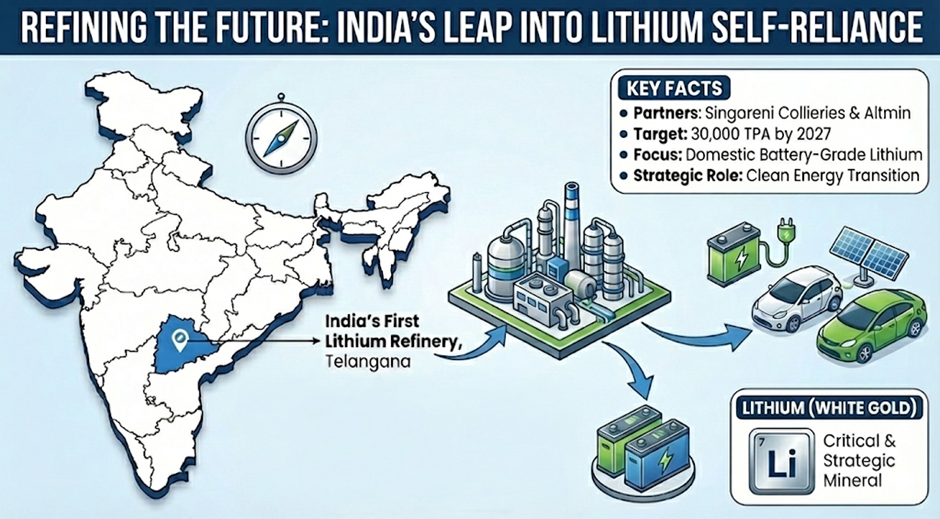
India is set to establish its first large-scale battery-grade lithium refinery. The Singareni Collieries Company (SCCL) and Hyderabad-based Altmin have signed a Memorandum of Understanding (MoU) to set up this strategic facility in Telangana.
I. The Project:
- Partners: Joint Venture between Singareni Collieries Company Ltd (SCCL) (jointly owned by Telangana Govt & GOI) and Altmin.
- Location: Telangana.
- Capacity: 30,000 tonnes-per-annum (TPA) of lithium carbonate.
- Target Timeline: Operations to commence by 2027.
- Objective: To localise lithium refining, secure long-term raw material supply from overseas, and support India’s EV and energy storage ecosystem.
II. Strategic Significance
- Import Substitution: Reduces dependency on imported battery-grade materials (currently dominated by China).
- Critical Mineral Supply Chain: Positions Telangana at the forefront of India’s transition to clean energy.
- Energy Security: Ensures a steady supply of raw materials for the “Make in India” EV sector.
Lithium (The ‘White Gold’)
1. What is Lithium?
- Nature: A non-ferrous, soft, silvery-white alkali metal.
- Properties:
- Lightest solid element (least dense metal) under standard conditions.
- Highly Reactive: Must be stored in vacuum, inert atmosphere, or mineral oil (like kerosene).
- Electrochemical Potential: High electrochemical potential makes it ideal for batteries.
- Occurrence: Never occurs freely in nature. Found in Pegmatitic minerals (hard rock) and Brines (saline groundwater/ocean water).
2. Global Landscape: Reserves vs. Production
- The Lithium Triangle: Holds ~54% of global reserves. Comprises Argentina, Bolivia, and Chile.
- Top Reserves (Resource Base):
- Bolivia
- Argentina
- Chile
- Top Producers (Extraction):
- Australia (Hard rock mining)
- Chile (Brine extraction)
- China
3. Lithium in India
- Status: Classified as a “Critical and Strategic Mineral” under the MMDR Amendment Act, 2023.
- Known Reserves:
- Reasi District (Jammu & Kashmir): 5.9 million tonnes (inferred resources).
- Mandya (Karnataka): Smaller reserves.
- Potential Belts: Mica belts of Rajasthan, Bihar, Andhra Pradesh; Pegmatite belts of Odisha, Chhattisgarh; Rann of Kutch (Gujarat).
4. Government Initiatives for Security
- KABIL (Khanij Bidesh India Ltd): A JV of three CPSEs (NALCO, HCL, MECL) to identify and acquire overseas mineral assets (e.g., in Argentina).
- Mineral Security Partnership (MSP): India recently joined this US-led alliance to secure critical mineral supply chains.
- Auctioning: The government has started auctioning critical mineral blocks to the private sector.
5. Applications & Concerns
- Uses: Li-ion batteries (EVs, mobiles), Alloys (with Al/Mg for aerospace), Thermonuclear reactions, CO2 absorption (in spacecraft/submarines).
- Environmental Concerns: High water footprint (especially in brine extraction), chemical pollution, and energy-intensive processing.
Q with respect to the properties and occurrence of Lithium, consider the following statements:
- It is the lightest solid element under standard conditions and possesses a high electrochemical potential.
- Due to its high reactivity, it is naturally found in its pure metallic form within pegmatite belts.
- It serves a critical function in carbon dioxide absorption systems in confined environments like spacecraft.
Which of the statements given above is/are correct?
(a) 1 and 2 only
(b) 1 and 3 only
(c) 2 and 3 only
(d) 1, 2 and 3
ANS.B
Explanation:
- Statement 1 is correct: Lithium is described as the least dense solid element with high electrochemical potential, making it ideal for batteries.
- Statement 2 is incorrect: Lithium never occurs freely in nature; it is found in pegmatitic minerals or brines.
- Statement 3 is correct: The text confirms its use in CO2 removal and air purification in spacecraft and submarines.