
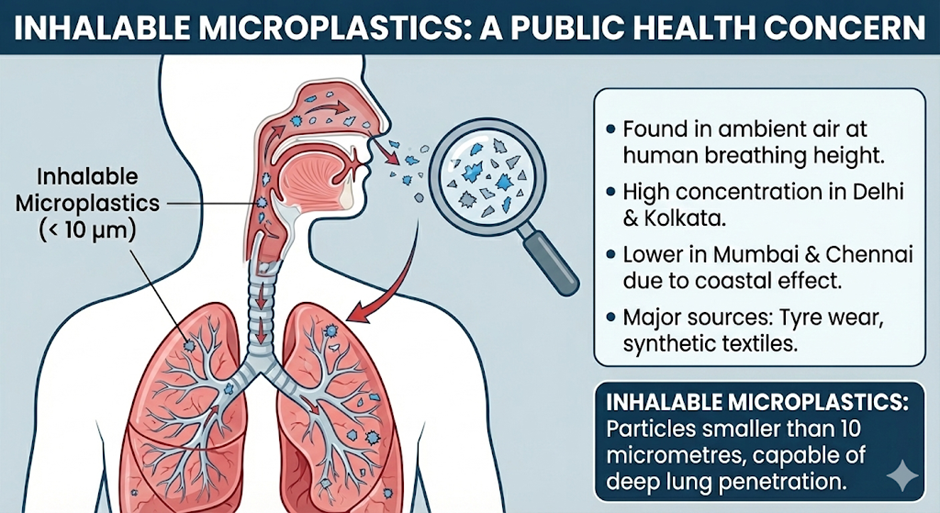
A first-of-its-kind study led by IISER Kolkata has detected “inhalable microplastics” in the ambient air of major Indian cities. The study highlights how these particles act as vectors for toxic pollutants and microbes.
Key Study Findings
- The Pollutant: Identification of Inhalable Microplastics (particles smaller than 10 µm).
- The “Trojan Horse” Effect: Microplastics are termed “Trojan Horses” because they act as carriers for:
- Heavy Metals: Lead (Pb) and Cadmium (Cd). Note: Kolkata recorded the highest atmospheric lead levels.
- Microbes: Harmful fungi like Aspergillus fumigatus carrying antibiotic-resistance genes.
- Chemicals: Hormone disruptors like Diethyl Phthalates.
- Geographical Variation:
- High Concentration: Delhi and Kolkata (due to high population density and waste mismanagement).
- Low Concentration: Mumbai and Chennai (Coastal meteorological conditions aid dispersion).
- Seasonal Spike: A 74% increase in concentration was observed during winter evenings due to low gravitational settling velocity.
- Source Analysis:
- Filaments: Derived from synthetic textiles and toy fillings.
- Fragments (<100 µm): Derived from tyre wear (carcinogenic) and packaging.
About Microplastics
- Definition: Plastic particles less than 5 mm in diameter.
- Nanoplastics: Particles smaller than 100 nm.
- Classification:
- Primary Microplastics: Intentionally manufactured tiny particles (e.g., microbeads in facewash/toothpaste, virgin plastic pellets).
- Secondary Microplastics: Result from the breakdown of larger plastics (e.g., water bottles, fishing nets) due to UV radiation and wind.
- Global Plastic Overshoot Day: The date when plastic waste generation exceeds the world’s capacity to manage it (Occurred on Sept 5th in 2024).
Related Regulatory Framework
- Global:
- UNEA Resolution: Mandates a legally binding international instrument to end plastic pollution.
- Intergovernmental Negotiating Committee (INC): Currently drafting the Global Plastics Treaty.
- India:
- Ban on Single-Use Plastics (SUP): Effective from July 1, 2022.
- Plastic Waste Management (Amendment) Rules, 2024: Emphasizes strict Extended Producer Responsibility (EPR) implementation.
Ecological Impact
- Ashtamudi Lake (Kerala): A recent study found significant microplastic contamination in this Ramsar Wetland, affecting fish and shellfish with heavy metals like Molybdenum and Barium.
Q. With respect to ‘Inhalable Microplastics’, consider the following statements:
1. They are defined as plastic particles smaller than 10 micrometres that can penetrate deep into the lungs.
2. Their concentration in ambient air significantly decreases during winter due to high gravitational settling velocity.

Which of the statements given above is/are correct?
(a) 1 only
(b) 2 only
(c) Both 1 and 2
(d) Neither 1 nor 2

Answer: A

Explanation:
Statement 1 is correct: Inhalable microplastics are particles smaller than 10 micrometres (PM10), capable of bypassing natural defences and entering the lungs.
Statement 2 is incorrect: The study found a 74% seasonal increase in concentration during winter evenings. This is because these particles persist in the air due to low gravitational settling velocity, not high.