
Researchers using the Fermi Gamma-ray Space Telescope have detected a gamma-ray signal extending towards the centre of the Milky Way. The energy spectrum of this signal aligns with the theoretical prediction for the annihilation of Weakly Interacting Massive Particles (WIMPs)potentially serving as direct evidence for Dark Matter.
What is Dark Matter?
- Definition: A hypothetical form of matter that is entirely invisible. It does not emit, absorb, or reflect light/energy, making it undetectable by conventional electromagnetic sensors.
- Cosmic Composition:
- Dark Matter: Constitutes approximately 27% of the universe.
- Visible (Baryonic) Matter: Accounts for only 5%. It consists of subatomic particles like protons, neutrons, and electrons.
- Ratio: Dark matter outweighs visible matter by a ratio of roughly six to one.
- Interaction: It interacts with ordinary matter primarily through gravity, not electromagnetic forces.
- Detection Method: Astronomers map it using Gravitational Lensing : the bending of light caused by massive objects (like dark matter halos).
The WIMP Hypothesis
- Definition: WIMPs (Weakly Interacting Massive Particles) are a hypothetical class of subatomic particles believed to be the primary constituent of Dark Matter.
- Detection Logic: While WIMPs barely interact with normal matter, theory suggests that when they collide, they annihilate each other, releasing high-energy Gamma-rays.
Cosmic Origins & Observational Evidence
- Big Bang Remnants: Primordial dark matter may have been trapped in black holes formed during the Big Bang.
- Stellar Objects: High concentrations may exist in stellar remnants like White Dwarfs, Neutron Stars, and Brown Dwarfs (failed stars lacking nuclear fusion).
Evidence of Existence:
- Galaxy Rotation Curves:
- Newtonian Prediction: Stars at galaxy edges should move slower than those at the center.
- Observation: Outer stars move faster than expected, implying unseen mass (Dark Matter) is providing extra gravitational pull.
- Gravitational Lensing:
- Massive objects bend light passing near them. Observations often reveal more bending than visible mass can explain, indicating the presence of Dark Matter.
- Galaxy Formation: The current clustering and structure of galaxies suggest Dark Matter acted as a gravitational “glue” in the early universe.
Major Experiments & Observatories
- Alpha Magnetic Spectrometer (AMS): Located on the International Space Station (ISS); detects excess positrons (antimatter) which may be a signature of Dark Matter.
- XENON1T (Italy): Aims to detect WIMPs by observing their interaction with liquid xenon atoms in a subterranean laboratory.
- IceCube Neutrino Observatory (Antarctica): Investigates sterile neutrinos as potential Dark Matter candidates.
- Large Hadron Collider (CERN): Conducts high-energy collisions to probe fundamental particles and signs of Dark Matter creation.
- James Webb Space Telescope (JWST): Studies early galaxy formation to understand the role Dark Matter played in cosmic evolution.
The Repulsive Force: Understanding Dark Energy
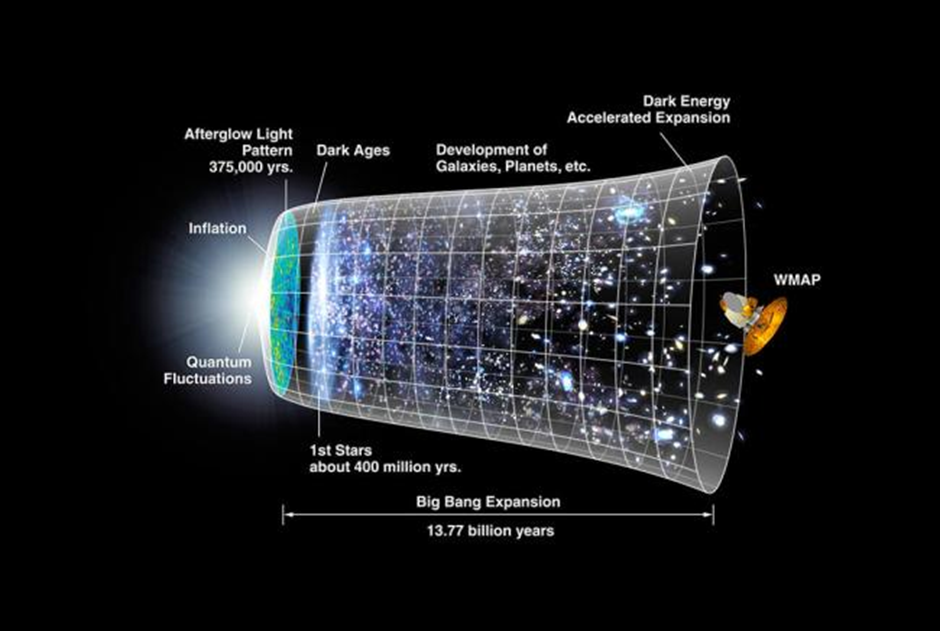
- Definition: A mysterious form of energy constituting 68% of the universe.
- Function: It is responsible for the accelerated expansion of the universe.
- Properties:
- Uniform Distribution: Spread evenly across space and time; its density does not dilute as the universe expands.
- Repulsive Nature: Unlike gravity (which attracts), Dark Energy exerts a repulsive force that pushes galaxies apart.
Key Notes
- Hubble’s Law: States that galaxies move away from Earth at speeds proportional to their distance, confirming the universe is expanding.
- Antimatter vs. Dark Matter:
- Antimatter: Particles identical to visible matter but with opposite electrical charges (e.g., Positrons are anti-electrons).
- Distinction: Antimatter is not the same as Dark Matter.
Q: With respect to Dark Matter, consider the following statements:
1. It is composed of non-baryonic matter that does not emit, absorb, or reflect electromagnetic radiation.
2. The phenomenon of gravitational lensing is utilized to infer the presence and distribution of dark matter.
3. Dark matter is the primary force responsible for the accelerated expansion of the universe.

Which of the statements given above is/are correct?
(a) 1 only
(b) 1 and 2 only
(c) 2 and 3 only
(d) 1, 2 and 3

ANSWER: B

Explanation:
Statement 1 is Correct: Dark matter is hypothetical non-baryonic matter. Unlike normal (baryonic) matter, it does not interact with the electromagnetic force. This means it does not absorb, reflect, or emit light, making it invisible to current telescopic instruments.
Statement 2 is Correct: Because dark matter has mass, it exerts a gravitational pull. Astronomers infer its presence through gravitational lensing—a phenomenon where the gravity of dark matter bends the light coming from distant galaxies, distorting their appearance.
Statement 3 is Incorrect: This statement describes Dark Energy, not Dark Matter.
-Dark Matter acts as a "cosmic glue," exerting attractive gravity that holds galaxies and clusters together.
-Dark Energy is a repulsive force that is driving the accelerated expansion of the universe.